
DSO Infrastructure Development: The Blueprint for Scaling Dental Groups in 2026

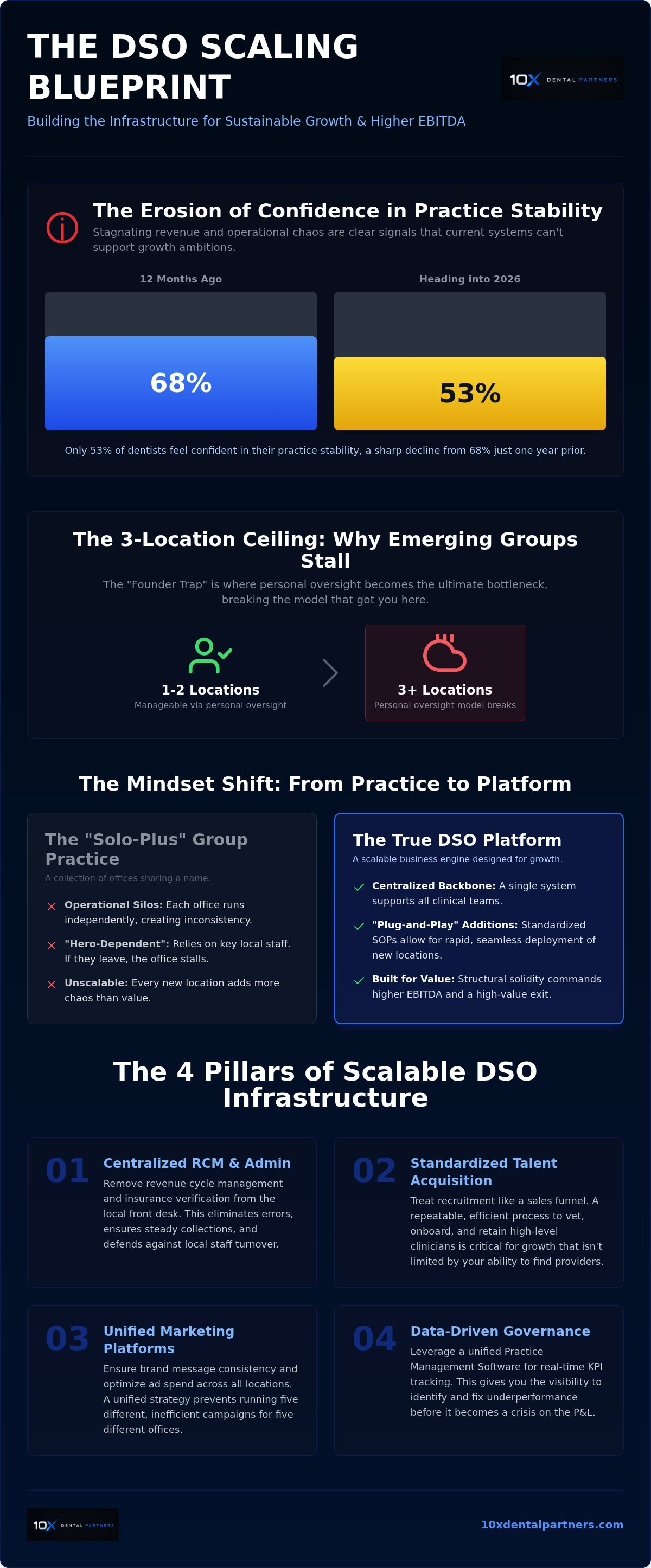
Only 53% of dentists felt confident in their practice stability heading into 2026, a sharp decline from the 68% reported just twelve months prior. This erosion of confidence usually stems from a harsh reality; scaling a dental group without a solid foundation is a recipe for burnout. You likely entered this year hoping for growth, but instead, you're managing operational inconsistency across locations and struggling to retain high-level talent. Stagnating revenue despite adding more offices is a clear sign that your current systems cannot support your ambitions.
Building a thriving multi-location group requires a shift from clinical practitioner to seasoned architect. You need a strategy that moves beyond simple acquisition and focuses on DSO infrastructure development. This article delivers the blueprint for creating a centralized operational backbone that reduces local overhead and standardizes excellence. We will explore how to deploy repeatable systems for new locations, leverage virtual staffing to eliminate front-desk fatigue, and optimize your revenue cycle. You'll learn how to build the systems that command higher EBITDA multiples by focusing on organic growth and structural solidity. This is your roadmap to transitioning from a solo practice owner to the leader of a sustainable, high-value dental group.
Key Takeaways
- Transition from a reactive "solo-plus" management style to a proactive platform mindset that supports clinical teams through centralized operations.
- Execute a strategic approach to DSO infrastructure development by unifying your revenue cycle management and talent acquisition into a single, scalable system.
- Explore the advantages of virtual centralization, using remote teams to provide administrative support without the burden of increasing your physical footprint.
- Implement a clear growth roadmap that identifies operational bottlenecks and utilizes a unified Practice Management Software for real-time KPI tracking.
- Discover how integrating specialized solutions like 10X Remote Assist can provide immediate relief to local offices while maintaining high-production standards.
What is DSO Infrastructure Development in 2026?
In 2026, the definition of a Dental Service Organization (DSO) has shifted away from mere consolidation toward active operational integration. DSO infrastructure development is the deliberate process of building the centralized systems required to support clinical teams across multiple locations. It is the operational nervous system. It isn't just about purchasing software; it's about creating a framework that functions independently of the owner. Think of it as the invisible floor. Without it, every new acquisition adds more chaos than value, eventually leading to a collapse under the weight of administrative debt.
The modern landscape favors tech-enabled, remote-first administrative support. This allows owners to move from a "solo-plus" mindset, where they manage a few extra chairs, to a platform mindset. In this model, the system manages the growth. You are no longer just a dentist with multiple offices; you are an operator with a scalable business engine. This transition is essential for survival as interest rates and construction costs remain elevated, demanding higher efficiency from every square foot of clinical space.
The Difference Between a Group Practice and a DSO
A group practice is often just a collection of independent offices sharing a brand name. A true DSO is a scalable platform designed for rapid deployment. The primary differentiator is the ability to perform "plug-and-play" location additions. In a typical group practice, each office operates as a silo with localized, "hero-dependent" operations. If a key office manager leaves, the entire location stalls. There is no backup, and there is no standard.
Effective DSO infrastructure development replaces these silos with standardized SOPs and centralized support. You aren't relying on a single individual's talent at a specific front desk. Instead, you're deploying a repeatable model that ensures consistency in patient experience and revenue collection across the entire enterprise. This structural solidity is what allows for vertical integration and sustainable scaling.
Why Most Emerging Groups Stall at Three Locations
The transition from two to three locations is where most founders hit the "Founder Trap." Up until this point, an owner can usually manage every administrative detail through sheer force of will and personal oversight. At location three, that model breaks. You simply cannot be in three places at once, and your physical presence becomes the ultimate bottleneck. Communication usually fails first, and the culture you worked hard to build begins to dilute across distances.
Without centralized data, you lose the ability to manage what you cannot measure. Stagnating revenue often follows because the owner is too busy putting out fires to focus on strategic optimization. Solving this requires shifting the burden from the founder to the infrastructure. You need a system that provides total visibility and accountability without requiring your constant intervention. Only then can you break the three-location ceiling and move toward a high-value exit.
The 4 Pillars of Scalable DSO Infrastructure
Scaling a group requires a compliant MSO structure to separate clinical and administrative functions. This legal and operational division is the first step in professional DSO infrastructure development. Centralized Revenue Cycle Management (RCM) and insurance verification act as your defensive line. By removing these tasks from the local front desk, you eliminate errors and ensure that collections remain steady regardless of local staffing turnover. It turns a collection of offices into a professional investment vehicle.
Standardized recruitment systems treat talent acquisition like a sales funnel. You need a repeatable process to vet, onboard, and retain high-level clinicians across all rooftops. Without this, growth is limited by your ability to find providers. Unified marketing platforms, such as 10X Dental Marketing, ensure your brand message is consistent while optimizing ad spend. You shouldn't have five different offices running five different campaigns. Finally, data-driven governance provides real-time KPI tracking. You need to see which locations are underperforming before the P&L reflects a crisis.
Centralized Administrative Support: 10X Remote Assist
Front-desk burnout is a growth killer. 10X Remote Assist provides a decentralized solution for administrative tasks. By moving scheduling and insurance verification to a centralized, remote team, you reduce local overhead and ensure 100% phone coverage. Every missed call is a lost high-value lead. Virtual staffing ensures your patient acquisition funnel never leaks, regardless of local office turnover. It allows your in-office team to focus entirely on the patient in the chair.
Standardizing the Patient Experience
Consistency creates enterprise value. Implementing "The Closing Experts" framework ensures that case acceptance remains high across every location, not just the founder's primary office. Standardizing high-production programs like Fast Arches provides clinical-business predictability. This allows you to maintain a professional brand identity without micromanaging every doctor. If you are ready to build a system that works, partner with an operator who understands the blueprint. This standardization is what makes your organization attractive to future buyers or partners.
Centralized vs. Decentralized: Choosing Your Growth Model
The choice between a "Hub and Spoke" model and a fully decentralized network defines the trajectory of your DSO infrastructure development. In a Hub and Spoke system, a flagship office or a dedicated corporate headquarters houses all administrative functions. While this creates a strong cultural anchor, it often carries high physical real estate costs. In 2026, many operators are pivoting toward "Virtual Centralization." This model uses remote teams to execute central office functions, such as billing and scheduling, without the burden of a commercial lease. It allows you to scale your administrative capacity in lockstep with your clinical growth.
Cost structures vary significantly between these models. A traditional local office manager is often capped by the needs of a single site. Conversely, a regional operations director, supported by centralized systems, can oversee five or more rooftops with greater precision. This shift from local "heroes" to regional "operators" is what professionalizes the business. It also directly impacts your final valuation. According to 2026 market data, solo and small group practices typically command multiples of 3 to 5 times adjusted EBITDA. In contrast, multi-location groups with integrated infrastructure can sell for 6 to 14 times EBITDA, depending on their size and operational maturity.
The ROI of Centralization
Centralization drives profitability through margin expansion and specialized performance. Bulk purchasing of clinical supplies and lab services offers immediate savings that single locations cannot access. Centralized call centers further enhance this by increasing conversion rates for high-production cases. These teams are trained specifically in sales psychology, ensuring that high-value inquiries aren't lost to a busy front desk. Economic Scale in a DSO context is the ability to lower per-patient acquisition costs as locations increase.
Maintaining Local Autonomy where it Matters
The risk of centralization is the "corporate" feel that can alienate both patients and staff. The solution is to keep clinical decisions at the local level while centralizing the business of dentistry. Your doctors should have autonomy over their chairs, while the platform handles the insurance verification and marketing. This balance preserves the community feel of a local practice while leveraging the power of a large-scale organization. If you are currently navigating this transition, read our Transitioning from Solo to Group Dental Practice: The 2026 Strategic Guide to understand how to maintain your culture during rapid expansion. Structural solidity doesn't have to mean clinical rigidity.
Building Your Infrastructure Roadmap
Building a scalable dental group isn't a matter of luck; it's a matter of sequence. The first step in professional DSO infrastructure development is an uncompromising audit of your current workflows. You must identify every "bottleneck" task where the owner's personal intervention is required. If a decision can't be made without you, that process isn't scalable. Once these bottlenecks are mapped, Step 2 focuses on data visibility. You cannot manage five locations through intuition. Implement a unified Practice Management Software (PMS) paired with a live KPI dashboard to ensure you have a single source of truth across all rooftops.
Step 3 involves stabilizing the front office by deploying 10X Remote Assist. This virtual staffing layer removes the administrative burden from local teams, allowing them to focus on the patient in the chair. Step 4 requires formalizing your recruitment and associate training programs. You aren't just hiring doctors; you're building a talent pipeline that ensures clinical consistency. Finally, Step 5 is the establishment of a regional leadership layer. This Director of Operations or Regional Manager acts as your surrogate, ensuring that SOPs are followed without requiring your physical presence at every site.
The Tech Stack of a Modern DSO
Cloud-based PMS platforms have become the gold standard in 2026, offering seamless multi-location access that server-based systems simply can't match. These platforms must be paired with business intelligence tools for real-time reporting and Revenue Optimization. This tech stack allows you to spot trends in case acceptance or hygiene reappointment rates instantly. To keep remote and local staff aligned, integrated communication platforms like Slack or Teams are essential. They replace fragmented email chains with organized, searchable channels that maintain operational momentum.
Recruiting for Scale
Your first "Director of Operations" hire is your most critical infrastructure investment. This individual transitions the business from founder-led to system-led. Beyond leadership, you must build a pipeline for associates through specialized clinical programs. This ensures your chairs remain productive and your clinical standards stay high as you add locations. For a deeper look at this transition, consult The Executive Guide to Dental Practice Growth Consulting. If you're ready to stop guessing and start building a professional system, partner with 10X Dental Partners to refine your roadmap today.
Partnering for Infrastructure Excellence
10X Dental Partners acts as the Seasoned Architect for your organization. We don't just advise; we deploy the specific structural components required for elite DSO infrastructure development. By integrating 10X Remote Assist into your daily operations, we provide immediate relief from the administrative friction that typically stalls growth at the two or three-location mark. This isn't a temporary fix. It's a fundamental shift in how your business processes patient data, verifies insurance, and manages the revenue cycle. We build the backbone so you can focus on the vision.
Beyond administrative stability, we refine your clinical production through specialized programs. Customizing high-margin systems like Fast Arches and HelpMeSleep allows you to drive predictable revenue without necessarily increasing your physical footprint. These programs are engineered to fit within your centralized framework, ensuring that every location delivers the same high-production results. This level of systemic integration is what prepares your organization for a high-multiple exit. Buyers in 2026 aren't just looking for EBITDA; they're looking for the systems that create it.
The 10X Infrastructure Audit
Every partnership begins with a comprehensive audit of your current multi-location management. We identify the specific gaps where your systems are leaking revenue, losing leads, or failing to retain talent. Our team creates a customized growth blueprint that aligns with your 10-year vision, ensuring every tactical move supports your ultimate objective. This process facilitates your transition from a stressed owner to a strategic CEO. You stop managing individual chairs and start leading a professional enterprise.
Taking the First Step
Waiting until you have five or more locations to start building infrastructure is a common, yet fatal, mistake. By then, the operational debt is often too deep to easily restructure. The cost of delay is measurable. Fragmented systems erode your EBITDA and lower your market valuation long before you're ready to consider an exit. Proactive DSO infrastructure development ensures that your organization is ready for the complexities of the 2026 market. Building the floor before you build the walls is the only way to ensure your growth remains unstoppable. To start your transformation, Schedule a strategy session with 10X Dental Partners and secure your blueprint for 2026.
Securing Your Operational Future
Scaling a dental group in 2026 is no longer about simply adding more chairs; it's about refining the engine that drives them. Successful expansion requires a deliberate shift from a founder-dependent model to a structured, scalable platform. You've learned how centralized systems for revenue cycles and talent acquisition provide the stability needed to break through the three-location ceiling. By prioritizing DSO infrastructure development now, you ensure that your organization is built for sustainable growth rather than eventual operational collapse.
The path from clinical practitioner to strategic CEO depends entirely on the strength of your operational backbone. 10X Dental Partners provides the specialized architecture required for this transition. Through our 10X Remote Assist virtual staffing experts and proven DSO growth consultants, we help you deploy the systems that command elite EBITDA multiples. We also integrate high-production clinical-business programs that drive predictable, high-margin revenue across every rooftop. Don't let fragmented management or administrative burnout limit your legacy.
Build your scalable DSO infrastructure with 10X Dental Partners today. Your blueprint for a high-value future is ready for implementation, and the momentum starts with a single strategic decision.
Frequently Asked Questions
What is the most critical part of DSO infrastructure?
The most critical part of DSO infrastructure is the centralization of non-clinical systems that support your providers. This includes revenue cycle management, insurance verification, and standardized recruitment. Without these centralized pillars, each new office remains a silo that requires personal oversight from the founder. Establishing a professional management layer allows clinical teams to focus on patient care while the organization handles the business of dentistry. This structural solidity prevents the common collapse that occurs during rapid multi-location expansion.
When should a dental group start centralizing its administrative tasks?
You should begin centralizing administrative tasks before opening your third location. Waiting until you have five or more offices often results in significant operational debt that's difficult to restructure. Early centralization allows you to build a repeatable blueprint for every subsequent acquisition or de novo start. By standardizing your SOPs and administrative workflows early, you ensure that your EBITDA remains healthy and your growth remains sustainable as you scale toward a larger enterprise.
How does virtual staffing fit into a DSO infrastructure model?
Virtual staffing acts as a decentralized administrative layer within the DSO infrastructure model. Solutions like 10X Remote Assist provide immediate relief to local front-desk teams by handling scheduling, patient communication, and insurance verification remotely. This integration reduces local office overhead and ensures 100% phone coverage across all rooftops. It allows your in-office staff to prioritize the patient experience in the chair while specialized remote professionals manage the high-volume administrative tasks that typically cause burnout.
Can I build DSO infrastructure without losing my practice culture?
It's entirely possible to build robust systems without losing your practice culture. The key is to centralize the "business of dentistry" while maintaining local autonomy for clinical decisions and patient-facing relationships. When you remove administrative friction through professional systems, your local teams have more time to engage with patients and foster a positive office environment. Infrastructure shouldn't create a cold corporate feel; it should provide the support that allows your unique culture to thrive across multiple sites.
What technology is required for multi-location dental management?
Multi-location management requires a tech stack centered on cloud-based Practice Management Software (PMS). Unlike server-based systems, cloud platforms allow for real-time data access and reporting across every rooftop. You also need business intelligence tools for revenue optimization and centralized KPI tracking. Integrated communication platforms like Slack or Teams are essential for keeping remote and local staff aligned. This unified digital ecosystem ensures that every decision is backed by accurate, real-time data rather than guesswork.
How much does it cost to develop a DSO infrastructure?
The cost of DSO infrastructure development depends on your current scale and the complexity of your existing workflows. While the initial investment in technology and leadership may seem high, the cost of delay is far greater. Fragmented systems often lead to stagnating revenue and high staff turnover, which erode your EBITDA over time. Investing in professional systems early ensures that each new location contributes to your profitability rather than adding to your administrative burden.
How does DSO infrastructure impact the valuation of my dental group?
Infrastructure has a profound impact on your final valuation during an M&A exit. Buyers in the 2026 market prioritize organizations with integrated, repeatable systems that can survive the founder’s departure. Multi-location groups with professional infrastructure can command multiples of 6x to 14x EBITDA, whereas solo or small group practices often stall at 3x to 5x. Building a solid operational backbone transforms your practice from a job into a high-value investment vehicle that's attractive to institutional buyers.
Is a centralized call center better than having front desks handle calls?
A centralized call center is generally superior to having local front desks handle all incoming calls. Local teams are often interrupted by in-person patients, leading to missed calls and lost high-value leads. Centralized teams, including specialists like The Closing Experts, focus exclusively on conversion and scheduling. This ensures 100% phone coverage and a consistent patient experience across all locations. It also removes a significant source of stress for your in-office staff, improving overall employee retention and performance.


