
Dental Practice Leadership Development: The 2026 Executive Roadmap

What if the primary bottleneck in your practice isn't your clinical skill, but your presence in the chair? Most high-performing dentists eventually hit a wall where growth stalls because the business cannot function without their constant physical oversight. If your team only hits their targets when you are watching, you haven't built a scalable organization. You've built a high-stress job that relies entirely on your personal stamina.
You likely recognize the frustration of high staff turnover and the exhaustion of being unable to delegate critical administrative tasks effectively. This is the pivot point where dental practice leadership development becomes your most valuable asset. We promise to provide the strategic frameworks necessary to transition from a solo practitioner to the CEO of a high-performance dental organization. In this 2026 executive roadmap, we will detail how to build a self-managing team that hits KPIs autonomously, how to leverage virtual staffing to reclaim your time, and how to construct the infrastructure required for DSO-level scaling. It's time to stop working in your practice and start building the system that runs it.
Key Takeaways
- Identify and escape the Founder’s Trap by shifting your focus from clinical output to organizational architecture and executive oversight.
- Implement a structured dental practice leadership development framework to build a self-managing team that delivers consistent results without your direct supervision.
- Differentiate between clinical and operational leadership to ensure your practice infrastructure supports business health as effectively as it supports patient care.
- Execute a multi-stage roadmap starting with a leadership audit to identify bottlenecks and formalizing a core vision that drives team alignment.
- Scale toward a multi-location DSO model by centralizing operations and utilizing virtual staffing solutions like 10X Remote Assist to reclaim strategic time.
The Leadership Bottleneck: Why Clinical Excellence Isn’t Enough to Scale
Clinical excellence is a prerequisite for any dental practice, yet it is rarely the catalyst for sustainable growth. Many practitioners find themselves ensnared in the Founder’s Trap, a state where every operational decision requires the owner’s direct input. When you are the only person capable of solving problems, you become the ultimate bottleneck. Business scalability is not a byproduct of better dentistry; it is the result of intentional infrastructure.
Relying on clinical proficiency to drive expansion is a fundamental strategic error. True growth requires a mastery of leadership development principles that move the focus from individual performance to systemic reliability. Without this transition, you are left with "accidental leadership." This lack of structure leads to high turnover and a fractured patient experience, both of which diminish the practice's market value. In the eyes of an investor or a DSO, leadership is the primary driver of valuation because it represents the stability of the cash flow when the founder is absent.
The Symptoms of a Leadership Gap
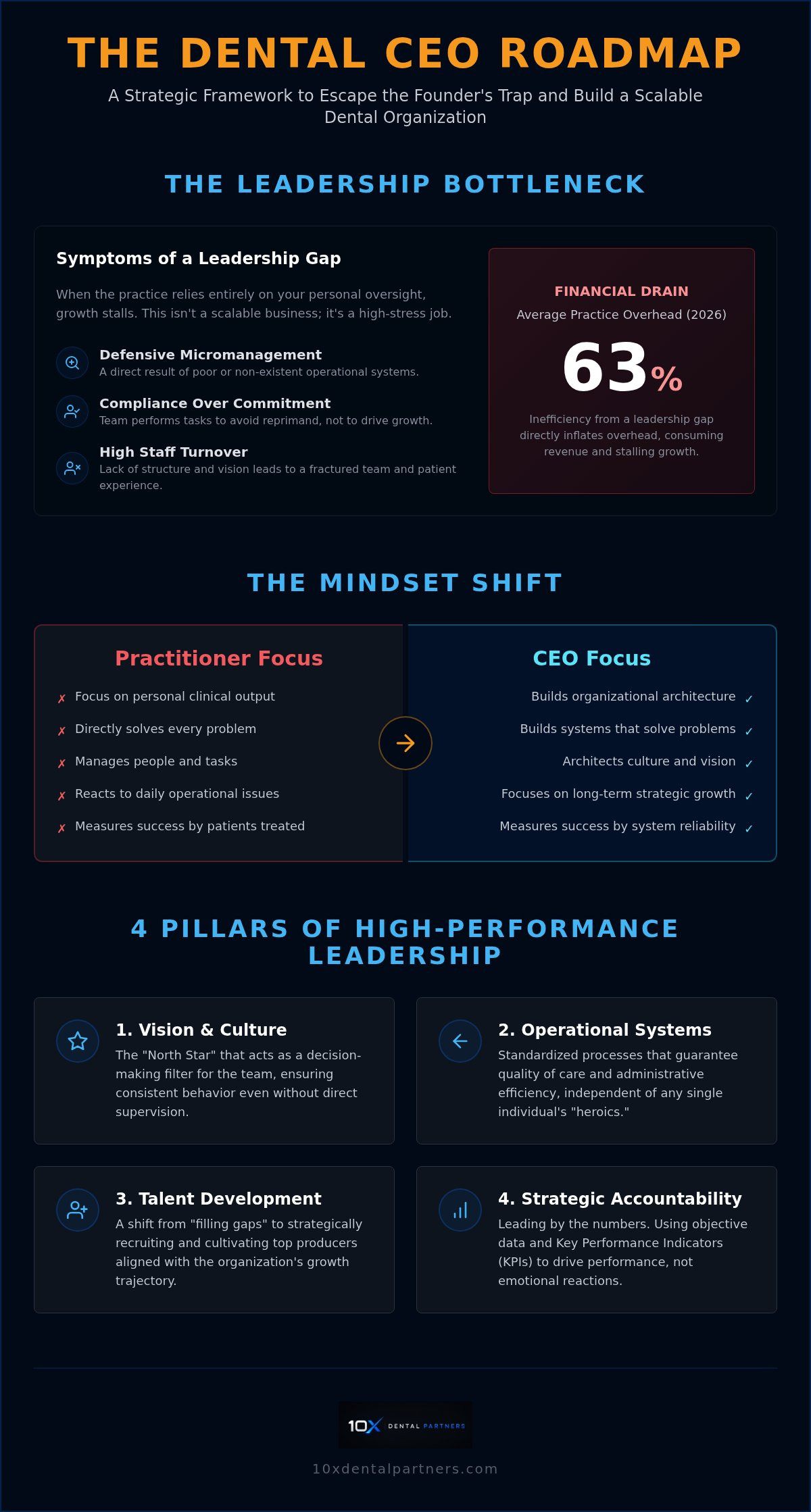
A leadership gap often manifests as micromanagement. This is usually a defensive reaction to poor systems. If you feel compelled to oversee every patient interaction or administrative task, your infrastructure has failed. This overhead of personal oversight is expensive. With average practice overhead in 2026 ranging from 59% to 67% of collections, efficiency is critical. When leadership is absent, you see a culture of compliance rather than commitment. Staff members perform tasks to avoid reprimand, but they lack the strategic alignment to drive the practice forward independently. This stagnation often occurs even as the owner increases their clinical hours to compensate for falling margins.
Shifting from Practitioner to CEO
The transition to a CEO mindset requires a radical redefinition of your daily responsibilities. A CEO does not just do the work; they build the environment where the work can be performed at a elite level by others. This involves vision casting and ensuring every team member understands the North Star of the organization. The first step in transitioning from solo to group dental practice is a deep investment in personal dental practice leadership development. You must build the capacity to delegate clinical and administrative burdens so you can focus on vertical integration and long-term stability. Scaling is a test of your ability to lead, not your ability to drill.
The Four Pillars of High-Performance Dental Practice Leadership
Leadership is not a personality trait; it is a measurable operational infrastructure. To scale effectively, a practitioner must move beyond "managing" and begin "architecting." This shift requires a commitment to a structured dental practice leadership development framework built on four non-negotiable pillars. These pillars transform a practice from a collection of individuals into a unified, high-output organization. While formal programs like the ADEA Leadership Institute provide academic foundations, the application in a private practice setting requires a more aggressive, operator-centric approach.
- Vision and Culture: This is your North Star. It is the set of non-negotiable principles that dictate team behavior when you are not in the room. A strong culture acts as a decision-making filter for every staff member.
- Operational Systems: Excellence must be standardized. Systems ensure that the quality of care and administrative efficiency are never dependent on the "heroics" of a specific individual.
- Talent Development: High-performance leaders stop hiring "warm bodies" to fill gaps. Instead, they focus on recruiting and cultivating top producers who are aligned with the organization's growth trajectory.
- Strategic Accountability: Elite operators lead by the numbers. They use objective data and KPIs to drive performance rather than relying on emotional reactions to daily stressors.
Establishing a Culture of Accountability
True accountability begins with "Outcome-Based" job descriptions. Instead of a list of tasks, these documents define the specific results each team member is responsible for achieving. For example, a front-desk role is not just about "answering phones"; it is about "maintaining a 90% schedule density." Daily huddles and weekly tactical meetings serve as the pulse of the practice, ensuring everyone remains aligned with these outcomes. By integrating "The Closing Experts" framework, leadership can align the entire team on case acceptance goals, turning every patient interaction into an opportunity for growth. Top-performing practices in 2026 maintain an overhead of 55% or less, a feat only possible through rigorous accountability.
Systematizing the Patient Experience
Leadership’s primary role is to engineer a standardized patient journey. Every touchpoint, from the initial call to the post-op follow-up, must be documented and repeatable. To maintain this consistency without adding to your internal management burden, leverage virtual staffing solutions like 10X Remote Assist. This allows you to delegate administrative bottlenecks to specialists while you focus on high-level strategy. Every system you build today serves as the foundation for future expansion, as DSO infrastructure development is impossible without a standardized operational blueprint. If you are ready to stop being the bottleneck and start building a legacy, explore how strategic growth consulting can accelerate your transition to CEO.
Clinical vs. Operational Leadership: Navigating the Dual Role
Clinical mastery is a prerequisite for patient care, but it is a poor substitute for organizational proficiency. Most owners fail to scale because they confuse the two. Clinical leadership ensures the quality of a crown or the success of an implant. Operational leadership ensures the business remains viable, profitable, and expandable. While academic settings like the Dental Public Health Leadership Academy focus on systems-level thinking for public health, private practitioners must apply these same principles to their own corporate architecture. You cannot treat a business with a handpiece.
The most significant barrier to growth is often "Clinical Ego." This is the subconscious belief that a doctorate in dental surgery confers an innate ability to manage complex human systems. It doesn't. Over-indexing on clinical leadership while neglecting operations creates a fragile environment where the owner is the only problem-solver. To break this cycle, you must schedule "CEO time" with the same rigidity as a high-production surgical block. This dedicated time is the engine of dental practice leadership development, allowing you to work on the business rather than just in it.
Delegating the Non-Clinical
Effective operators ruthlessly audit their schedules to identify tasks that do not require a dental degree. If you are still reviewing insurance verification logs or troubleshooting scheduling gaps, you are mismanaging your most expensive resource: yourself. Reclaiming just 10 hours a week through specialized solutions like 10X Remote Assist provides the mental bandwidth needed for strategic planning. This creates a "Leadership Buffer" between you and the front-line staff. It ensures that your focus remains on vertical integration and revenue optimization, while the administrative machinery runs autonomously in the background.
Empowering Middle Management
Transitioning your Office Manager into a Strategic Operations Leader is a critical milestone in your executive roadmap. You must move away from a hub-and-spoke model where every decision returns to your desk. This requires implementing a "Leadership Cascade." You train your team leads to manage their own departments, from hygiene to the front office. By defining clear authority levels, you reduce decision fatigue and empower your staff to take ownership of their KPIs. This systematic approach to dental practice leadership development ensures that the practice’s momentum is driven by a unified team rather than a single exhausted individual.
A Step-by-Step Roadmap for Dental Leadership Development
Transitioning from a clinician to a high-level operator requires a phased approach to organizational design. You cannot build a multi-location DSO on a foundation of fragmented management. This roadmap provides the structural sequence needed to mature your practice from a doctor-centric model into an enterprise-level organization. Each step is designed to remove you as the primary bottleneck and replace your personal effort with systemic reliability.
- Step 1: Conduct a Leadership Audit. Identify every decision that currently requires your approval. Pinpoint where administrative or clinical workflows stall when you are not physically present.
- Step 2: Formalize Vision and Core Values. Document the non-negotiable standards of your organization. This provides your team with a decision-making framework that functions autonomously.
- Step 3: Implement Data-Driven Management. Shift from intuition to objective KPI tracking. Focus on overhead control, aiming for the 55% threshold achieved by elite performers in 2026.
- Step 4: Build a Recruiting Engine. Establish a proactive talent acquisition system. You must attract high-producers who are capable of executing complex clinical-business programs like Fast Arches or HelpMeSleep.
- Step 5: Scale Through Vertical Integration. Deploy the DSO infrastructure needed to maintain these leadership standards across multiple sites.
The 90-Day Leadership Sprint
To establish immediate authority and build team trust, start with a 90-day sprint focused on quick wins. The most impactful move is implementing a "Stop-Doing" list. Identify three administrative tasks you will permanently delegate to 10X Remote Assist specialists this month. By reclaiming these hours, you create the mental bandwidth to set your first set of measurable performance benchmarks. When your team sees you prioritizing strategy over minutiae, their respect for your executive role increases. This period is about proving that the practice can hit targets through systems rather than through your individual stamina.
Investing in Strategic Growth Consulting
Growth plateaus are rarely clinical; they are almost always leadership-related. Recognizing when your internal systems have reached their capacity is a hallmark of a seasoned leader. Professional coaching provides the outside perspective needed to identify blind spots in your organizational architecture. Understanding how dental practice growth consulting accelerates your development allows you to skip years of trial-and-error. The ROI of professional intervention is measured in the speed of your transition to CEO and the solidity of your scaling infrastructure. If your growth has stalled, it's time to partner with experts who have already navigated the path to multi-location success. Contact us today to audit your current leadership framework.
Scaling Through Systems: Integrating Leadership into DSO Infrastructure
The transition from a single-site practice to a multi-location DSO is the ultimate leadership stress test. While clinical quality must remain high, the success of this expansion depends entirely on your operational architecture. Most practitioners struggle at the three-location mark because they attempt to lead through physical presence rather than systemic oversight. At this stage, dental practice leadership development shifts from personal productivity to organizational design. You are no longer just leading a team; you are building a "Master Blueprint" that ensures every location operates with the same precision and profitability as the original site.
Centralizing operations is the only way to maintain leadership standards across geographic distances. By consolidating administrative functions, you remove the variability that leads to overhead bloat and inconsistent patient experiences. 10X Remote Assist plays a critical role in this transition, serving as a scalable, centralized hub for insurance verification, scheduling, and billing. This allows individual office teams to focus exclusively on the patient experience while the executive team maintains objective control over the data. This level of vertical integration is what separates a collection of offices from a true high-performance dental organization.
Building the Multi-Location Leadership Team
Your internal hierarchy must evolve alongside your footprint. This often requires transitioning a high-performing Office Manager into a Regional Operations Director. This is a strategic shift from managing tasks to managing leaders. Maintaining a unified culture across multiple sites requires rigorous communication protocols and a shared set of core values that guide behavior without your direct intervention. Recruiting for these leadership roles is a core competency of a scaling DSO. You are no longer just looking for dental experience; you are looking for executive-level operators who can execute your vision across multiple geographic points.
The 10X Strategic Growth Platform
Infrastructure is the ultimate expression of leadership. It is the system that allows your vision to exist independently of your physical presence. The 10X Strategic Growth Platform integrates recruiting, marketing, and revenue optimization into a single, unified engine. This approach ensures that your growth is not just fast, but stable and predictable. By partnering with the seasoned architects of dental growth, you gain access to the proven systems required for multi-location success. It is time to stop managing offices and start leading an enterprise. Partner with 10X Dental Partners to deploy the infrastructure your legacy deserves.
Architecting Your Practice Legacy
Clinical excellence is the baseline for any practice, but operational leadership is the true multiplier for growth. To move from practitioner to CEO, you must deploy systems that function independently of your physical presence. This involves mastering the four pillars of high performance and distinguishing between clinical and operational duties to avoid the Founder's Trap. Investing in dental practice leadership development is the only way to build a scalable organization that maintains its value over the long term.
By leveraging proven DSO infrastructure development and case acceptance optimization through The Closing Experts, you can reclaim your time and focus on high-level strategy. Solutions like 10X Remote Assist provide the virtual staffing needed to eliminate administrative bottlenecks and support a multi-location footprint. It's time to build a business that serves your vision instead of a job that relies on your personal stamina. Ready to scale? Book a strategy session with 10X Dental Partners today.
The roadmap to an enterprise-level dental organization is clear. With the right systems in place, your potential for growth is limitless.
Frequently Asked Questions
What is the difference between dental practice management and leadership?
Management focuses on the execution of daily tasks like scheduling and insurance verification. Leadership, however, involves architecting the vision and strategic alignment of the entire organization. While management maintains the status quo, dental practice leadership development creates the infrastructure for scalability. You manage processes, but you lead people toward a shared objective. Transitioning from a manager to a leader is the primary requirement for anyone looking to scale a practice into a multi-location DSO.
How much time should a practice owner spend on leadership development?
A practice owner should dedicate at least 10% of their weekly schedule to intentional leadership activities. This "CEO time" is not for catching up on charts; it's for strategic planning, KPI analysis, and team development. As you move toward a multi-location model, this requirement often grows to 50% or more. Reclaiming this time is often the first hurdle, which is why delegating administrative tasks to virtual specialists is a critical move for growth-minded operators.
Can I develop leadership skills if I am naturally an introvert?
Leadership is a set of learned operational frameworks rather than an inherent personality trait. Introverts often make superior leaders because they tend to be highly analytical and data-driven. Effective leadership is about building systems, defining accountability, and casting a clear vision. You don't need to be the loudest person in the room to be a Master Operator. You simply need a disciplined approach to organizational design and a commitment to your team's success.
What are the most important KPIs for a dental leader to track?
Elite leaders focus on outcome-based metrics like overhead percentage, which top-performing practices keep at 55% or less. You should also track schedule density, new patient acquisition costs, and case acceptance rates. Monitoring these KPIs allows you to lead objectively rather than emotionally. By using data to identify bottlenecks, you can make surgical adjustments to your operational systems without disrupting the clinical workflow. Leadership is about managing the numbers that drive the vision.
How do I handle a long-term employee who resists new leadership systems?
Resistance to new systems is often a sign of cultural misalignment. You must first provide clear, outcome-based job descriptions and the training required to succeed. If the resistance persists, you have to decide if the individual fits the future of your organization. A high-performance practice cannot be held hostage by legacy employees who refuse to adapt. Leadership requires protecting the integrity of the system to ensure long-term stability and team-wide accountability.
Is leadership development different for a multi-location DSO vs. a solo practice?
Solo leadership is focused on personal oversight and immediate team dynamics. In contrast, DSO leadership is about building a centralized infrastructure that maintains standards across multiple geographic points. The jump from one to three locations is a test of your ability to lead through systems rather than physical presence. You must shift from being a "Lead Dentist" to becoming a "Strategic Architect" who manages the organization's vertical integration and long-term stability.
What is the first step in building a high-performance dental team?
The first step is conducting a comprehensive leadership audit to identify where you are currently the bottleneck. You must have absolute clarity on your practice's vision and core values before you can recruit high-producers. A high-performance team requires a "North Star" to guide their independent decision-making. Once the vision is formalized, you can build the recruiting and talent acquisition engine needed to bring in specialists who are aligned with your growth trajectory.
How does virtual staffing impact dental practice leadership?
Virtual staffing is a strategic tool that allows leaders to delegate administrative burdens and reclaim their time. By utilizing solutions like 10X Remote Assist, you can centralize tasks such as insurance verification and scheduling. This creates a scalable administrative hub that supports multi-location expansion without increasing internal overhead. It changes the leadership dynamic by moving the owner away from minutiae and toward high-level strategic development and revenue optimization.


