
Transitioning from Solo to Group Dental Practice: The 2026 Strategic Guide

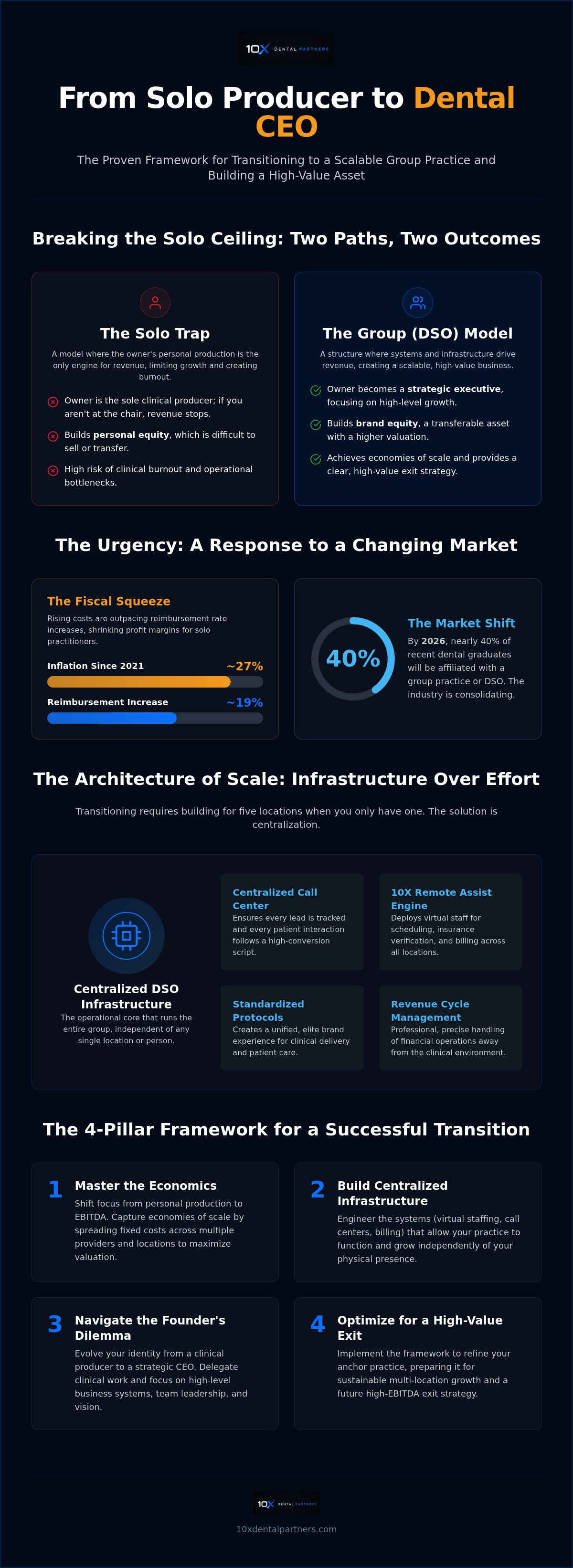
By the close of 2026, nearly 40% of dentists who graduated within the last decade will be affiliated with a group practice or DSO. This shift isn't just a trend; it's a necessary response to a fiscal environment where insurance reimbursements fail to keep pace with inflation. You likely feel this pressure daily as rising overhead costs eat into your margins while the burden of being the sole clinical producer leads toward inevitable burnout. Transitioning from solo to group dental practice is the only viable path for owners who want to reclaim their time and build a truly scalable asset.
The journey requires a fundamental shift in identity from a high-level clinician to a strategic executive owner. This guide provides the proven framework for that architectural transition; it's a blueprint for building the infrastructure necessary to support multiple locations and high-performing associates. We will detail how to optimize your revenue through systemic integration, deploy centralized virtual staffing engines like 10X Remote Assist, and refine your operations to maximize EBITDA. You'll learn to move away from fragmented management toward a structured growth model that secures your long-term stability and a sustainable exit strategy.
Key Takeaways
- Identify why the solo producer model limits your net worth and how to capture economies of scale by spreading fixed costs across multiple providers.
- Master the architectural requirements for transitioning from solo to group dental practice by building a centralized DSO infrastructure that functions independently of the owner.
- Navigate the "Founder’s Dilemma" by shifting your identity from a clinical producer to a strategic CEO focused on high-level business systems.
- Deploy centralized operational engines like 10X Remote Assist to manage virtual staffing and revenue optimization across a scalable multi-location model.
- Implement a proven four-pillar framework to refine your anchor practice and prepare for a sustainable, high-EBITDA exit strategy.
Breaking the Solo Ceiling: Why Transition to a Group Practice?
The dental landscape in 2026 is defined by a tightening fiscal squeeze. Recent data indicates that while inflation has risen by approximately 27% since 2021, reimbursement rates for dental services have only increased by 19% in that same period. For the solo practitioner, this means working longer hours just to maintain historical profit margins. Transitioning from solo to group dental practice is no longer merely a growth option; it's a strategic necessity to protect your net worth against rising overhead and stagnant insurance payouts.
Many owners remain caught in the "Solo Trap," where their personal production is the only engine for revenue. If you aren't at the chair, the business stops. This model builds personal equity, which is difficult to sell, rather than brand equity, which is a transferable asset. A true business must have value that exists independently of the founder's physical presence. By adopting the operational structures found in Dental Service Organizations, you shift the value of your practice from your individual clinical skill to your organizational systems and infrastructure.
The Financial Case for Group Expansion
Group models allow you to capture significant economies of scale by spreading fixed costs like rent, utilities, and management software across multiple providers. This optimization directly increases your EBITDA, the primary metric used by investors to determine valuation. Group practices command higher multiples than solo offices because they represent lower risk and higher scalability. You can also drive revenue by integrating specialized service offerings, such as Fast Arches, across the group to capture high-value cases that a solo producer cannot manage alone. Group practices are more resilient in shifting economies because they diversify revenue streams across multiple clinicians and locations.
Quality of Life and Exit Strategies
Scale provides the only permanent solution to clinical burnout. When you move toward a group model, you transition from 40 hours of clinical labor to a role defined by strategic oversight. You become the architect of a dental enterprise rather than a technician in a small shop. This shift creates a platform for an eventual high-value exit, as buyers are looking for systems, not just a single producer. It ensures the practice thrives through associate coverage, giving you the freedom to focus on high-level growth consulting and long-term vision rather than daily emergencies.
The Architecture of a Group Practice: Infrastructure Over Effort
Transitioning from solo to group dental practice is an architectural challenge. It requires you to build for five locations even when you only have one. This intentional over-engineering prevents "growth friction," a state where the fragile systems of a small office break under the weight of expansion. True DSO infrastructure consists of the standardized protocols and centralized systems that allow a practice to run without the owner present. It's the functional difference between owning a job and owning a scalable enterprise.
The front desk of a solo practice is often the biggest bottleneck. It cannot support a group model because the staff is usually overwhelmed by local clinical demands and physical patient flow. Centralization is the primary solution. By moving administrative tasks away from the chairside environment, you ensure that insurance verifications and billing are handled with professional precision across every site. This creates a unified brand experience that isn't dependent on the specific person answering the phone at a specific location.
Centralizing the Patient Experience
A centralized call center is the heartbeat of a successful group practice. It ensures that every lead is tracked and every patient interaction follows a high-conversion script. You can deploy 10X Remote Assist to handle scheduling and insurance verification across all your locations. This removes the administrative burden from your local teams and allows them to focus on clinical delivery. Standardizing the "Closing Experts" approach for high-production cases ensures that your treatment presentation remains elite, regardless of which associate is in the room. If you are ready to begin scaling your operations, starting with centralization is the most impactful move you can make.
Technology as the Scaling Foundation
The technological stack must provide total transparency. When transitioning from solo to group dental practice, you can't rely on being physically present to monitor performance. Cloud-based practice management systems are non-negotiable for multi-site visibility. Whether you utilize Open Dental, which starts at approximately $199 per month, or more integrated platforms like CareStack or Denticon, you need real-time access to data across your entire enterprise. Automated patient communication and lead tracking systems prevent patients from falling through the cracks during the transition. Real-time KPI dashboards provide the group oversight necessary to manage by the numbers rather than by intuition. This stack creates the transparency needed to hold associates and administrative teams accountable to your growth targets.
Clinical Producer to CEO: The Mindset Shift Required for Scale
Scaling is a psychological evolution. Your clinical excellence, the very thing that built your reputation, is now your biggest hurdle. This is the "Founder’s Dilemma." When your hands are the primary source of revenue, you are the bottleneck. Transitioning from solo to group dental practice requires a fundamental abandonment of the technician's mindset in favor of the architect's vision. You must stop asking "How do I do this?" and start asking "Who can do this for me?"
The shift from clinical producer to CEO involves moving from a micromanager to a leader who empowers others. You aren't just hiring associates to fill chairs; you are building a high-performance culture that survives across multiple locations. This culture is the invisible infrastructure that ensures clinical quality remains consistent even when you aren't in the building. It requires a commitment to mentoring rather than just managing, creating an environment where top-tier talent wants to stay and grow.
Leadership Development for the Modern Dentist
A dental CEO must master three specific pillars: vision, delegation, and financial literacy. You need the ability to see the three-year roadmap while trusting your team to handle the Tuesday afternoon schedule. For those committed to this journey, scaling beyond the solo practitioner requires a rigorous commitment to leadership training. While a clinical manager focuses on the daily oversight of patient flow, a strategic leader engineers the systems that allow that flow to scale across multiple locations. This distinction defines your ability to move from a single site to a sustainable group model.
Recruiting Top Talent for Growth
Recruiting top producers is about the opportunity you provide, not just the compensation package. High-performing associates are looking for clinical autonomy, mentorship, and a clear path to professional fulfillment. By the end of 2026, it's expected that 39% of dentists with fewer than 10 years of experience will be affiliated with a group practice or DSO. To capture this talent, you must implement associate compensation models that align their production with group profitability. Utilizing specialized Recruiting & Talent Acquisition services allows you to find the right clinical fit while you focus on the strategic oversight of your expanding enterprise. Data shows that 54.8% of DSOs plan to add staff in 2026, which means your value proposition as a leader must be undeniable to win the war for talent.
The 4 Pillars of a Successful Solo-to-Group Transition
The process of transitioning from solo to group dental practice is a sequence of high-leverage actions. You cannot simply add locations and hope for the best; you must build a repeatable system that ensures profitability at every stage. Successful owners follow a four-pillar framework that moves from internal optimization to external expansion. This methodology turns a clinical practice into a predictable business asset.
- Step 1: Revenue optimization of the anchor location to ensure maximum cash flow.
- Step 2: Implementation of DSO-level systems and virtual staffing to remove administrative bottlenecks.
- Step 3: Strategic recruiting and associate onboarding to build your clinical team.
- Step 4: Aggressive marketing to secure high-value patient acquisition across the entire group.
Pillar 1: Systematizing Operations
Efficiency is the precursor to scale. Before you add a second provider, you must audit your current workflows to identify points of friction. Transitioning from solo to group dental practice is impossible if the owner remains the only person who knows how the business functions. Implementing 10X Remote Assist allows you to decouple the administrative front desk from the clinical floor. This virtual staffing solution handles the high-volume tasks of scheduling and insurance verification, ensuring that your on-site team remains focused on patient care. Every role in the practice needs a "Playbook," which is a definitive manual of protocols that ensures consistency across every site you acquire or build.
Pillar 2: Marketing for Multi-Location Volume
Relying on word-of-mouth referrals is a strategy for a solo office, not a group enterprise. You must shift to data-driven 10X Dental Marketing that targets high-production cases to fuel your expansion. Focusing on procedures like Fast Arches allows you to maximize the revenue per chair hour, providing the capital necessary for further growth. Your lead generation strategies must be built for a group brand, creating a predictable pipeline of patients that can be distributed across multiple locations based on capacity and clinical specialty. This data-driven approach ensures that your marketing spend is an investment in measurable growth rather than a speculative expense. If you are ready to build your blueprint for expansion, contact us to start your growth consulting journey today.
Building Your DSO Infrastructure: The 10X Dental Partners Approach
Transitioning from solo to group dental practice requires more than a series of tactical changes; it demands a unified growth engine. 10X Dental Partners acts as the lead architect for this evolution, providing the blueprint necessary to convert a clinician-dependent office into a system-driven enterprise. We integrate people, technology, and marketing into a single operational pillar. This alignment ensures that every component of your business works toward a common strategic objective rather than operating in isolated fragments.
Our approach focuses on vertical integration. We don't just advise on growth; we deploy the infrastructure that makes it possible. By refining your revenue optimization strategies and implementing elite talent acquisition, we build a foundation that supports rapid multi-site expansion. This roadmap moves you from the limitations of a single location to the sustainable momentum of a high-EBITDA group practice. It's a methodical progression designed to maximize your net worth while minimizing the chaos typically associated with scaling.
Why Virtual Staffing is the Key to Scaling
Physical space is one of your highest overhead costs. Traditional scaling models often fail because they require more front desk personnel than the physical office can accommodate. We eliminate this front desk bottleneck by utilizing 10X Remote Assist to handle administrative support from a centralized remote environment. This ensures that insurance verification, billing, and scheduling never stop, even during peak clinical hours. Virtual staffing allows you to scale your administrative capacity without increasing your physical footprint costs, providing a lean operational model that is essential for group profitability.
Getting Started with Your Growth Strategy
The first step in any successful expansion is a comprehensive strategic growth audit. You cannot build a multi-location group on a fractured foundation. We analyze your current workflows, financial health, and clinical production to identify the specific levers that will drive the most immediate impact. Partnering with experts who have already built the blueprint for success allows you to avoid the expensive trial-and-error phase of business development. We provide the Seasoned Architect's perspective, ensuring your transition is disciplined, organized, and profitable from day one. If you are ready to move beyond the chair and lead a scalable enterprise, Schedule your growth consulting session with 10X Dental Partners today.
Architect Your Future: The Path to Scalable Ownership
Success in 2026 requires a definitive departure from the traditional solo model. You've seen that scaling requires more than just adding chairs; it demands a fundamental shift from clinical production to strategic leadership. By building a robust DSO infrastructure and decoupling your front desk from clinical operations, you create a business that thrives independently of your physical presence. Transitioning from solo to group dental practice is the strategic move for owners who want to reclaim their time while maximizing their enterprise value.
The transition is complex, but you don't have to navigate it alone. We provide the strategic growth platform and the expert recruiting necessary to build a high-performance team. With 10X Remote Assist virtual staffing, we remove the administrative friction that prevents sustainable growth. It's time to stop managing a job and start leading a scalable enterprise. Partner with 10X Dental Partners to build your group practice infrastructure and secure your professional legacy. Your blueprint for success is ready for deployment.
Frequently Asked Questions
How do I know if my solo practice is ready to become a group practice?
Readiness is determined by EBITDA and operational stability. Your anchor location should be at maximum capacity with optimized revenue streams and a proven patient acquisition engine. If your clinical production is maxed out and you have documented systems that allow for delegation, you are prepared for the next phase. Transitioning from solo to group dental practice requires a foundation that doesn't collapse when your attention shifts to a second site.
Is it better to build a second location or add an associate to my current office first?
Adding an associate to your current office is almost always the superior first step. This allows you to test your leadership and delegation systems within a controlled environment before taking on the capital risk of a new facility. It proves that your practice can generate revenue without your physical production. Once the associate is profitable and integrated, you have the operational confidence to duplicate that success at a second location.
What is the ideal associate compensation model for a group practice?
The ideal model aligns associate production with the practice’s net profitability. Most successful groups utilize a percentage of adjusted production, typically 25% to 35%, or a tiered system based on collections. You should also consider performance bonuses tied to specific high-value procedures like Fast Arches. This ensures that your recruiting and talent acquisition efforts attract producers who are financially motivated to support the group’s overall growth targets.
How does a centralized call center help a dental group scale?
Centralization removes the administrative burden from the clinical floor. A centralized call center ensures that every lead is captured and every patient interaction follows an elite conversion script, regardless of which location they call. By deploying 10X Remote Assist, you decouple your front desk from physical location constraints. This allows you to scale your patient volume rapidly across multiple sites without the high overhead of hiring on-site administrative staff for every office.
What is the biggest mistake dentists make when transitioning to a group model?
The most frequent error is scaling before the infrastructure is ready. Many dentists attempt to add locations while still acting as the primary clinical producer at their first office. This leads to burnout and operational fragmentation. You cannot manage multiple sites using the same informal methods that worked for a solo practice. Transitioning from solo to group dental practice requires a commitment to standardized DSO-level systems before the expansion begins.
Can I still maintain clinical quality if I am not the one seeing every patient?
Clinical quality is maintained through standardized protocols and rigorous associate onboarding. You shift from being the sole provider to being the clinical director who sets the standard of care. By implementing a playbook for every procedure and utilizing specialized recruiting, you ensure that every clinician in your group shares your philosophy. Regular peer reviews and data-driven KPI tracking allow you to monitor quality across all locations without being chairside.
How much does it cost to build the infrastructure for a dental group?
Costs vary based on the complexity of your technology stack and the scale of your growth consulting needs. You must budget for cloud-based practice management software, which can range from $199 to over $1,300 per month depending on features. Administrative infrastructure is often more cost-effective when outsourced. Utilizing virtual staffing solutions like 10X Remote Assist allows you to build a scalable administrative engine without the massive capital investment required for a physical headquarters.


