
Strategic Dental Practice Growth Strategies for 2027: The Operator’s Playbook

Scaling a dental practice is often mistaken for a marketing challenge, but in reality, it's an architectural one. You can't simply buy your way to the top if your infrastructure is already buckling under the weight of front-desk bottlenecks and rising overhead. Implementing the right dental practice growth strategies means building the foundation before you buy the volume; otherwise, you're just accelerating an operational collapse. Most owners find themselves trapped in a cycle where more patients only lead to more stress and thinner margins while they struggle to retain high-quality clinical staff.
We're here to change that trajectory by deploying a proven framework for 2027. This playbook details the exact methods required to master the integration of infrastructure, talent, and high-ticket clinical programs. You'll learn how to build a self-sustaining operation that secures predictable patient flow for cases like full-arch restorations without demanding more of your personal chair time. We'll explore the shift toward virtual staffing, revenue optimization through specialized clinical tracks, and the structural requirements for multi-location scalability. By the end of this guide, you'll have the blueprint to scale your practice with the precision and calm of a seasoned operator.
Key Takeaways
- Identify and bridge the "Infrastructure Gap" to ensure your operational foundation can support rapid scaling without risking systemic collapse.
- Transition from hygiene-dependent revenue to high-ticket clinical models by integrating specialized programs like the Fast Arches framework into your daily workflow.
- Implement sophisticated dental practice growth strategies that prioritize solution-based marketing over general patient acquisition to capture high-intent cases.
- Utilize virtual staffing solutions through 10X Remote Assist to eliminate front-desk bottlenecks and significantly reduce administrative overhead.
- Develop a centralized command center to manage the complex transition from a single location to a scalable, multi-site DSO architecture.
The Infrastructure Gap: Why Most Dental Growth Strategies Fail
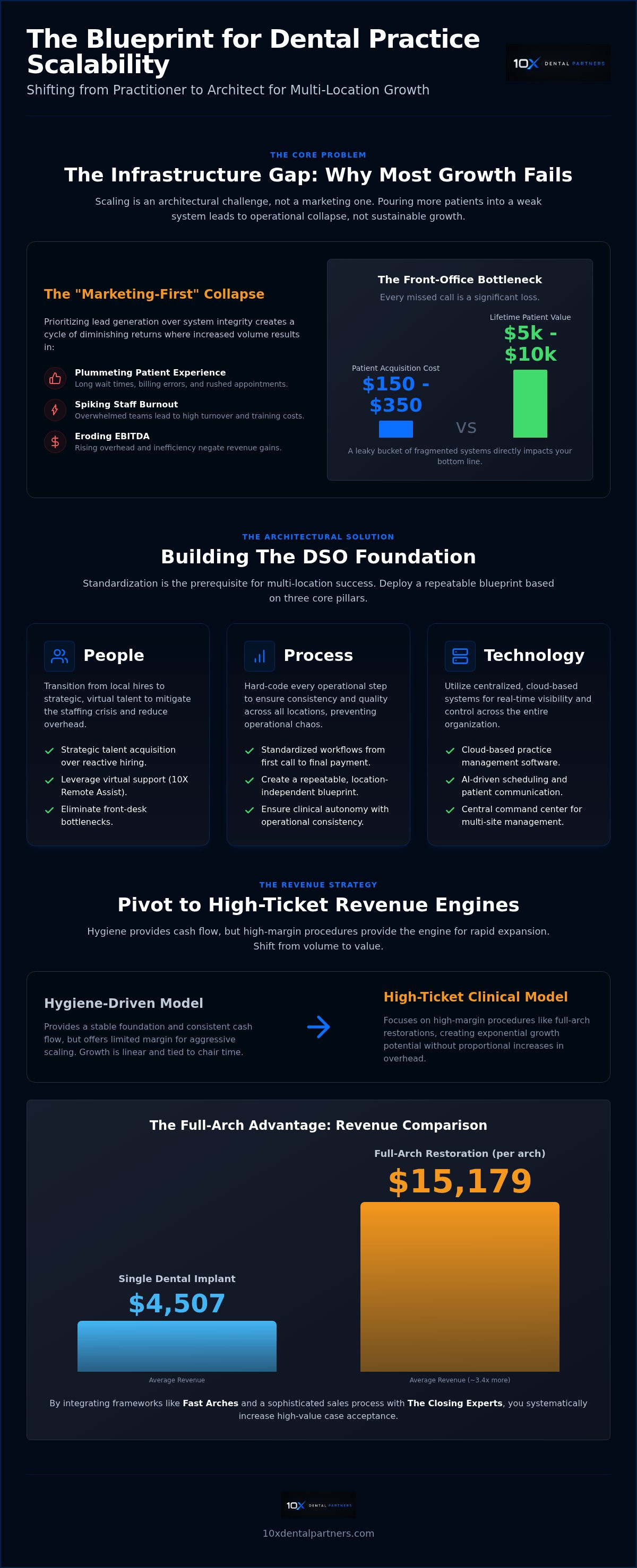
Sustainable scale is not a marketing problem. It is a structural one. Many owners invest heavily in dental practice growth strategies that focus exclusively on lead generation, only to watch their EBITDA erode as operational complexity outpaces their systems. This is the Infrastructure Gap. It's the disconnect between the volume you can buy and the volume you can actually process with excellence. When you prioritize marketing over infrastructure, you create a "marketing-first" collapse where staff burnout spikes and patient experience plummets. Transitioning from a practitioner mindset to an operator mindset requires you to stop viewing your practice as a clinic and start viewing it as a vertically integrated business system designed for efficiency.
The Front-Office Bottleneck
Fragmented systems act as a leaky bucket. If your average patient acquisition cost sits between $150 and $350, every missed call or unverified insurance claim is a direct hit to your bottom line. Front-desk teams are often overwhelmed by the dual demands of in-person care and phone management. Centralizing these functions is the only way to ensure lead conversion remains consistent across multiple locations. Without a unified command center for scheduling, your growth is limited by the manual bandwidth of your busiest employee. You aren't just losing a single appointment; you're losing the lifetime value of a patient, which can range from $5,000 to $10,000 over an eight to ten year relationship.
Building the DSO Foundation
Standardization is the prerequisite for multi-location success and the cornerstone of modern dental practice growth strategies. Most practices stall at three to five locations because they haven't formalized their core pillars: People, Process, and Technology. Scaling requires more than just adding chairs; it requires deploying a repeatable blueprint that functions independently of the owner. This architectural approach involves three key segments:
- People: Transitioning from local hires to strategic talent acquisition and virtual support to mitigate the current staffing crisis and rising overhead.
- Process: Hard-coding every operational step from the first call to the final payment to ensure clinical autonomy doesn't mean operational chaos.
- Technology: Utilizing cloud-based management and AI-driven scheduling to maintain real-time visibility into practice performance across the entire organization.
Leveraging expert growth consulting allows you to bypass the common pitfalls of rapid expansion. It ensures your infrastructure is built to handle the weight of a national platform before you ever sign a lease for your next location. By refining these pillars early, you move away from the anxiety of fragmented management toward the calm of structured, predictable growth.
High-Ticket Revenue Engines: Scaling with Specialized Clinical Programs
Hygiene-driven growth is a foundation, but it isn't an engine. While a robust hygiene department provides the consistent cash flow necessary for day-to-day operations, it rarely provides the margin required for rapid, multi-location expansion. To scale effectively in 2027, your dental practice growth strategies must pivot toward high-ticket clinical-business models that prioritize high-margin procedures over sheer patient volume. Transitioning from a general practitioner model to a specialized revenue engine allows you to increase your EBITDA without proportional increases in chair time or staffing overhead.
The Full-Arch Advantage
Full-arch restorations represent the ultimate lever for practice optimization. Data from 2026 indicates that while a single dental implant averages roughly $4,507, a full-arch procedure (All-on-4) averages $15,179 per arch. By deploying the Fast Arches framework, you aren't just adding a service; you're integrating a standardized clinical workflow designed for maximum efficiency and predictable outcomes. The challenge isn't just performing the surgery; it's the conversion. This is where utilizing The Closing Experts becomes critical. High-ticket cases require a sophisticated sales process that addresses patient objections and financing hurdles before they reach the clinical chair. Standardizing these treatment plans ensures your team maintains clinical excellence while capturing the massive ROI inherent in full-arch marketing.
Diversifying Revenue with Sleep Medicine
Sleep apnea treatment is one of the most underserved markets in general dentistry today. Integrating a program like HelpMeSleep allows you to tap into a recurring revenue stream that functions independently of traditional restorative cycles. It's a turnkey addition that doesn't require a complete overhaul of your daily operations. By following expert advice on practice management, you can build a referral network that feeds high-value specialty cases into your practice with minimal external ad spend. This diversification protects your business against fluctuations in general dentistry demand and builds a more resilient financial profile.
Specialized programs do more than just increase monthly collections; they significantly enhance your practice valuation. DSOs and private equity buyers look for practices with diversified, high-margin revenue streams that are not dependent on the owner's individual production. If you're looking to refine your clinical mix for maximum impact, our team at 10X Dental Partners can help you architect a clinical-business model designed for an elite exit. Building these engines now ensures your scaling trajectory remains unstoppable as you move toward a national platform.
Strategic Patient Acquisition: Beyond Basic Dental Marketing
Basic dental marketing is a race to the bottom. Bidding on generic "dentist near me" keywords might fill your hygiene chairs, but it won't fuel a high-growth trajectory. Advanced dental practice growth strategies for 2027 require a shift toward solution-based marketing that targets high-intent patients looking for specific, high-value outcomes. This approach moves beyond passive visibility. It focuses on architecting an omnichannel ecosystem where paid search, social media, and referral systems work in a unified rhythm to establish "Doctor-Authority." By leveraging 10X Dental Marketing, you can deploy targeted campaigns that speak directly to the pain points of patients needing complex restorative work, ensuring your ad spend is an investment in EBITDA rather than a sunk cost.
Targeting High-Value Cases
Scaling a practice requires a surgical focus on cases like full-arch restorations and advanced restorative dentistry. Data-driven insights are essential to lower your Cost Per Patient Acquisition (CPA), which currently ranges from $150 to $350 for the average new patient according to 2026 benchmarks. You can't rely on generic homepages to convert these leads. High-ticket patient acquisition demands optimized landing pages that provide deep technical clarity and social proof. When you combine precise targeting with data-backed refinement, you stop guessing and start scaling with a predictable cost-per-lead model that sustains your growth.
Conversion-Centric Communication
A lead that isn't contacted within minutes is a lead that's already looking at your competitor. Speed to lead is the most underrated component of modern patient acquisition. Utilizing professional call center services plays a pivotal role here, ensuring that digital inquiries are converted into scheduled appointments before the intent fades. This isn't just about answering phones. It's about deploying a sophisticated "lead-to-chair" strategy that communicates elite expertise from the first touchpoint. Building a brand rooted in trust and clinical authority ensures that when a patient walks through your doors, they are already pre-sold on your solution. This level of operational discipline is what separates a standard clinic from a high-performing dental organization.
Operational Efficiency via 10X Remote Assist & Virtual Staffing
Most dental practice growth strategies fail because they focus exclusively on the top of the funnel while ignoring the operational friction at the front desk. You can spend thousands on high-intent lead generation, but if your team is too overwhelmed to answer the phone or verify insurance in real time, your marketing spend is being wasted. The "Virtual Front Office" model solves this by decoupling your administrative capacity from your physical square footage. By deploying 10X Remote Assist, you can scale your administrative layer without the high overhead and turnover associated with traditional in-house hiring. This isn't just about outsourcing; it's about building a specialized, integrated support system that functions as a seamless extension of your clinical team.
Remote Scheduling & Communication
Patient expectations have shifted toward immediate responsiveness. If a prospective patient for a high-ticket case like a full-arch restoration calls and reaches a voicemail, they've already moved on to the next provider. Virtual staffing allows for extended-hour coverage that ensures no lead is left behind. The ROI of this model is undeniable. While a U.S.-based in-office coordinator carries significant salary and benefit costs, a direct-hire virtual assistant typically costs between $1,200 and $2,000 per month. This represents a 60% to 75% reduction in administrative overhead. These remote professionals handle the heavy lifting of scheduling and follow-up, allowing your in-office staff to focus entirely on the patient experience within the four walls of the clinic.
Revenue Cycle Management (RCM) Optimization
Billing friction is a primary driver of patient dissatisfaction and clinical staff burnout. Outsourcing insurance verification and claims processing to dedicated remote experts eliminates the "leaky bucket" in your revenue cycle. These specialists focus exclusively on reducing aging accounts receivable and ensuring that every claim is clean before submission. By automating this administrative heavy lifting, you free your clinical staff from the phone lines and the paperwork. This leads to a more disciplined, results-oriented culture where every team member is operating at the top of their license. It's a strategic move that stabilizes your EBITDA as you prepare for multi-location expansion.
Building a self-sustaining operational infrastructure is the only way to scale without collapse. If you're ready to eliminate the front-desk bottleneck and optimize your administrative costs, you can learn more about 10X Remote Assist here. Transitioning to a virtual model provides the agility required to navigate the complexities of the 2027 dental landscape with total confidence.
The Scaling Trajectory: From Solo Practice to National DSO
Scaling a dental organization is a journey of structural evolution. It begins at the Solo stage and progresses through Group and DSO phases before reaching the complexity of a National Platform. Each transition demands a more sophisticated application of dental practice growth strategies. To manage this verticality, you must establish a centralized "Command Center." This is the strategic heart of your organization that oversees multi-location performance in real time. It ensures that as you add rooftops, your EBITDA grows proportionally rather than being diluted by decentralized chaos or unmonitored overhead. Moving from one location to ten is not a matter of doing the same thing ten times; it's about doing things entirely differently.
Standardizing the Patient Experience
Standardization is the only way to maintain clinical and operational excellence across a national footprint. You must develop Standard Operating Procedures (SOPs) that are followed with religious consistency at every site. Training "The Closing Experts" ensures that high case acceptance for complex treatments remains a systemic outcome rather than a byproduct of a single high-performing office manager. Monitoring these results requires a set of unified KPIs that allow you to identify underperforming sites before they impact your overall valuation. When the patient experience is hard-coded into your infrastructure, your brand becomes a predictable asset rather than a collection of individual clinics.
Recruiting for Scale
High-growth organizations live and die by their talent pipeline. You aren't just hiring dentists; you're recruiting clinical leads and executive leaders who can drive DSO infrastructure development. This requires a shift from passive job postings to proactive recruiting and talent acquisition. Aligning team incentives with long-term organizational goals ensures your staff is as committed to the scale as you are. A robust associate pipeline is essential to prevent the "founder trap," where growth stalls because the primary owner cannot step away from the chair. By refining your operator blueprint now, you create an environment where top-tier clinicians want to build their careers.
Private equity firms in 2026 are looking for more than just high production. They value clean EBITDA, low provider turnover, and transferable systems that don't rely on the owner's personal production. With 69% of DSOs expecting to increase acquisition activity in 2026 according to Becker's Dental Review, the market is becoming increasingly selective. Preparing for a high-multiple exit means proving that your practice can thrive independently. You must demonstrate that your systems are scalable, your revenue is diversified, and your leadership team is capable of managing a national footprint. This level of preparation is what separates a standard sale from an elite exit.
Architecting Your Elite Scaling Blueprint
Transitioning from a clinical practitioner to a master operator is the defining move for the 2027 landscape. We've detailed how bridging the infrastructure gap and deploying high-ticket revenue engines like Fast Arches creates a foundation that doesn't buckle under volume. By integrating proprietary virtual staffing through 10X Remote Assist, you can decouple your administrative capacity from your physical square footage, ensuring your EBITDA remains protected as you scale toward a national platform. The goal is to move away from the anxiety of fragmented management toward the calm of a structured, self-sustaining system.
Successfully executing these dental practice growth strategies requires a disciplined, systemic approach rather than disconnected efforts. You now possess the playbook to navigate the trajectory from solo practice to high-multiple exit with total operational clarity. It's time to build the infrastructure that supports your vision without compromise. Build your strategic growth blueprint with 10X Dental Partners. Your future as a high-level operator starts today.
Frequently Asked Questions
What are the most effective dental practice growth strategies for 2027?
The most effective dental practice growth strategies for 2027 center on vertical integration and operational infrastructure. Success requires moving beyond basic marketing to implement high-ticket clinical programs like Fast Arches and leveraging virtual staffing solutions. By centralizing front-office tasks and focusing on high-intent patient acquisition, you create a scalable model that increases EBITDA without demanding more of your personal chair time or causing systemic staff burnout.
How can I reduce my dental office overhead while scaling?
Reducing overhead while scaling is achieved by decoupling your administrative capacity from your physical office space. Utilizing 10X Remote Assist allows you to replace high-cost, in-office administrative positions with specialized virtual professionals. This model can reduce administrative overhead by 60% to 75% compared to traditional U.S.-based hires. These remote experts handle scheduling and insurance verification, allowing your in-person team to focus exclusively on delivering high-quality patient experiences.
What is DSO infrastructure and why does my practice need it?
DSO infrastructure refers to the centralized "Command Center" of systems, technology, and talent that allows a practice to operate across multiple locations with total consistency. It includes standardized SOPs for scheduling, Revenue Cycle Management, and recruiting. You need this infrastructure to bridge the gap between being a practitioner and becoming an operator. Without it, most practices stall at three to five locations because their fragmented systems cannot support the increased operational complexity.
How does virtual staffing for dental offices actually work?
Virtual staffing involves integrating remote professionals into your practice management software to handle administrative heavy lifting. These experts manage scheduling, patient follow-up, and insurance verification from a remote environment. 10X Remote Assist ensures these individuals function as a seamless extension of your clinical team. This model provides extended-hour coverage for patient inquiries, ensuring that high-value leads are captured and scheduled immediately without overwhelming your in-office front-desk staff.
What is the "Fast Arches" program and how does it drive revenue?
Fast Arches is a proprietary clinical-business program designed to standardize and scale full-arch implant procedures. It drives revenue by shifting your practice focus from high-volume, low-margin hygiene appointments to high-ticket restorations. By providing a repeatable clinical workflow and combining it with solution-based marketing, the program allows you to capture the massive ROI inherent in complex cases. It transforms your practice into a specialized revenue engine while maintaining elite clinical standards.
How do I improve case acceptance for high-ticket dental treatments?
Improving case acceptance for high-ticket treatments requires a sophisticated communication framework like The Closing Experts. You must address patient objections, emotional triggers, and financing options before the patient ever sits in the clinical chair. Standardizing this sales process ensures that your team maintains high acceptance rates across all locations. By treating the consultation as a strategic conversion point rather than a casual conversation, you ensure predictable growth for your most valuable procedures.
What KPIs should I track to ensure my dental practice is growing profitably?
To ensure profitable dental practice growth strategies, you must track EBITDA, Cost Per Patient Acquisition (CPA), and lead-to-chair conversion ratios. Monitoring aging accounts receivable is also critical to maintaining a healthy revenue cycle. These metrics provide a clear view of your operational efficiency and financial health. Tracking these specific data points allows you to identify bottlenecks early and ensures that your expansion efforts are actually increasing your bottom-line profitability.
When is the right time to transition from a single practice to a DSO?
The right time to transition to a DSO is when your single location operates independently of your personal clinical production. You must have standardized SOPs, a centralized administrative layer, and a robust talent acquisition pipeline in place. If your current systems allow you to step away from the chair without a drop in revenue, you have built the foundation necessary for multi-location scale. This transition marks your evolution from a dentist to a master operator.


