
Maximizing Dental Practice Operational Efficiency: A Strategic Blueprint for Growth

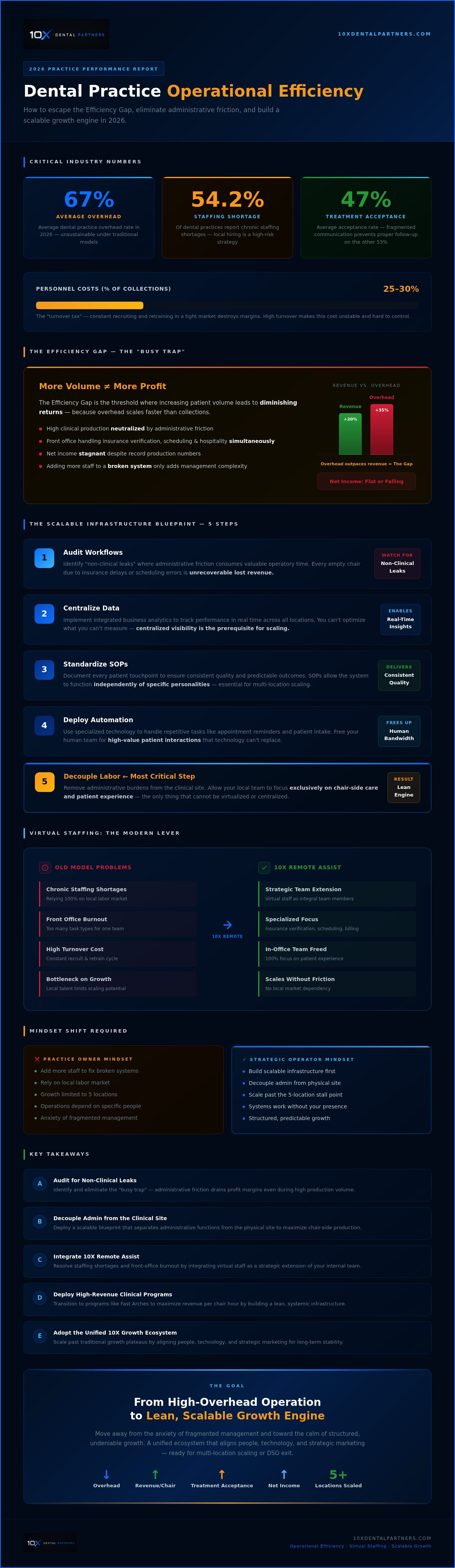
With average overhead for dental practices reaching as high as 67% in 2026, the traditional model of local, fragmented management is no longer sustainable. You've likely felt the fiscal squeeze as rising personnel costs and stagnant reimbursement rates erode your bottom line. Achieving true dental practice operational efficiency requires more than just working harder; it requires a fundamental shift in how you deploy your human capital. The front office shouldn't be a bottleneck that limits your clinical output.
It's frustrating to watch administrative tasks bleed into clinical production time while high staff turnover keeps you in a constant state of retraining. You deserve a system that scales without the constant friction of the local labor market. This article will show you how to transform your practice from a high-overhead operation into a lean, scalable growth engine through systemic infrastructure and virtual integration. We'll explore how to decouple administrative labor from your physical site, deploy specialized programs like Fast Arches to maximize revenue per chair hour, and build a predictable system that functions with clinical precision. It's time to move away from the anxiety of fragmented management and toward the calm of structured, undeniable growth.
Key Takeaways
- Identify and eliminate the "busy trap" by auditing non-clinical leaks that drain profit margins despite high production volume.
- Deploy a scalable blueprint for dental practice operational efficiency that separates administrative functions from the physical clinical site to maximize chair-side production.
- Resolve staffing shortages and front-office burnout by integrating 10X Remote Assist as a strategic extension of your internal team.
- Transition from high-overhead operations to high-revenue clinical programs, such as Fast Arches, by building a lean, systemic infrastructure.
- Scale past traditional growth plateaus by adopting a unified ecosystem that aligns people, technology, and strategic marketing for long-term stability.
The Dental Practice Efficiency Gap: Why Traditional Management Stalls
Growth is not always profitable. In the current 2026 landscape, many clinicians find themselves trapped in the "Efficiency Gap." This is the specific threshold where increasing your patient volume actually leads to diminishing returns because your overhead scales faster than your collections. You might be producing more than ever, yet your net income remains stagnant. This "busy trap" occurs when high clinical production is neutralized by administrative friction. When your front office team is forced to manage insurance verification, complex scheduling, and in-person patient hospitality simultaneously, they become a permanent bottleneck. This fragmented approach fails because it asks local staff to be experts in every operational pillar at once.
Traditional hiring models are no longer sufficient to bridge this gap. With 54.2% of dental practices reporting chronic staffing shortages in 2026, relying solely on the local labor market is a high-risk strategy. The old method of "hiring your way out" of a problem only increases operational complexity and management fatigue. True dental practice operational efficiency requires a departure from these legacy habits. It demands a system where administrative labor is decoupled from the physical practice site to allow your in-office team to focus exclusively on the patient experience and clinical support.
The High Cost of Administrative Friction
Administrative friction is a silent drain on your profitability. Every hour an operatory sits empty due to insurance verification delays or scheduling errors represents lost revenue that can't be recovered. These "non-clinical leaks" are expensive. Industry data shows that average treatment acceptance rates hover around 47%, often because fragmented communication prevents proper follow-up. Furthermore, the "turnover tax" is a significant burden. With personnel costs averaging 25 to 30% of collections, the constant cycle of recruiting and retraining in a tight market destroys your margins. Applying foundational practice management principles means recognizing that your front office shouldn't be a catch-all for every task that isn't clinical.
Moving from Practice Owner to Strategic Operator
Scaling to a multi-location model or preparing for a DSO exit requires a fundamental mindset shift. You must move from being a practice owner to a strategic operator. A common tactical error is adding more staff to a broken system, which only creates more people to manage without fixing the underlying drag. Strategic operators focus on building a scalable infrastructure that works independently of specific personalities. This involves deploying centralized systems that maintain quality and consistency across every chair. By shifting to an integrated architecture, you reduce your reliance on local talent pools and create a predictable, lean engine for growth. This structural solidity is the prerequisite for any practice looking to scale past the five-location stall point.
Engineering a Scalable Practice Infrastructure
Infrastructure isn't a luxury; it's the architecture of a scalable business. To move beyond the five-location stall point, you must build a system that functions independently of your physical presence. This requires a methodical approach to dental practice operational efficiency that treats your office as a high-performance engine rather than a series of disconnected tasks. Building this foundation allows you to absorb more volume without increasing your stress levels or compromising patient care.
Deploy this five-step blueprint to stabilize and scale your operation:
- Audit Workflows: Identify "non-clinical leaks" where administrative friction consumes valuable operatory time.
- Centralize Data: Implement integrated business analytics to track performance in real time across all locations.
- Standardize SOPs: Document every patient touchpoint to ensure consistent quality and predictable outcomes.
- Deploy Automation: Use specialized technology to handle repetitive tasks like appointment reminders and patient intake.
- Decouple Labor: Remove administrative burdens from the clinical site to allow your local team to focus on chair-side care.
Revenue Cycle Management (RCM) Optimization
Financial health begins with a lean RCM process. Reducing days in Accounts Receivable (AR) is critical for maintaining cash flow and increasing practice valuation for future exits. High-performing operators prioritize "clean claims" by implementing proactive insurance verification protocols before the patient ever arrives. This precision ensures that billing is an automated byproduct of the clinical visit rather than a delayed administrative hurdle. If you're looking to refine these back-office systems, 10X Dental Partners offers the strategic consulting necessary to overhaul your financial infrastructure.
Data-Driven Decision Making
Success in the 2026 market depends on the KPIs you choose to monitor. While many owners focus on total production, elite operators prioritize revenue per chair hour. This metric reveals the true health of your schedule and identifies where predictive analytics can optimize patient flow. Operational leverage in a dental context is the ability to increase clinical production without a proportional increase in fixed administrative costs. By using data to anticipate scheduling gaps and treatment trends, you create a resilient system that thrives regardless of market volatility. This shift from reactive management to proactive operation is what separates stagnant practices from scalable growth engines.
Virtual Staffing: The Modern Lever for Front-Office Efficiency
The 2026 labor market has fundamentally altered the math of practice management. With over 54% of practices struggling to fill critical administrative positions, the traditional reliance on local talent pools is now a strategic vulnerability. Virtual staffing represents the most significant shift in dental practice operational efficiency since the adoption of digital records. It isn't merely about cutting costs; it's about deploying a specialized, scalable workforce that functions as a seamless extension of your local team. By integrating 10X Remote Assist, you decouple administrative labor from the clinical site, ensuring that your physical office remains dedicated to high-value patient care.
Moving administrative burdens to a dedicated remote team provides an immediate return on investment. You eliminate the overhead associated with office space, equipment, and local benefits while gaining access to a higher tier of specialized talent. This model transforms the front office from a chaotic bottleneck into a disciplined, results-oriented hub. It allows you to scale your patient volume without a proportional increase in personnel management or physical infrastructure.
10X Remote Assist: Reclaiming Your Front Office
The primary benefit of 10X Remote Assist is the elimination of the "distraction tax." When your in-office team is constantly interrupted by ringing phones and insurance verification hurdles, their ability to serve the patient in the chair diminishes. Remote professionals handle the heavy lifting of patient communication and scheduling, providing your office with 24/7 or extended-hour availability. This ensures that no lead is lost and every patient inquiry is handled with professional precision. Your local staff can then focus on their most important role: creating an elite, in-person experience that drives case acceptance and patient loyalty.
Specialized Outsourcing for Complex Tasks
Insurance verification is too complex and time-consuming to be handled by the same person who is checking in a patient. It requires dedicated focus to ensure clean claims and accurate cost estimates. By outsourcing these specialized tasks, you reduce errors that lead to claim denials and patient frustration. Virtual assistants also play a critical role in managing referral networks and treatment follow-ups, tasks that often fall through the cracks in a busy office. This integration ensures that your brand voice remains consistent across every touchpoint. Unlike generic AI receptionists that lack the nuance for complex dental cases, professional remote staffing provides the high-touch expertise required to maintain a sophisticated patient experience.
Strategic Clinical Programs: Boosting Revenue per Chair Hour
Operational excellence is the prerequisite for high-ticket clinical production. You can't effectively deliver complex, multi-stage treatments in a practice plagued by administrative friction. While foundational dental practice operational efficiency stabilizes your overhead, it also creates the bandwidth necessary to deploy specialized programs that significantly increase revenue per chair hour. High-ticket clinical programs require a disciplined delivery system where marketing, consultation, and clinical execution are perfectly aligned. Without this systemic integration, even the most skilled clinician will struggle with the administrative weight of specialty services.
The Closing Experts framework is central to this alignment. By standardizing the consultation process, you move beyond the average 47% treatment acceptance rate seen in 2026. This framework ensures that every high-value opportunity is handled with clinical and financial precision, maximizing the efficiency of your chair time. It's about ensuring that your team is as skilled at presenting the value of a case as you are at performing the procedure.
Fast Arches: Scaling High-Value Implant Cases
The Fast Arches program is designed for practices ready to scale full-arch dental implants. Successful delivery of these cases requires more than clinical skill; it demands a specific operational infrastructure. By implementing a structured clinical-business blueprint, you reduce the learning curve for your staff and ensure consistent outcomes. This specialization increases the revenue density of your clinical schedule, allowing you to produce more in fewer hours. It transforms your practice into a destination for complex care, supported by a marketing and delivery system that functions with predictable accuracy. This is how you move from a high-volume general model to a high-value specialty model without increasing your personal workload.
HelpMeSleep: Diversifying Revenue with Sleep Apnea Programs
Integrating sleep medicine through the HelpMeSleep program allows general and specialty practices to diversify their revenue streams without disrupting existing workflows. The efficiency of this program lies in its turnkey approach to medical billing within a dental setting, a critical factor in maintaining dental practice operational efficiency while adding new services. It helps you navigate the complexities of 2026 reimbursement landscapes while building a sustainable referral ecosystem with non-dental healthcare providers. This vertical integration ensures that your practice remains resilient against market shifts, providing a high-margin service that complements your core offerings. To begin building these high-revenue pillars, partner with 10X Dental Partners for a comprehensive strategic assessment.
Deploying the 10X Growth System for Sustainable Scaling
The 10X Growth System is the culmination of strategic integration across three core pillars: people, technology, and marketing. Unlike competitors who suggest software alone can solve growth plateaus, we recognize that sustainable scaling requires a comprehensive architectural overhaul. Our strategic growth consulting identifies the specific "stalls" that prevent your practice from reaching its next tier of production. By prioritizing dental practice operational efficiency, we help you move from a collection of disconnected offices to a unified, scalable engine. It's about building a system where every component works in harmony to drive predictable results.
Elite recruiting and talent acquisition are the lifeblood of a DSO-ready organization. You can't scale a broken culture or a revolving door of staff. We assist you in deploying the right operators who understand the value of systemic consistency. This isn't just about filling seats; it's about building a team capable of maintaining quality as you expand. When your human capital is aligned with your operational goals, growth becomes a predictable byproduct rather than a constant struggle. This alignment is what allows you to maintain high standards of care across multiple locations without increasing your personal management burden.
Building for National Scale
Scaling past the five-location stall point requires a fundamental shift toward centralized authority. 10X Dental Partners provides the DSO infrastructure development needed to manage complex groups with precision. There's a direct synergy between 10X Dental Marketing and your internal operational flow. When your marketing generates high-value leads, your systemic infrastructure must be ready to convert and deliver those cases without friction. Demonstrating this level of operational excellence is what ultimately drives practice valuations toward a high-value exit in the 2026 market. Investors and DSOs prioritize practices that have decoupled their growth from the physical presence of the owner.
Your Next Steps to Operational Mastery
Achieving mastery starts with an honest evaluation of your current state. A comprehensive practice audit reveals the non-clinical leaks currently draining your profit margins. From there, you can begin to integrate 10X Remote Assist into your workflow to offload administrative weight and reclaim your clinical focus. This integration is the first step toward building a lean, high-output operation that can thrive in any economic climate. It's time to stop managing by crisis and start leading with a proven blueprint. Schedule a strategy session with 10X Dental Partners to evaluate your scaling readiness and begin your transition to a high-performance operation.
Architecting Your Practice for Sustainable Growth
The transition from a high-overhead practice to a lean, scalable growth engine requires a fundamental departure from fragmented management. By decoupling administrative labor from your clinical site and engineering a systemic infrastructure, you transform your office into a predictable operation. True dental practice operational efficiency isn't about working more hours; it's about deploying specialized systems that maximize every chair hour through vertical integration. You've seen how virtual staffing and high-ticket clinical programs can stabilize your margins and protect your bottom line.
As DSO infrastructure experts, we specialize in helping groups scale past the five-location stall point with precision. Our 10X Remote Assist virtual staffing model significantly reduces overhead and turnover, while The Closing Experts program provides the framework needed to boost case acceptance on high-ticket treatments. You don't have to navigate the complexities of the 2026 labor market alone. We invite you to partner with 10X Dental Partners to scale your practice and move away from the anxiety of management toward the calm of structured growth. Your practice is ready for its next tier of production. Let's refine your blueprint together.
Frequently Asked Questions
How does operational efficiency impact dental practice valuation?
Operational efficiency directly increases the valuation multiple applied to your EBITDA by demonstrating that the practice is a scalable system rather than a collection of clinical tasks. Investors and DSOs prioritize organizations with predictable margins and lower overhead, which top performers maintain between 55% and 60% in 2026. A practice that functions independently of the owner physical presence is seen as a lower-risk asset, making systemic excellence the primary driver of a high-value exit.
Can virtual staffing really maintain the same patient experience as in-office staff?
Virtual staffing often improves the patient experience by eliminating the distraction tax from your local team. Professionals from 10X Remote Assist focus exclusively on patient communication and scheduling without the interruptions of a busy physical lobby. This allows your in-office staff to provide undivided attention to the patient in the chair. Because these remote agents aren't juggling clinical support or check-ins, they deliver a consistent, high-touch hospitality that mimics an elite concierge service.
What are the first signs that my dental practice has an efficiency problem?
The most common sign is a busy trap where high clinical production volume doesn't result in increased net profit. You might notice administrative friction like insurance verification delays, chronic staff burnout, or treatment acceptance rates falling below the 47% industry average. If your front office has become the bottleneck for growth, your dental practice operational efficiency is compromised. These non-clinical leaks indicate that your current infrastructure can't support your patient volume.
How does the 10X Remote Assist program integrate with my existing practice management software?
The 10x Remote Assist program functions as a secure, real-time extension of your team. Our professionals work directly within your existing practice management software through encrypted, HIPAA-compliant connections to handle scheduling and insurance verification. This integration ensures that your data remains centralized and accurate across all locations. We don't require complex software migrations; instead, we deploy trained operators who follow your established SOPs to ensure a seamless, disciplined workflow that matches your brand voice.
What is the typical ROI for implementing a specialized clinical program like Fast Arches?
ROI is realized through increased revenue density per chair hour and significantly reduced clinical downtime. Programs like Fast Arches provide a structured clinical-business blueprint that allows you to perform high-value full-arch implants with predictable accuracy. By standardizing the delivery and marketing of these cases, you maximize the production of every operatory. This specialization transforms your practice from a general model into a high-margin destination, allowing you to produce more in fewer clinical hours.
Is it possible to scale to multiple locations without a centralized call center?
Scaling past the five-location stall point is nearly impossible without centralized systems. Decentralized offices often suffer from inconsistent patient experiences and fragmented scheduling that drains management resources. A centralized call center or virtual staffing model ensures that quality is maintained across the entire organization. It provides the operational leverage needed to grow without a proportional increase in local administrative costs. Without this centralized infrastructure, management fatigue will eventually halt your expansion efforts.
How does insurance verification outsourcing reduce front-office stress?
It removes one of the most time-consuming and error-prone tasks from your local team's daily responsibilities. In 2026, navigating constant CDT code changes and complex reimbursement rules requires dedicated focus that in-office staff rarely have. By outsourcing this to 10X Remote Assist, your front-office team can stop battling insurance companies and start building relationships with patients. This reduction in administrative friction directly lowers staff burnout and turnover, creating a more stable, professional office environment.
What KPIs should I track to measure the success of my efficiency improvements?
You should prioritize revenue per chair hour and your overall overhead percentage over total production. Tracking your treatment acceptance rate and days in Accounts Receivable also provides critical insights into your dental practice operational efficiency. These metrics reveal whether your systems are lean and scalable. Successful improvements should move your overhead toward the 55% range, indicating that your infrastructure is effectively converting clinical effort into sustainable profit while reducing reliance on local labor markets.


