
Dental Practice Key Performance Indicators: The 2026 Executive Guide to Data-Driven Scaling

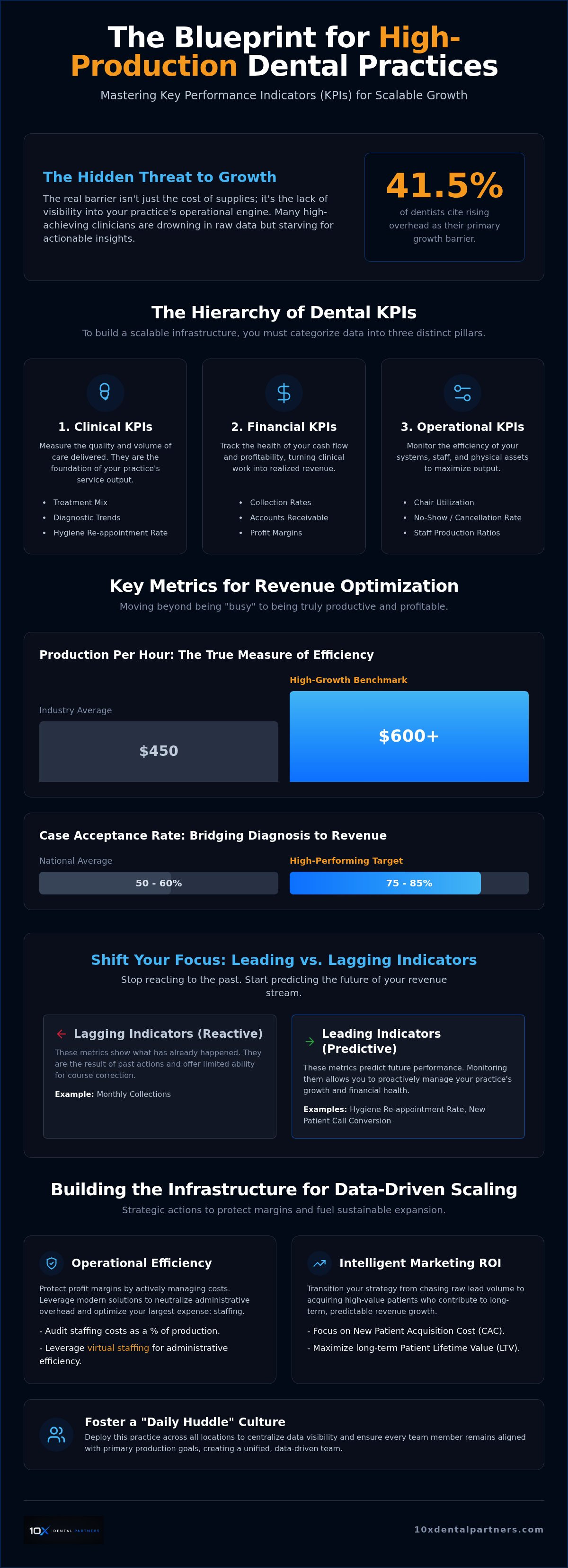
While 41.5% of dentists cite rising overhead as their primary growth barrier in 2026, the real threat isn't the cost of supplies. It's the lack of visibility into the engine of the business. You've likely felt the fiscal squeeze of rising operating costs and stagnant margins, even as your patient volume remains high. It's a common frustration for high-achieving clinicians who find themselves drowning in raw data but starving for actionable insights. To move from a solo practitioner to a high-production dental group, you must transition from clinical reporting to executive-level operational analytics. Mastering specific dental practice key performance indicators is the only way to build a predictable, scalable infrastructure.
This guide provides the architectural blueprint for that transition. We'll move beyond basic production numbers to establish a clear hierarchy of metrics that actually drive multi-location growth. You'll learn how to improve case acceptance for high-value procedures, reduce overhead through better resource allocation, and use virtual staffing as a primary lever for administrative efficiency. We're moving away from the anxiety of fragmented management toward the calm of a structured, proven growth system. It's time to stop managing by gut feeling and start leading with data.
Key Takeaways
- Establish a rigorous hierarchy for your data by categorizing metrics into clinical, financial, and operational pillars to build a scalable infrastructure for DSO expansion.
- Identify the specific dental practice key performance indicators that bridge the gap between diagnosis and realized revenue, focusing specifically on case acceptance and production per hour.
- Protect your profit margins by auditing staffing costs as a percentage of production and leveraging virtual staffing solutions to neutralize administrative overhead.
- Transition your marketing strategy from raw lead volume to high-value metrics like New Patient Acquisition Cost (CAC) and long-term Patient Lifetime Value (LTV).
- Deploy a "Daily Huddle" culture across all locations to centralize data visibility and ensure every team member remains aligned with primary production goals.
The Hierarchy of Dental Practice KPIs: Moving Beyond Basic Reporting
Data serves as the pulse of any high-performing dental organization. Most practitioners focus exclusively on gross production, but that is a lagging indicator that tells you what happened yesterday, not what will happen tomorrow. A Key Performance Indicator (KPI) functions as a diagnostic tool for your business infrastructure. To scale effectively in 2026, you must categorize your data into three distinct pillars: clinical, financial, and operational. This methodical approach ensures that every dental practice key performance indicators report you generate drives a specific strategic action.
Clinical KPIs measure the quality and volume of care, such as treatment mix and diagnostic trends. Financial KPIs track the health of your cash flow, including collection rates and accounts receivable. Operational KPIs monitor the efficiency of your systems, such as your no-show rate and staff production ratios. Relying on surface-level production numbers is a liability. It often hides deep-seated operational inefficiencies, such as poor chair utilization or inflated lab costs, that erode margins even when the schedule looks full.
Solo vs. Group Practice: How Your Metrics Must Evolve
In a solo environment, the business typically revolves around the individual doctor's hands. When you begin transitioning from solo to group dental practice, the focus shifts from individual provider production to facility utilization. You're no longer just a clinician; you're an asset manager. Group practices require visibility across multiple locations to maintain consistency. You need to know which chairs are generating the highest ROI and which teams are maximizing the available operatory time. Without this structural shift in reporting, scaling leads to administrative chaos rather than sustainable profit.
The Leading Indicators of Scaling Success
Lagging indicators like monthly collections only show the results of past efforts. Leading indicators predict your revenue three months in advance, allowing for proactive course correction. Two critical metrics dominate this category: hygiene re-appointment rates and new patient call conversion. If your re-appointment rate drops today, your production will crater in ninety days. Similarly, your marketing spend is wasted if your front office isn't converting inquiries into appointments. We deploy The Closing Experts to specifically address the gap in case acceptance. This ensures that high-production dental practice key performance indicators, such as treatment plan conversion, move from the diagnostic chair to the ledger.
Revenue Optimization and High-Production Metrics
Revenue optimization is the process of converting clinical capacity into liquid capital. While many practitioners focus on gross production, true operators measure production per hour to determine clinical efficiency. For a high-growth practice in 2026, the benchmark for good production is $600 or more per hour, compared to the industry average of $450. High-production dental practice key performance indicators provide the visibility required to identify whether your schedule is truly optimized or simply busy. To achieve exponential growth, you must look beyond general dentistry and track the ROI of specialized programs like Fast Arches and HelpMeSleep, which command significantly higher hourly yields.
Maximizing Case Acceptance for High-Value Procedures
The gap between a diagnosis and realized revenue is defined by your conversion funnel. Case Acceptance is the ratio of treatment accepted versus treatment presented in dollars. In 2026, high-performing practices target a 75% to 85% acceptance rate, while the national average remains stagnant between 50% and 60%. Achieving these elite numbers requires a systematic approach to patient commitment. Deploying professional Call Center Services and specialized training from The Closing Experts ensures that high-value cases, such as full-arch restorations or sleep apnea treatments, don't stall at the consultation stage. These systems remove the friction from the patient's decision-making process, turning complex treatment plans into scheduled production.
Industry leaders often reference six popular KPIs for dental practices to establish a baseline, but scaling a DSO requires deeper analysis of the treatment mix. You should monitor how many new patients are converted specifically into high-production programs rather than just hygiene. If your acquisition cost is high but your case acceptance is low, your marketing spend is effectively a donation to your competitors.
The Production-to-Collection Gap
Production is a vanity metric if the funds never hit your bank account. Insurance verification errors and sluggish billing cycles are "leaky buckets" that erode your net profit. A healthy practice maintains a collection rate of 98% or higher. We utilize 10X Remote Assist to manage the entire revenue cycle, ensuring that insurance claims are clean and patient balances are collected promptly. This virtual staffing model allows your in-office team to focus on the patient experience while experts handle the technicalities of proactive billing. If you're struggling to bridge this gap, our Revenue Optimization strategies can help you tighten your financial infrastructure and eliminate administrative drag. By benchmarking your 2026 collections against elite DSO standards, you ensure that every dollar produced is a dollar earned.
Operational Efficiency: Managing Overhead and Staffing Ratios
Overhead is the silent predator of dental profitability. In 2026, the average dental practice overhead fluctuates between 59% and 67%, leaving thin margins for reinvestment. High-growth organizations don't settle for these averages. They target a total overhead benchmark below 55% by ruthlessly analyzing fixed and variable costs. Staffing costs are the primary profit killer in this equation. When payroll and benefits exceed 25% of collections, your scaling efforts are effectively subsidizing your administrative drag. Monitoring dental practice key performance indicators related to labor efficiency allows you to identify exactly where capital is leaking before it compromises your cash flow.
Operational excellence requires a shift from viewing staff as a fixed expense to viewing them as a variable lever for production. You must also account for the cost of an empty operatory. Every minute a chair sits idle, your facility costs remain static while your revenue potential drops to zero. True operators focus on maximizing the yield of every square foot of the practice through precise scheduling and high-production clinical programs.
The Virtual Staffing Leverage: 10X Remote Assist ROI
Traditional P&L statements are often weighted down by heavy in-office administrative costs, including taxes, benefits, and physical workspace requirements. 10X Remote Assist transforms this model by replacing high-cost local hires with specialized virtual professionals. This shift reduces your staffing ratio while improving critical metrics like insurance verification speed and clean claim rates. Centralizing these functions is a foundational requirement for DSO infrastructure development. By deploying remote support for billing and scheduling, you decouple your growth from the local labor market and build a predictable, scalable back office.
Facility and Technology Utilization
Investing in high-end clinical equipment only makes sense if the ROI is measurable through increased hourly production. You shouldn't buy technology for the sake of innovation; buy it to compress procedure times and expand your service mix. Optimizing the schedule ensures that your highest-paid providers are performing the highest-value work. Chair-Time Productivity is the total production divided by available operatory hours. If this number isn't trending upward as you integrate new software or equipment, your systems are failing to translate technology into profit. Use your dental practice key performance indicators to audit facility utilization monthly, ensuring that every operatory functions as a high-yield asset.
Marketing KPIs: Customer Acquisition and Lifetime Value
Marketing is a precision instrument for scaling, not a generic overhead expense. Most practices fail by focusing on raw new patient volume, which provides no insight into actual profitability. To lead a high-production group, you must master the relationship between Customer Acquisition Cost (CAC) and Patient Lifetime Value (LTV). These dental practice key performance indicators allow you to audit the efficiency of every dollar spent and ensure your marketing engine is driving high-intent traffic to your operatories. Without clear attribution, you're simply guessing which campaigns are fueling your growth.
CAC vs. Procedure Value
Your acquisition cost must be weighted against the diagnostic value of the lead. A $200 CAC is unsustainable for a patient seeking a simple cleaning, but it represents an exceptional ROI when it converts into a Fast Arches restorative case. We deploy 10X Dental Marketing to target these high-production opportunities specifically. By segmenting spend across clinical programs, you can identify which campaigns are yielding the highest revenue per lead. This level of attribution is what separates a guessing game from a predictable growth platform. It's about buying revenue, not just phone calls.
Retention and Re-appointment Metrics
Acquisition is expensive; retention is profitable. Your hygiene re-appointment rate is the foundation of your practice stability, functioning as a leading indicator for your revenue six months down the line. If your patient attrition rate exceeds 10%, you're effectively paying to fill a leaky bucket. We utilize dental practice leadership development to refine the patient experience and ensure your team is equipped to secure long-term commitment. A disciplined focus on these metrics prevents the stagnant revenue that often plagues high-volume practices despite high patient counts.
To optimize your conversion from phone call to chair time, you need a system that tracks every touchpoint in the patient journey. If you're ready to stop wasting capital on unoptimized leads, explore our 10X Dental Marketing solutions to start scaling with data-driven precision.
Building the Infrastructure for Data-Driven Scaling
Scaling is an architectural challenge that requires a shift from clinical intuition to executive infrastructure. To manage a multi-location group in 2026, you must establish a single source of truth. Centralizing your dental practice key performance indicators across all facilities ensures that you have total DSO visibility, allowing you to identify high-performing locations and those requiring operational intervention. Without this centralized data, your expansion will likely lead to fragmented management and diluted profits.
Data centralization allows you to distinguish between vanity metrics and reality metrics. Raw new patient volume is a vanity metric; net EBITDA and case acceptance for high-production procedures are reality metrics. You must avoid the trap of "busy-ness" and focus on the numbers that drive actual cash flow. Implementing a "Daily Huddle" culture transforms these numbers from static reports into tactical commands. It's the daily mechanism that ensures every team member knows exactly which primary KPIs must be moved before the end of the business day.
Developing a Culture of Accountability
Teams must be deeply involved in the tracking process for data to remain accurate and impactful. Accountability isn't about surveillance; it's about empowering your clinical and administrative staff to own their specific operational outcomes. You can incentivize your team based on measurable improvements, such as reducing the no-show rate or increasing hygiene re-appointment percentages. When dental office managers are equipped with strategic growth tools, they move from being task-oriented to being results-oriented. This cultural shift ensures that the entire organization is pulling in the same direction, fueled by the clarity of objective data.
Partnering for Strategic Revenue Optimization
Bringing in an external perspective is often the fastest way to break through a growth plateau. When you're ready to audit your current system, engaging in dental practice growth consulting provides the strategic roadmap needed to identify hidden bottlenecks. We deploy 10X Remote Assist to stabilize your operational KPIs, ensuring that your billing and scheduling functions are handled by specialists who understand the mechanics of high-volume groups. This partnership allows you to focus on clinical leadership while we handle the heavy lifting of revenue cycle management.
The transition from a solo clinician to a master operator requires a commitment to systemic integration. By refining your dental practice key performance indicators and building a culture of accountability, you create a business that is predictable, profitable, and ready for 10X expansion. It's time to deploy the blueprint for your 2026 growth and move toward the calm of a structured, high-production system.
Transition to the Master Operator Phase
Scaling a dental group in 2026 requires more than clinical excellence; it demands a rigorous commitment to data-driven infrastructure. We've established that tracking the right dental practice key performance indicators is the only way to expose operational inefficiencies and capture high-yield opportunities. By decoupling administrative overhead from your physical location through 10X Remote Assist virtual staffing, you protect your margins while driving specialized high-production programs like Fast Arches and HelpMeSleep. This systemic integration is what transforms a busy, chaotic practice into a predictable and scalable DSO.
The path from a solo practitioner to a master operator is paved with objective data and disciplined accountability. If you're ready to move away from the anxiety of fragmented management toward the calm of structured, systemic growth, it's time to refine your operational blueprint. Partner with 10X Dental to Audit Your Practice Infrastructure and leverage our Strategic Growth Platform for DSOs. We're here to help you build a legacy of efficiency and unstoppable momentum. Your blueprint for long-term stability and success is ready for deployment.
Frequently Asked Questions
What are the top 5 KPIs every dental practice should track daily?
The top five dental practice key performance indicators to track daily are daily production versus goal, number of new patient calls, call-to-appointment conversion rate, hygiene re-appointment rate, and same-day treatment acceptance. Monitoring these metrics daily allows for immediate course correction rather than waiting for a month-end post-mortem. These indicators function as an early warning system for your revenue engine, ensuring your team remains focused on high-yield activities and schedule optimization throughout the business day.
How do I calculate the Customer Acquisition Cost (CAC) for my dental marketing?
To calculate Customer Acquisition Cost (CAC), divide your total marketing expenditure by the number of new patients acquired during a specific period. For strategic scaling, you should segment this metric by clinical program. A higher CAC is acceptable for high-production procedures like Fast Arches compared to general hygiene. This calculation provides the transparency required to audit your 10X Dental Marketing campaigns and ensure you are buying revenue at a sustainable and profitable margin.
What is a healthy overhead percentage for a growing dental practice in 2026?
A healthy overhead percentage for an elite, high-growth practice in 2026 is below 55% of total collections. While the current industry average fluctuates between 59% and 67%, top-tier operators focus on reducing administrative drag and facility costs to maximize EBITDA. Achieving this benchmark requires a disciplined analysis of fixed and variable expenses, with a specific focus on keeping staffing costs between 20% and 24% of your total production through strategic resource allocation.
How does virtual staffing through 10X Remote Assist impact my practice KPIs?
Integrating 10X Remote Assist directly improves your staffing ratio and collection rate by offloading administrative tasks to specialized virtual professionals. This model reduces the physical office space required for support staff and eliminates the high costs associated with local recruiting and benefits. By centralizing insurance verification and billing, you stabilize your dental practice key performance indicators, specifically reducing accounts receivable over 90 days and ensuring a collection rate of 98% or higher.
What is the difference between gross production and net production?
Gross production represents the total dollar amount of services billed at your standard office fees before any adjustments. Net production is the more critical metric, as it reflects the actual revenue you expect to receive after accounting for insurance write-offs, professional discounts, and adjustments. Scaling a DSO requires a primary focus on net production, as this figure determines your true cash flow and provides the basis for calculating your practice’s actual profitability and growth potential.
Why is case acceptance rate the most important metric for high-production practices?
Case acceptance rate is the ultimate measure of clinical-to-business conversion because it reflects the patient's commitment to the proposed treatment plan. High-production practices prioritize this metric to ensure that expensive diagnostic time translates into realized revenue. Improving this rate through systems like The Closing Experts directly impacts your hourly production yield. It is the most effective lever for increasing revenue without necessarily increasing your patient volume or marketing spend.
How often should a DSO review its multi-location performance indicators?
A high-performing DSO should review leading indicators daily at the location level and aggregate performance indicators weekly at the executive level. Daily huddles ensure immediate accountability for production goals and schedule gaps. Weekly reviews allow operators to identify trends across multiple facilities, such as facility utilization or supply chain compliance. Monthly strategic reviews are then used to audit long-term financial health, including EBITDA variance and the ROI of specialized clinical programs across the entire organization.
Can tracking KPIs help reduce staff burnout in my dental office?
Tracking KPIs reduces burnout by identifying operational bottlenecks that cause unnecessary stress for your clinical and administrative teams. When you monitor metrics like chair-time utilization and front-office conversion, you can pinpoint exactly where the system is failing. This data-driven approach allows you to offload administrative drag to 10X Remote Assist, ensuring your in-office staff can focus on patient care rather than drowning in insurance paperwork. Clear metrics provide a predictable structure that eliminates management by crisis.


