
Dental Practice Revenue Optimization: The Systems-Led Framework for 2026

What if your next stage of growth came from improving how the practice operates, not adding more hours at the chair? Dental practice revenue optimization starts by connecting functions that often work in isolation: marketing, case acceptance, specialized programs, and administrative support.
If production stays flat despite higher marketing spend, your front desk is stretched thin, or patients hesitate over treatment plans, more leads alone may not solve the problem. Growth depends on what happens after a patient responds, from timely follow-up to a clear, consistent conversation about care.
This framework shows how to build a more coordinated approach to growth while reducing administrative pressure and easing the owner’s day-to-day workload. We’ll cover how Fast Arches and HelpMeSleep may fit into a practice’s growth strategy, how The Closing Experts can support case acceptance, and how 10X Remote Assist can help with administrative workflows. The aim is an operating system that supports growth without relying on the owner to manage every handoff.
Key Takeaways
- Approach dental practice revenue optimization as a coordinated system for improving production, collections, and overhead, not simply as a plan to increase patient volume.
- Identify where disconnected processes limit growth, then assess which shared workflows could make performance more consistent.
- Evaluate whether specialized programs such as Fast Arches and HelpMeSleep fit your practice’s clinical capacity and growth priorities.
- Consider whether 10X Remote Assist could ease administrative pressure by supporting scheduling, insurance verification, and patient communication.
- Connect marketing with case-acceptance support from The Closing Experts to create a clearer path from patient inquiry to treatment decision.
Beyond the Chair: Defining Modern Dental Practice Revenue Optimization
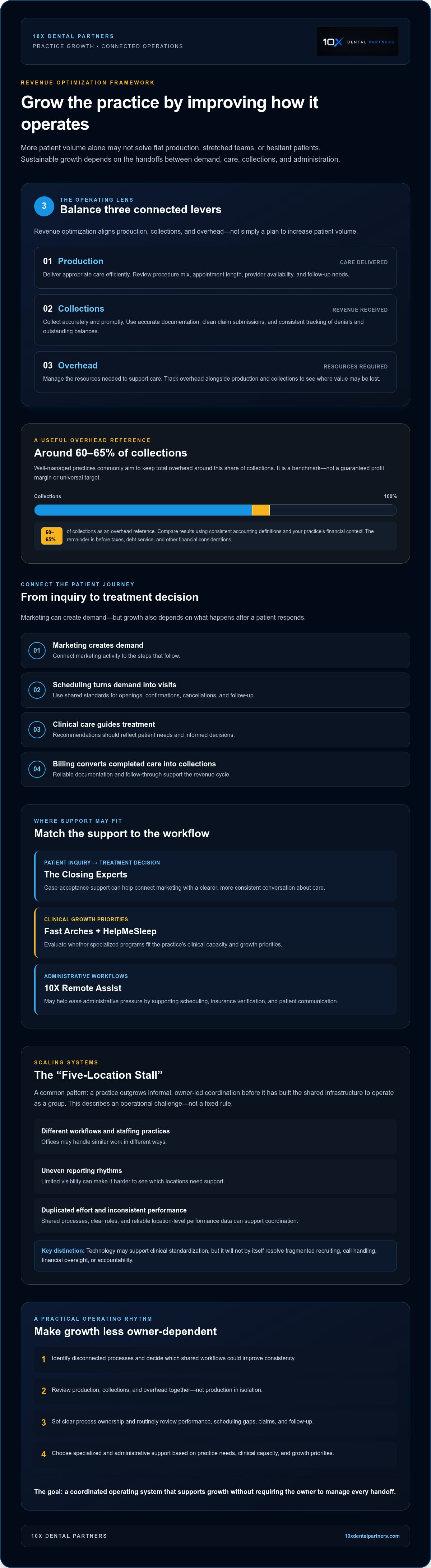
More patients don’t automatically create a healthier practice. If added volume strains the team, leaves claims unresolved, or increases operating costs faster than collections, production can rise while profitability stalls. Dental practice revenue optimization means aligning three operating levers: production, collections, and overhead. The aim is to deliver appropriate care efficiently, collect accurately and promptly, and manage the resources required to support that care.
This is practice management viewed through a financial lens. A high-level overview of practice management includes the administration of an office, from finance and staffing to marketing. In a dental practice, these functions need to work together. Marketing creates demand, scheduling turns demand into visits, clinical care determines appropriate treatment, and billing converts completed care into collections.
Rising operating costs can make informal, owner-dependent habits harder to sustain as a practice grows. A sound operating model establishes clear processes and ownership, then reviews performance routinely. Growth should not depend on the owner personally stepping in to resolve every scheduling gap or outstanding claim.
The Production-Collection-Overhead Triad
Increasing production alone can mean longer days, greater team strain, and more administrative work without a corresponding increase in profit. Track production alongside collections and overhead, then look for where value is lost between care delivered and revenue received. Accurate documentation, clean claim submissions, and a consistent process for tracking denials and outstanding balances can support a more dependable revenue cycle.
As an operating reference, well-managed practices commonly aim to keep total overhead around 60–65% of collections, leaving the remainder before taxes, debt service, and other financial considerations. This is an overhead benchmark, not a guaranteed profit margin or universal target. Compare results using consistent accounting definitions and your practice’s own financial context.
Value-Based Scheduling vs. High-Volume Hustle
Build the schedule around appropriate care and available clinical capacity, not a blanket push to fit in more appointments. Review procedure mix, appointment length, provider availability, and follow-up needs. Protected time for planned, higher-production procedures can support a better-designed schedule, provided recommendations remain grounded in each patient’s needs and informed decisions.
Shared scheduling standards can help teams coordinate openings, confirmations, cancellations, and follow-up across providers or locations. They make gaps visible sooner and give staff a defined process for filling them, rather than relying on last-minute improvisation. The patient experience is part of the operating model too. Clear communication and reliable follow-through can support trust and continued care over time, contributing to long-term patient value without treating patients as production targets.
The DSO Infrastructure Gap: Why Scaling Practices Hit a Revenue Ceiling
Adding locations can expand reach, but it also multiplies decisions, handoffs, and opportunities for inconsistency. The “Five-Location Stall” describes a common operational pattern: a practice grows beyond what informal, owner-led coordination can reliably manage but has not yet built the infrastructure to operate as a group. Offices may use different workflows, staffing practices, and reporting rhythms. The result can be duplicated effort, uneven performance, and limited visibility into which locations need support.
This is a systems problem, not simply a software problem. Diagnostic technology may support clinical standardization, but it won’t resolve fragmented recruiting, call handling, financial oversight, or accountability. The American Dental Association’s resources on successful dental practice management underscore the breadth of practice operations. For multi-location groups, the next step is to create shared processes while preserving the clinical leadership and local context each office needs.
Centralized infrastructure can also support long-term business value. Consistent reporting, documented processes, clear roles, and reliable location-level performance data help owners understand operations and prepare for potential transition or expansion. They don’t guarantee a particular sale outcome, but they can make the business less dependent on undocumented knowledge held by one person. For a deeper framework, see DSO Infrastructure Development: The Blueprint for Scaling Dental Groups in 2026.
Centralizing the Administrative Engine
Review which responsibilities need to happen locally and which could follow shared group-wide standards. Centralized call handling or billing workflows may reduce duplicated site-level effort, but only when ownership, escalation paths, and performance measures are clear. A coordinated growth platform connects operational planning with recruiting, marketing, and revenue optimization, helping leaders spot gaps across locations instead of managing each office in isolation. Track the effect on overhead and EBITDA rather than assuming centralization automatically saves money.
Talent Acquisition as a Revenue Driver
Recruiting capable clinicians can expand a group’s capacity to deliver care, but hiring alone won’t unlock production. Set clear expectations, support effective onboarding, and build a workplace where clinical teams can succeed. Retention matters too: frequent turnover disrupts continuity and requires repeated recruiting and training effort.
Multi-location leaders should assess staffing needs, hiring processes, and retention practices together. Build repeatable infrastructure before complexity overwhelms the team. Practices evaluating how consulting, recruiting, and multi-location growth fit together can explore 10X Dental Partners’ growth support as one potential resource.
Specialized Clinical Programs: Scaling with Fast Arches and Sleep Medicine
Once core operations are stable, specialized clinical-business programs can add a focused growth opportunity. They aren’t automatic profit engines: results depend on clinical capacity, patient fit, case acceptance, scheduling, and the costs of delivering care. The opportunity is to build a repeatable pathway around a service area rather than treating every high-value case as a one-off. That’s where dental practice revenue optimization goes beyond filling the schedule and aligns demand with the systems needed to support it.
The Fast Arches Advantage for Full-Arch Implants
Full-arch implant treatment calls for coordination across patient education, case presentation, scheduling, and follow-up. Fast Arches gives practices a specialized business pathway to consider, while treating clinicians remain responsible for diagnosis and care. To understand where a pipeline needs attention, track each stage: qualified inquiries, consultations scheduled, treatment plans presented, patient decisions, and cases scheduled. This can show whether the constraint is lead flow, appointment availability, or the handoff after consultation.
Marketing and case acceptance need to work together. 10X Dental Marketing can support demand generation, while The Closing Experts can support the process for discussing treatment plans and following up with patients. The objective isn’t to pressure patients. It’s to ensure they understand their options and have a clear opportunity to make an informed decision. Measure conversion alongside patient experience and clinical capacity before expanding volume.
Implementing HelpMeSleep for a Broader Care Mix
HelpMeSleep is a specialized program for practices considering dental sleep medicine as an additional service line. Before launching, define clinical oversight, team responsibilities, patient screening and referral workflows, documentation, scheduling, and billing processes. For oral appliance therapy, E0486 is often used for medical billing, and G47.33 is the ICD-10 code for obstructive sleep apnea. Practices should confirm documentation and payer requirements for each case.
Sleep medicine may diversify a practice’s mix beyond standard PPO dentistry, but it shouldn’t be treated as guaranteed recurring revenue. Establish the workflow first, then monitor referrals, completed evaluations, treatment acceptance, collections, and the time required from staff. Clear communication matters: patients should understand how the practice coordinates care and what follow-up involves.
These programs can offer a focused growth opportunity when the practice has the clinical capability and operating infrastructure to deliver them well. Compare performance using contribution after relevant labor and operating costs, not production alone. That discipline helps owners decide whether to refine, expand, or pause a program based on evidence rather than expectation.
Operational Efficiency: The Role of 10X Remote Assist in Revenue Growth
Administrative friction can quietly limit growth. Calls that go unanswered, appointments that aren’t confirmed, and insurance details checked too late can add work for the in-office team and disrupt the patient journey. Virtual staffing offers a way to assign repeatable administrative workflows beyond the physical front desk while keeping responsibilities and escalation paths clear.
10X Remote Assist is 10X Dental Partners’ virtual staffing solution for dental practices. Its support can include appointment scheduling, insurance verification, and patient communication. The aim isn’t to remove the human element. It’s to give the team a consistent way to handle administrative work, so in-office staff can focus on patients and needs that require an in-person response.
Outsourcing the Administrative Burden
Start by mapping where work stalls: incoming inquiries, appointment changes, incomplete insurance information, or follow-up that competes with front-desk demands. Then define which tasks can be handled virtually, what information staff need to document, and when an issue should be escalated to the practice. Don’t assume remote support means 24/7 coverage or perfect verification. Confirm service scope, workflows, and quality checks before implementation.
Assess the business case using your own operating data. Compare staffing and service costs with measurable changes in response times, completed scheduling tasks, verification issues, and in-office capacity. A claim that virtual staffing reduces overhead by a fixed percentage shouldn’t substitute for this analysis. Track the results, refine the handoffs, and make sure patient communication remains timely and clear. For a deeper look at planning these workflows, read the Virtual Staffing for Dental Offices: 2026 Strategic Guide.
Case Acceptance and The Closing Experts
Administrative follow-up and treatment-plan conversations serve different purposes. A virtual assistant can help maintain communication and coordinate next steps, while The Closing Experts can support case acceptance through professional follow-up on unscheduled treatment. A respectful, consistent process gives patients room to ask questions and consider their options without turning every interaction into a sales pitch.
10X Remote Assist can help connect an inquiry with a scheduled appointment by supporting the administrative follow-through along the way.
For dental practice revenue optimization, connect these roles rather than treating them as separate fixes: marketing generates interest, operational support helps manage the response, and case-acceptance support follows up on treatment decisions. Explore 10X Remote Assist for dental practices as part of a staffing plan built around your workflows and capacity.
Executing Your 2026 Revenue Optimization Strategy
Growth becomes more manageable when marketing, staffing, case acceptance, and financial oversight operate as a connected platform instead of a collection of separate fixes. Dental practice revenue optimization means finding the constraint that matters most, building the infrastructure to address it, and measuring whether the change improves practice performance. Start with a clear baseline, then introduce improvements in a deliberate sequence.
10X Dental Partners works across growth consulting, recruiting, virtual staffing, marketing, specialized programs, and DSO infrastructure development. For practice owners, that range of services can support planning around how people, processes, and growth initiatives fit together. The executive guide to dental practice growth consulting offers a related perspective on building beyond the solo-practitioner model.
Conducting a Comprehensive Revenue Audit
Before adding another tool or program, examine how revenue moves through the practice. Compare scheduled production with completed care and collections. Review claim delays, denials, outstanding balances, appointment gaps, cancellations, and follow-up for unscheduled treatment. For each issue, identify its likely cause, who owns the next step, and how progress will be tracked.
Use benchmarks carefully. Rather than assuming an unsupported “top 1%” target applies to your practice, compare results with reliable, relevant sources and your own historical performance. Prioritize changes by likely operational impact, implementation effort, and effect on patient experience. A fix for a recurring billing or scheduling bottleneck may deserve attention before a larger expansion the team isn’t ready to support.
Partnering for Sustainable Scale
Move from audit to infrastructure, then to specialized programs. First, standardize the workflows and reporting needed to operate consistently. Next, address capability gaps through appropriate staffing, recruiting, consulting, or marketing support. Then assess whether Fast Arches or HelpMeSleep fits the practice’s clinical capacity, patient needs, and operational readiness. A solo practice considering multi-location growth can build toward DSO infrastructure in stages, with defined responsibilities and repeatable processes.
Connect the parts, assign ownership, and refine the system as the business grows. Explore growth infrastructure with 10X Dental Partners to consider how its growth consulting, DSO and multi-location growth, virtual staffing, and specialized programs may align with your priorities.
Build a Practice That Can Grow Beyond You
Sustainable growth comes from connecting the systems behind production, collections, staffing, and patient follow-through. That’s the core of dental practice revenue optimization: strengthen the operating foundation, then expand with initiatives your team can support.
Specialized programs such as Fast Arches and HelpMeSleep can create focused growth pathways, while 10X Remote Assist can help address administrative workload through virtual staffing. For owners planning to grow across locations, DSO infrastructure consulting can help turn individual processes into a more coordinated operating model.
These pieces work best as a connected strategy, not a stack of disconnected fixes. 10X Dental Partners brings growth consulting, specialized programs, virtual staffing, and DSO expertise together for practice owners planning their next stage. Explore growth support with 10X Dental Partners and take the next step toward a more structured growth platform. Begin with the operational needs and priorities that matter most to your practice.
Frequently Asked Questions
What is the most effective way to increase dental practice revenue?
Start by finding where revenue is being lost between patient inquiry, scheduling, completed care, and collection. Review production, collections, overhead, appointment gaps, and follow-up before investing in more demand. Then prioritize the operational constraint with the clearest path to improvement. Dental practice revenue optimization works best as a coordinated system: marketing, scheduling, case acceptance, and administrative workflows should support growth the team can deliver.
How does virtual staffing like 10X Remote Assist impact practice overhead?
Virtual staffing can shift selected administrative work, such as scheduling, patient communication, and insurance verification, away from the in-office team. Whether this reduces overhead depends on the practice’s staffing needs, service scope, and implementation costs. Compare those costs with changes in workload, task completion, scheduling performance, and the time in-office staff can devote to patient-facing responsibilities. Don’t assume a fixed savings percentage; evaluate results against your own baseline.
What is the average case acceptance rate for full-arch implants using professional closers?
There isn’t a single verified average that applies across practices, patient populations, and full-arch treatment plans. A professional follow-up process can help patients get answers and understand next steps, but it can’t guarantee acceptance. Measure your own rate by dividing accepted treatment plans by the number presented during a defined period. Track full-arch cases separately, and compare results by lead source, consultation stage, and follow-up process.
Can a solo practice implement DSO-level infrastructure without multiple locations?
Yes. A solo practice can adopt useful DSO-style disciplines without building a multi-location organization. Document repeatable workflows, assign clear ownership for administrative tasks, and review consistent measures for production, collections, and overhead. Centralize or outsource selected tasks only when it makes operational sense. These foundations can reduce dependence on the owner for every decision and provide a more orderly base if the practice later considers expansion.
How much does dental practice revenue optimization typically cost?
There’s no single typical cost because the work can involve different combinations of growth consulting, marketing, recruiting, virtual staffing, call center services, or DSO infrastructure development. Pricing depends on the services and scope a practice needs. Before engaging a provider, request a written scope, pricing, responsibilities, and measurement plan so you can assess fit against your priorities and budget.
What are the most important KPIs to track for dental practice growth?
Start with a focused dashboard: production, collections, total overhead as a share of collections, appointment utilization, cancellations, outstanding claims, and follow-up on unscheduled treatment. For specialized programs, track the patient journey from inquiry to consultation, treatment decision, and completed care. Define each measure consistently and review it over comparable periods. Multi-location groups should also compare locations using the same definitions while interpreting differences in clinical mix and operating context.
How do specialized programs like Fast Arches differ from standard implant marketing?
Standard implant marketing generally focuses on generating interest in implant services. Fast Arches is a specialized clinical-business program associated with full-arch implant growth, so the strategy extends beyond promotion to how the practice coordinates inquiry follow-up, consultations, case acceptance, scheduling, and operational capacity. The program doesn’t replace clinical judgment or patient-specific treatment planning. Practices should assess whether their team and workflows can support the patient experience behind the marketing.
Is it better to hire more in-office staff or use virtual staffing for growth?
Choose based on the work, not a blanket preference for one staffing model. In-office team members are essential for responsibilities requiring physical presence and direct patient interaction. Virtual staffing may suit defined administrative workflows such as scheduling, patient communication, or insurance verification. Map task volume, response needs, handoffs, and costs first. Some practices may combine both models, with clear ownership and escalation procedures to keep service consistent.


