
Centralized Dental Call Center: How to Compare Models in 2026

The best centralized dental call center may not be fully centralized. For a growing group, standardizing repeatable calls can improve consistency across locations, while clear escalation paths preserve the local knowledge patients still need. The challenge is to centralize work without making every interaction feel scripted.
If locations handle calls differently, coverage is difficult to match with demand, or follow-up disappears from view, the current setup may not scale. Centralization only helps when the operating model supports reliable workflows and personal patient communication.
This guide compares in-house, outsourced, and AI-supported call center models using the criteria that matter to a multi-location dental group. You’ll learn how to assess staffing coverage, workflow fit, ownership, escalation, quality standards, and visibility into calls and appointment outcomes. Use these criteria to choose a model that fits your group’s operating needs, then build a system that connects call handling with the broader patient experience.
Key Takeaways
- A centralized dental call center can bring shared workflows across locations while keeping local context available through clear ownership and escalation.
- Compare in-house, outsourced, AI-supported, and hybrid models by control, staffing needs, scalability, patient experience, and oversight.
- Protect the patient experience by defining handoffs, decision authority, and escalation routes before centralizing calls.
- Use a measured rollout: map call patterns, standardize workflows, pilot with selected locations, then test and refine against baseline measures.
- Evaluate potential partners on scope, training, technology fit, reporting, governance, and how they handle real dental workflows and exceptions.
What a centralized dental call center changes for a growing group
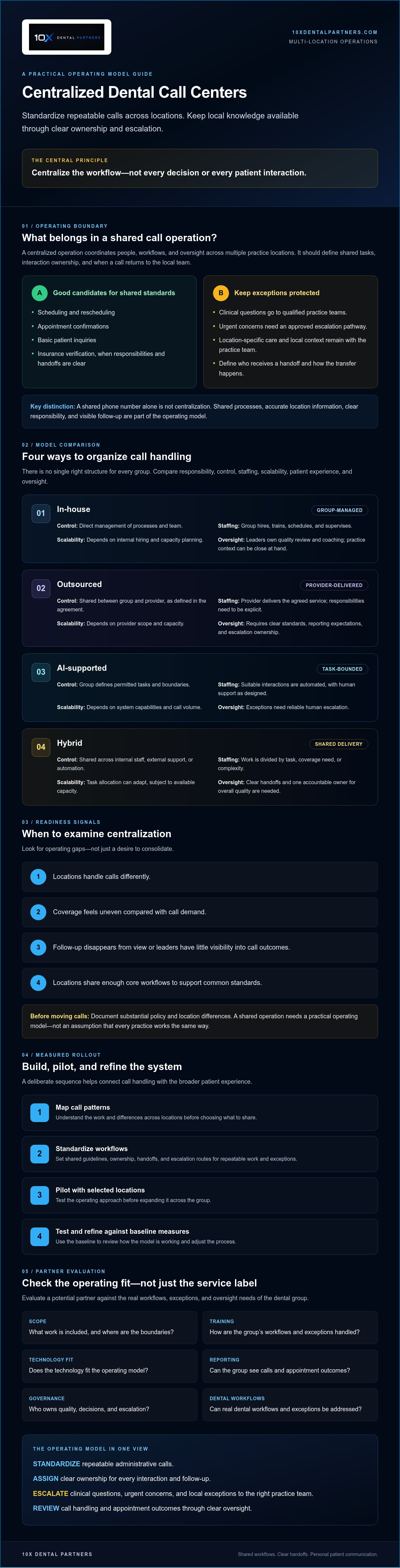
A centralized dental call center is a shared operation that handles calls for multiple practice locations through coordinated people, workflows, and oversight. It gives a group a consistent way to manage routine requests and helps leaders see how calls are handled and what follow-up remains outstanding.
That’s more than routing every location’s calls to one phone number. A shared number without agreed processes, clear responsibility, and accurate location information can simply move confusion to a new place. Centralization means deciding which tasks follow group-wide standards, who owns each interaction, and when a call should return to the local team. The broader call center model provides a useful foundation, but dental groups need to shape it around their patient communication and operating workflows.
Keep the boundary clear: call handlers can coordinate administrative requests, but clinical decisions and location-specific care remain with qualified practice teams. A centralized operation should make that handoff clear, not replace it.
Which call workflows are suitable for centralization?
Start with repeatable administrative work, such as scheduling, appointment confirmations, rescheduling, and basic patient inquiries. These workflows are good candidates when locations can follow shared guidelines without losing the details needed to serve each patient appropriately.
Insurance verification may also be suitable when responsibilities, required information, and handoffs are clearly defined. Clinical questions and urgent concerns need approved escalation pathways, including a clear recipient and transfer process. Standardize routine work, and protect the exceptions.
When does a dental group need a shared call operation?
Look for operational signals, not just a desire to consolidate. Calls may be handled differently by location, coverage may feel uneven, or group leaders may have little visibility into call outcomes and follow-up. These are reasons to examine whether shared processes could address the underlying gaps.
Centralization is most workable when locations share enough core workflows to support common standards while retaining a defined way to handle local differences. If policies vary substantially, document those variations before moving calls. A shared operation needs a practical operating model, not an assumption that every practice works the same way.
For broader context on building the systems that support multi-location growth, see the DSO infrastructure development blueprint. It can help frame call handling as part of a wider operating structure, rather than a standalone phone-routing project.
Compare in-house, outsourced, AI-supported, and hybrid call center models
There isn’t one right structure for every group. A centralized dental call center should match the work you need handled, the level of control you require, and how patients move between centralized support and local teams. Compare how each model assigns responsibility, not just where calls are answered.
| Model | Control | Staffing | Scalability | Patient experience and oversight |
|---|---|---|---|---|
| In-house | Direct management of processes and team | Group hires, trains, schedules, and supervises staff | Depends on internal hiring and capacity planning | Practice-specific context can be close at hand; leaders own quality review and coaching |
| Outsourced | Shared between the group and provider, as defined in the agreement | Provider delivers the agreed service; responsibilities need to be explicit | Depends on provider scope and capacity | Requires clear standards, reporting expectations, and escalation ownership |
| AI-supported | Group defines permitted tasks and boundaries | Automated handling for suitable interactions, with human support as designed | Depends on the system’s capabilities and call volume | Routine interactions may be automated; exceptions need reliable human escalation |
| Hybrid | Shared across internal staff, external support, or automation | Work is divided by task, coverage need, or complexity | Can adapt by adjusting task allocation, subject to available capacity | Needs clear handoffs and one accountable owner for overall quality |
How do centralized in-house and outsourced teams differ?
With an in-house team, the group controls reporting lines, training, process updates, and scheduling, but must also manage hiring and ongoing supervision. Outsourced support shifts call delivery to an external provider; it doesn’t remove the group’s responsibility to set standards and monitor results. Define who trains staff, approves workflow changes, handles exceptions, schedules coverage, and answers for call quality. Confirm the actual scope rather than assuming a provider includes particular tasks or staffing arrangements.
Where can AI and hybrid call handling fit?
AI may suit repeatable interactions with defined steps, such as straightforward scheduling requests, but not every call follows a fixed path. Test how a solution recognizes an exception, transfers the caller, and passes useful context to a person. Hybrid models can reserve human support for nuanced requests, but only if staff know when to take over and who owns the resolution. AADOM’s guidance on creating an exceptional patient experience reinforces why the first call and follow-up deserve deliberate attention.
For related staffing considerations, review this virtual staffing guide for dental offices. Groups assessing external call center support can also explore dental call center services as an option to evaluate against their workflows and oversight requirements.
Will centralization weaken the patient experience? Design safeguards first
It can, if central handlers lack the context or authority to resolve a caller’s request. A patient may have to repeat information, receive an answer that doesn’t reflect a location’s process, or be transferred without a clear next step. Shared handling can also create consistency, but only when workflows make ownership and handoffs explicit.
Build safeguards before shifting call responsibility. Give the central team accurate location profiles, current provider schedules, available services, and routing rules. Define when a caller should be connected to a specific practice team or clinician, and what information should accompany the transfer. Use approved scripts as a foundation, not a substitute for listening. Consistent language should guide the interaction without forcing identical responses to different patient situations.
How can a central team preserve local practice context?
Assign an owner to maintain each location’s information and a process for notifying the central team when details change. Document which requests can be resolved centrally, which require local input, and what triggers escalation. For example, a routine scheduling request may follow a shared process, while a question that depends on a provider’s judgment should reach the appropriate practice team. Make the boundary clear to both the caller and the handler.
What quality controls should leaders put in place?
Set a practical quality framework before launch. Specify who reviews calls, coaches staff, handles complaints, and tracks unresolved issues through to resolution. If calls are recorded or patient information is shared across teams or systems, confirm consent practices, access controls, and retention procedures with qualified compliance advisers. HIPAA and other patient information safeguards are requirements to verify with compliance counsel, not assumptions to make based on a vendor’s assurances.
Measure more than call volume. Pair operational indicators, such as abandoned calls, transfers, and completed follow-up, with patient feedback and complaint themes. Review patterns by location and call type to identify whether an issue comes from the shared workflow, a local variation, or an unclear handoff. Use findings to update scripts, routing rules, and training, then communicate changes to everyone responsible for the process.
A centralized dental call center doesn’t need to make service feel less personal. It needs to make the patient’s next step clear, preserve relevant context, and give every interaction an accountable owner. When those safeguards are part of daily operations, standardization can support a dependable experience without erasing local differences.
How to assess readiness and roll out a centralized dental call center
A centralized dental call center rollout works best as a controlled operating change, not a switch flipped across every location at once. Establish what happens today, define how the shared model should work, and use a pilot to find gaps before expanding.
- Map current calls. Document call categories, volume patterns, existing systems, local variations, and who handles each type of request.
- Standardize workflows. Set common steps for routine calls, define exceptions, and identify where locations need different instructions.
- Select a representative pilot. Choose locations and workflows that reflect the group’s real operating conditions, including meaningful differences in processes.
- Test the operation. Walk through routine requests, exceptions, transfers, and downtime procedures with the people responsible for handling them.
- Refine before expanding. Review baseline and pilot results, resolve ownership or workflow gaps, then determine whether the model is ready for more locations.
Assign accountable owners for training, escalation, system access, and ongoing process improvement. A rollout needs named decision-makers, not just a shared call queue.
What should a dental group measure?
Set a baseline before implementation, then define each measure consistently so location comparisons are useful. For every metric, document its calculation, denominator, exclusions, data source, reporting cadence, and owner.
- Answered-call rate: Calls answered divided by eligible inbound calls, with rules for excluded calls and transfers.
- Abandonment: Calls ended by the caller before an answer, using an agreed threshold and excluding defined routing cases.
- Response time: Time from the group’s defined starting point to answer or callback, sourced from phone records or a tracked callback log.
- Appointment outcomes: Requests that result in booked, rescheduled, or unresolved appointments, checked against scheduling records.
- Patient feedback: Call-related comments, survey responses, or complaints, categorized and reviewed by an assigned owner.
Choose measures that reflect operational priorities, such as access, completed scheduling, or follow-up. Use them to identify issues and guide decisions, not to assume a particular result.
How should a group prepare for a pilot?
Before launch, document call categories, current systems, location-specific rules, and escalation contacts. Test how staff handle an ordinary scheduling request, an exception requiring local input, a transfer with context, and a system outage. Record issues and assign owners to resolve them before expanding. For a broader view of how growth stage can shape rollout planning, see this roadmap for scaling to five dental locations.
Building a rollout plan for your group? Explore dental call center services as an option to evaluate against your workflows, ownership structure, and readiness measures.
Choose a call center partner that fits your dental group’s operating model
A provider should fit the workflows and accountability structure you’ve defined, not force your group into an assumed model. Before comparing proposals, decide whether you need technology, virtual staffing, call center services, or a combination. These solve different operational needs. A platform may provide tools without supplying staff; a service provider may handle calls within an agreed scope. Confirm precisely what’s included.
Use this checklist to structure the evaluation:
- Scope: Which calls and administrative tasks are included, excluded, or escalated? Ask for the boundaries in writing.
- Staffing and training: Who provides the team, trains them on your workflows, supervises their work, and communicates process changes?
- Technology fit: What systems or access does the provider require? Verify any proposed integrations and technical capabilities rather than assuming compatibility.
- Reporting: What call and outcome information will be available, how is it defined, and who reviews it with your group?
- Escalation and governance: Who handles exceptions, complaints, and unresolved requests? Identify decision-makers on both sides.
- Transition: Who owns setup, workflow documentation, staff preparation, and communication with each location?
Ask candidates to demonstrate actual dental workflows, not just deliver a general presentation. Walk through a routine scheduling request, a location-specific exception, and a call that must be escalated. Check whether the proposed process captures context, routes the issue appropriately, and makes follow-up responsibility clear. Request references or examples relevant to comparable dental workflows, and ask what each example does and does not demonstrate.
Questions to ask before selecting a provider
Ask how the provider trains and supervises its team, what access it needs, how it reports activity, and who is accountable for quality. Clarify how changes to scripts or routing rules are approved and communicated. Confirm transition responsibilities and escalation contacts before signing, so important work doesn’t fall between your group and the provider.
How 10X Dental Partners may fit the evaluation
Once you’ve established your criteria, compare them with the support available from 10X Dental Partners. Its call center services are an option for groups evaluating external call handling. 10X Remote Assist supports scheduling, patient communication, and insurance verification. The Closing Experts is a distinct offering focused on patient experience and case acceptance. Confirm current scope, staffing, technology fit, reporting, and implementation responsibilities directly.
If your group is assessing call handling alongside its broader growth infrastructure, discuss call center and virtual staffing support with 10X Dental Partners. Use the conversation to assess fit against your workflows, oversight needs, and defined escalation standards.
Build a call operation that can grow with your group
The right centralized dental call center isn’t defined by whether it’s in-house, outsourced, AI-supported, or hybrid. It’s the model that fits your workflows, gives every call a clear owner, and preserves a dependable path to local expertise when a patient needs it.
Start with the operational basics: standardize repeatable work, document escalation rules, and establish baseline measures before a pilot. Then compare providers on scope, staffing, training, reporting, technology fit, and accountability. A careful rollout lets your group test how the system works before expanding it across locations.
Call handling also connects to broader growth operations. 10X Dental Partners offers call center services as part of a wider dental growth and operational support platform. 10X Remote Assist supports scheduling, patient communication, and insurance verification. Fit depends on your group’s needs and the specific scope confirmed with a provider.
Discuss call center and virtual staffing support with 10X Dental Partners to explore how those options align with your operating model. With clear standards and accountable ownership, your group can build a more coordinated call operation while keeping patient communication personal.
Frequently Asked Questions
What is a centralized dental call center?
A centralized dental call center is a shared operation that handles calls for multiple practice locations using coordinated workflows and clear ownership. It may be managed in-house, delivered by an external provider, supported by AI, or built as a hybrid. Centralization is more than routing calls to one number: it also requires agreed processes for routine requests, location-specific information, follow-up, and escalation to the appropriate practice team.
Should a dental group centralize its call center?
A group should consider centralization if locations handle similar calls inconsistently, have uneven coverage, or lack shared visibility into call outcomes. The model is more practical when common workflows can be established without erasing important local differences. Map call types and responsibilities first. If locations have substantially different processes, document those variations before deciding whether to centralize all calls or begin with a smaller set of repeatable tasks.
What is the difference between an in-house and outsourced dental call center?
An in-house team is hired and directly managed by the dental group, which controls its training, supervision, scheduling, and process changes. An outsourced call center is operated by an external provider under an agreed scope. The group still needs to set standards, define escalation paths, and review performance. Compare who owns training, exceptions, reporting, and call quality rather than assuming either model includes a particular staffing level or capability.
Can AI handle calls for a dental practice?
AI can be considered for routine interactions with clear, repeatable steps, such as straightforward scheduling requests or reminders. It may not be suitable for every caller or situation, especially when a request needs judgment, local knowledge, or a nuanced conversation. Before adopting it, test typical calls and exceptions. Confirm how callers reach a person, what context transfers with them, and who owns follow-up when automation cannot resolve the request.
How do you measure whether a dental call center is working?
Track operational measures alongside appointment outcomes and patient feedback. Useful indicators include answered-call rate, abandonment, response time, completed scheduling requests, unresolved follow-up, and call-related complaints. Define each metric, its denominator, exclusions, data source, reporting cadence, and owner before comparing locations. Establish a baseline before implementation, then review results against the group’s priorities. Measures help identify where workflows need attention, but they don’t guarantee a particular outcome.
How do dental groups protect patient experience when calls are centralized?
Give the central team accurate location profiles, current routing rules, and clear authority for resolving routine requests. Specify when a caller should be transferred to a local practice team or clinician, and what information should accompany the handoff. Use shared scripts as guidance, not rigid responses for every situation. Assign owners for call review, coaching, complaints, and follow-up, and verify patient information handling practices with qualified compliance advisers.
What should a dental group ask a call center provider?
Ask which calls and administrative tasks are included, excluded, or escalated, and who supplies, trains, and supervises the staff. Confirm required system access, reporting details, transition responsibilities, and ownership of exceptions and call quality. Request a demonstration using your actual dental workflows, including a routine call and a scenario that needs local input. Ask for relevant references or examples, and verify current capabilities rather than relying on assumptions.


