
Scaling a Dental Practice to 5 Locations: A 2026 Roadmap

Five locations don’t create scale by themselves. Without shared systems, every new office can add staffing, communication, and workflow complexity, while routine decisions still depend on the owner. That’s the central challenge of scaling dental practice to 5 locations: building the capacity to operate consistently without weakening local clinical leadership.
If you’re considering another location, ask whether centralization will improve consistency or create a new bottleneck. The answer depends on what your current offices can manage reliably, where responsibilities still rely on individual workarounds, and who has the authority to resolve routine issues.
This roadmap will help you assess readiness before committing to expansion, build a repeatable operating model, and decide which functions belong at the group level and which should remain local. It covers the core stages of growth, from strengthening systems and clarifying leadership roles to adding support for recruiting, patient communication, and revenue operations as needs evolve. The goal is a five-location organization that runs on reliable infrastructure, not constant owner intervention.
Key Takeaways
- Measure whether your current offices can operate consistently without the owner resolving routine issues before committing to another location.
- Approach scaling dental practice to 5 locations as a staged build: assess the foundation, design the operating model, then expand against clear readiness gates.
- Identify workflows that could benefit from shared support while keeping clinical judgment and patient care decisions close to each office.
- Use a readiness scorecard across leadership, staffing, processes, technology, and financial visibility to find the weakest point in your expansion plan.
- Prioritize infrastructure gaps, assign accountable owners, and choose support based on the group’s needs rather than centralizing for its own sake.
Scaling a Dental Practice to 5 Locations Starts With an Operating-Model Shift
Opening another office adds capacity. Scaling means the group can maintain reliable performance as locations, teams, and decisions multiply. In business terms, scalability is the ability to grow without a matching increase in operational strain. For a dental group, that depends on repeatable systems and clear accountability, not just a shared name or ownership structure.
Definition: Scaling a dental practice to five locations means building consistent operating systems and accountable local leadership, with clear decision rights that preserve clinical leadership at each office.
A growing group practice and a fully developed DSO operating model aren’t the same thing. A group can own or operate multiple offices and still rely on the owner to fill staffing gaps, approve routine decisions, and connect teams informally. A more developed model defines management responsibilities, shared processes, reporting rhythms, and the boundaries between group-level support and site-level leadership. Five locations don’t automatically make a group a DSO. The operating structure matters.
What changes when a dental group approaches five locations?
At one or two offices, the owner may be able to keep decisions moving through direct conversations. As the group grows, that approach can turn the owner into a decision queue: local leaders wait for approvals, and the owner loses time for strategic work. Informal updates also become less dependable across sites. A process that lives in one manager’s memory won’t reliably transfer to a new team.
Consistency requires defined workflows and named owners. For example, each office should know how patient inquiries are handled, who follows up on unresolved issues, and which decisions a site leader can make independently. The goal isn’t identical care decisions. It’s a dependable patient experience supported by clear, repeatable operational processes.
Is five locations the right target for every dental group?
No. Treat five as a planning milestone, not a universal measure of success. The right pace depends on whether leadership can support another site, recruiting can meet staffing needs, demand supports expansion, and current processes work without constant owner intervention.
Separate ambition from evidence. Before expanding, look for a model that works across existing offices, leaders who can own local execution, and enough visibility to spot problems early. If performance depends on the owner personally bridging gaps, strengthen the operating model before adding another location. Expansion should follow repeatability, not substitute for it.
Build the Five-Location Roadmap in Stages, Not One Opening at a Time
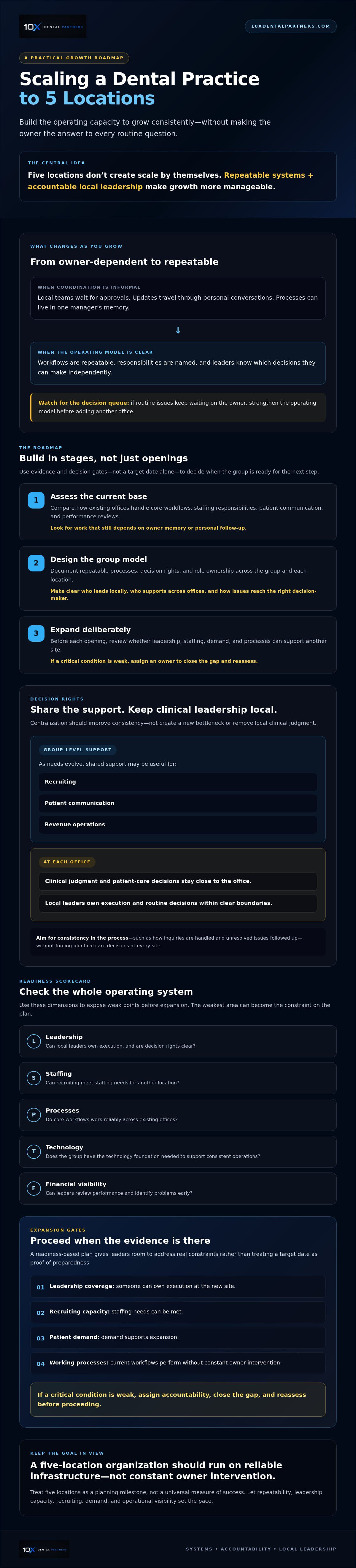
A five-location plan needs decision gates, not just a sequence of leases or acquisitions. Define the operating conditions each new office must meet before authorizing the next step. That keeps expansion tied to leadership coverage, recruiting capacity, patient demand, and workflows that work in practice, rather than an arbitrary calendar.
Use this sequence to build the roadmap:
- Assess the current base. Compare how existing offices handle core workflows, staffing responsibilities, patient communication, and performance reviews. Note where execution depends on the owner’s memory or personal follow-up.
- Design the group model. Document repeatable processes, decision rights, and role ownership. Define who leads each location, who supports the group across offices, and how issues reach the right decision-maker.
- Expand deliberately. Before each opening, review evidence that leadership, staffing, demand, and processes can support another site. If a critical condition is weak, assign an owner to close the gap and reassess before proceeding.
This sequence may take different amounts of time for different groups. A fixed expansion schedule can push a team forward before it has the capacity to support another office. A readiness-based plan gives leaders room to address actual constraints instead of treating a target date as proof of preparedness. For a deeper look at the systems behind this work, see the DSO infrastructure development blueprint.
From one or two offices to a repeatable group model
Start by turning informal knowledge into usable operating documents. Record who handles hiring steps, schedule questions, patient follow-up, and routine escalations. Then identify which roles need clear coverage across existing and planned offices. The right structure depends on the group, but each responsibility should have an accountable owner and a defined backup. This reduces reliance on memory and makes the model easier to test before adding another location.
From three locations toward five: use explicit expansion gates
At three locations, evaluate readiness conditions together, not in isolation. A recruiting pipeline may look active, for example, but still leave site leaders stretched or administrative work unresolved. Check whether agreed processes are followed consistently and whether leaders can raise problems with enough context for the group to act.
For each readiness condition, record the evidence required, the accountable owner, and the review cadence. That could mean reviewing staffing plans during leadership meetings and confirming process adoption before approving an opening. The gate isn’t paperwork. It’s a shared decision rule that makes expansion deliberate and keeps responsibility visible.
If your group needs help assessing infrastructure gaps, dental growth consulting may be one option as you shape the roadmap.
Centralize Shared Operations Without Removing Local Clinical Leadership
Centralization should create consistency, not take clinical judgment away from the people responsible for care. As you consider scaling dental practice to 5 locations, distinguish administrative standards from clinical decisions. Shared teams can support repeatable workflows, while site leaders remain accountable for local execution and clinical leadership.
There’s no single structure every group should adopt. Choose shared support where it improves consistency and capacity without slowing decisions that need a local response. Keep ownership close to the office when context, timeliness, or clinical judgment matters.
Which dental practice functions can be shared across locations?
Review each administrative workflow for variation, workload, and handoff friction. Scheduling, patient communication, insurance verification, recruiting coordination, and performance reporting may be candidates for shared support if the process can be defined and monitored. For example, centralized reporting can give leaders a consistent view across offices, while local managers explain the context behind the numbers.
Virtual support is one possible part of an operating model, not a requirement. 10X Remote Assist supports scheduling, patient communication, and insurance verification. Whether it fits depends on the group’s workflows, capacity, and accountability needs.
| Function | Shared support can own | Site-level ownership should retain |
|---|---|---|
| Scheduling | Consistent processes and routine coordination | Local adjustments and timely resolution of office-specific issues |
| Patient communication | Defined communication workflows and follow-up processes | Context-sensitive responses and local patient experience |
| Insurance verification | Standardized administrative steps and handoffs | Escalation of exceptions to the appropriate office leader |
| Recruiting | Shared coordination and visibility into hiring needs | Local input on team fit and site requirements |
| Reporting | Consistent measures and group-wide visibility | Interpretation of local conditions and action at the office |
| Care delivery | Not an administrative function to centralize | Clinical judgment and care decisions remain with the appropriate clinical leaders |
How should location leaders retain ownership?
Give each site leader clear accountability for team execution, operational standards, and the patient experience at that office. Group-wide processes should define consistent execution, but they shouldn’t replace local clinical judgment or require approval for every routine issue.
Make escalation paths explicit. Identify which decisions a local leader can resolve, which require group-level support, and which belong to clinical leadership. Review exceptions and recurring delays to see whether the process needs refinement. The right balance is visible in practice: shared systems improve consistency, local leaders can respond to their teams, and accountability doesn’t disappear between offices.
Use a Readiness Scorecard to Test Capacity Before the Next Opening
Before committing to another site, assess whether the group can support it without weakening the locations already operating. Use the scorecard below to record evidence at both group and office level. Mark each area ready, needs work, or unclear. These are planning labels, not universal benchmarks. The key question is whether your evidence supports expansion under your practice’s specific conditions.
- Leadership: Does every location have a clearly accountable operational leader? At the group level, can leaders make decisions and resolve escalations without routing routine matters through the owner?
- People: Is there a recruiting pipeline for the roles an additional office will require? Review onboarding practices, open positions, and team continuity across current locations. Note where recruiting or training depends on one person.
- Processes: Compare core workflows across offices. Document variations, whether intentional or unresolved, and check whether teams can follow the agreed process without repeated intervention.
- Technology: Can staff access the systems and information needed to carry out shared workflows? Check for gaps that create duplicate work, inconsistent records, or avoidable delays between locations.
- Financial visibility: Can leadership review comparable operating information for each location and understand differences in context? Model a potential expansion using practice-specific assumptions, and identify which assumptions still need validation.
Assess leadership, talent, and operating consistency
Look beyond whether a role is filled. Confirm that each site leader has the authority, time, and information to manage local execution. Review how recruiting needs are identified, how new team members are onboarded, and where continuity is fragile. Compare locations against the same process expectations, then assign an owner to investigate each meaningful variation.
Test financial visibility and support capacity
For each location, check whether leaders can access the same categories of operating information and review them on a consistent cadence. Build expansion scenarios from your own demand, staffing, and operating assumptions rather than relying on unsupported industry averages. Also test whether administrative support can absorb added work without slowing responses to existing offices. For further metric guidance, see the dental practice revenue optimization framework.
Start with the weakest area. If leadership coverage is unclear or financial information isn’t comparable, define the corrective action, accountable owner, and review date before approving the next opening. For help assessing infrastructure gaps, request a growth infrastructure assessment.
Turn the Five-Location Plan Into a Managed Growth Partnership
A readiness review is useful only if it leads to action. Turn its findings into a managed sequence: diagnose the gaps, prioritize the infrastructure that constrains growth, assign an accountable owner to each initiative, and review progress on a defined cadence. This keeps the plan connected to operational needs rather than a generic goal of adding locations.
Outside support may help when the group has a clear gap but lacks the expertise or capacity to address it internally. Repeated execution problems, leadership overload, or fragmented support functions can signal a need to reassess responsibilities and implementation capacity. Match support to the constraint: growth consulting can help shape the operating plan; recruiting and talent acquisition can address hiring needs; marketing can support demand generation; revenue optimization can focus on revenue systems; and virtual staffing may support administrative workflows. These are distinct options, not a package every group needs. For a broader consideration-stage perspective, explore this dental practice growth consulting guidance.
When outside growth support may be useful
Consider outside help when the same gap recurs despite internal effort, key decisions keep escalating to the owner, or administrative responsibilities are spread across teams without clear accountability. Before engaging support, define the problem in operational terms: which process is breaking down, who owns it now, and what expertise or implementation capacity is missing? Strategic and operational support can help a practice build its growth model, but it doesn’t replace clinical care, clinical judgment, or the practice’s responsibility for day-to-day ownership.
What to bring to a growth-planning conversation
Bring information that makes the next decision concrete:
- A current location map and leadership structure, including gaps in decision ownership.
- Near-term expansion assumptions, with the reasoning behind the timing and sequence.
- Available operating measures for each location, plus a list of unresolved process variations.
- The specific decision the group needs to make next, such as whether to strengthen leadership coverage or prepare for another opening.
This preparation helps focus the conversation on priorities, owners, and review points. The goal of scaling dental practice to 5 locations isn’t simply reaching a count. It’s building a model the team can operate and improve as the group grows.
If your readiness review has surfaced a specific infrastructure gap, explore growth consulting and multi-location support as a next step.
Build the Next Stage on a Stronger Operating Foundation
Scaling dental practice to 5 locations is an operating-model decision, not simply a target number of offices. Growth is more sustainable when each opening follows clear readiness checks, shared administrative systems support consistency, and local leaders remain responsible for their teams and clinical leadership.
Start with the weakest area in your scorecard. Prioritize the infrastructure gap, assign an owner, and review progress before committing to the next expansion step. The right support depends on what your group needs: strategic growth and DSO infrastructure development, recruiting, virtual staffing, call center capabilities, marketing, or revenue optimization may each address a different constraint.
10X Dental Partners supports dental groups with these growth capabilities. Build on your readiness review by identifying the support that matches your priorities, then discuss your dental group’s next stage of growth with 10X Dental Partners.
With clear decision rights and a roadmap grounded in your practice’s readiness, you can pursue expansion with greater focus and confidence.
Frequently Asked Questions
How do you scale a dental practice to five locations?
Scale by proving the current operating model can be repeated before adding sites. Document leadership responsibilities and core workflows, then identify gaps in recruiting, patient communication, reporting, and administrative support. Set readiness conditions for each opening and review how existing offices perform against them. The pace should reflect your group’s actual capacity, not a preset timeline. If leaders or systems can’t support the next location yet, address those constraints first.
When should a dental practice open its third or fourth location?
Consider another location when existing offices demonstrate a repeatable model and leaders can manage performance without constant owner intervention. Review demand, recruiting capacity, site leadership, administrative support, and financial visibility together. No particular location count or timeline proves readiness. Define the evidence required to proceed, assign decision owners, and revisit assumptions before committing. If one office depends on informal workarounds, determine whether the group can resolve them before adding further complexity.
Should a multi-location dental practice centralize its operations?
Centralize administrative functions when shared support improves consistency without undermining responsiveness or local accountability. Scheduling, patient communication, and insurance verification may be candidates if workflows and escalation paths are clear. Evaluate each function based on workload, the need for standardization, and the context required to resolve issues. Keep location leaders accountable for team execution and patient experience. A central model should support local teams, not require approval for every routine decision.
What systems does a dental group need before expanding to five locations?
A group needs clear leadership responsibilities, documented workflows, consistent reporting, recruiting processes, and reliable patient communication. It also needs process owners and defined routes for resolving issues between locations and shared support. The right technology depends on how the practice operates; no single platform or setup is automatically right for every group. Before expansion, check that systems can support comparable information across offices, and review technology compatibility and privacy obligations with qualified advisors.
How do you maintain a consistent patient experience across dental offices?
Define which experience standards and administrative workflows should be consistent, then make location leaders accountable for execution. Review scheduling practices, patient communication, team onboarding, and feedback through comparable processes across offices. Consistency doesn’t mean relying on identical scripts in every situation. Give teams room to use judgment, while tracking meaningful differences, investigating their causes, and sharing effective practices. Clear standards paired with local accountability help patients experience dependable service across the group.
What is the difference between a dental group practice and a DSO?
A dental group practice generally describes multiple practices operating under shared ownership or management. DSO commonly refers to an organization that provides business support to dental practices. The terms can be used differently, and structures and responsibilities vary, so they aren’t interchangeable in every context. Describe the specific operating model rather than relying on the label alone. For questions about ownership, agreements, or legal structure, consult qualified legal and regulatory professionals.
Can virtual staffing support a five-location dental group?
Yes. Virtual staffing may support selected administrative workflows, such as scheduling, patient communication, and insurance verification, when processes, oversight, and escalation paths are defined. It isn’t a replacement for every onsite role or clinical responsibility. Assess each location’s workload, training needs, communication protocols, and privacy considerations before implementation. 10X Remote Assist is one available support option; review whether its scope fits the group’s needs and assess how the arrangement works after deployment.


