
Reducing Dental Office Staff Turnover: A 2026 Myth-Busting Guide

What if the next resignation is a signal to improve how work gets done, not just a vacancy to fill? Reducing dental office staff turnover starts with looking beyond the hiring pipeline. Departures can disrupt schedules and continuity, while recruiting and training replacements use time and practice resources.
It’s understandable to suspect pay is the main problem. Compensation matters, but workload, unclear expectations, limited training, team culture, and management can also influence whether people stay. Without staff feedback and a clear view of daily operations, it’s easy to invest in the wrong fix.
This guide separates common retention myths from practical changes your practice can assess and act on. You’ll learn how to identify addressable causes, gather useful feedback, and match retention steps to the conditions your team faces. We’ll also cover when leadership support, workflow changes, administrative capacity, or an external recruiting partner may help. The aim is a more stable team built through better systems, not a one-size-fits-all promise.
Key Takeaways
- Separate voluntary departures from routine staffing changes to understand where vacancies are affecting schedules, workload, and patient communication.
- Pay matters, but it may not explain every departure. Examine workload, training, leadership, and team culture before choosing a fix.
- Use stay conversations, exit feedback, scheduling patterns, and role-specific observations to identify the retention lever your team needs most.
- Make reducing dental office staff turnover an operational priority with a 90-day plan, a clear owner, one focused change, and regular feedback reviews.
- Distinguish retention challenges from immediate coverage or recruiting needs, then assess whether recruiting support, workflow changes, or added administrative capacity fits the situation.
Reducing Dental Office Staff Turnover Starts with Understanding the Disruption
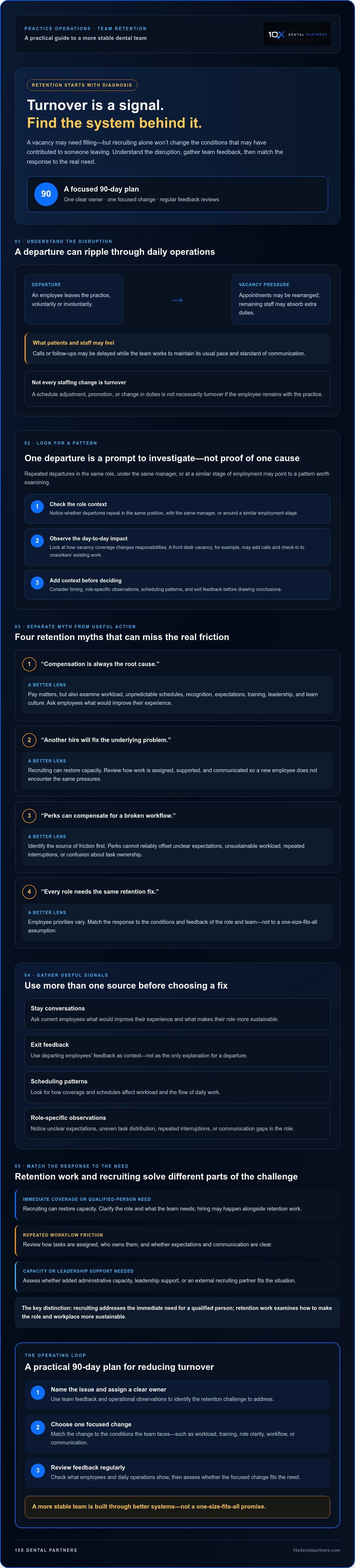
Dental office staff turnover is the departure of employees from a practice and the process of replacing them. It can be voluntary, such as an employee resigning, or involuntary, such as an employer ending employment. A schedule adjustment, promotion, or shift in duties isn’t necessarily turnover if the employee remains with the practice. The broader employee turnover concept also distinguishes departures from internal role changes.
A vacancy can disrupt more than the staffing roster. Appointments may need to be rearranged, remaining employees may take on extra duties, and patient calls or follow-ups may be delayed. These pressures can compound: the team is covering a gap while trying to maintain its usual pace and standard of communication. Turnover is a signal to investigate, not proof of one specific management failure.
What dental office staff turnover can reveal
One departure may reflect a personal decision or a role change. Repeated departures in the same role, under the same manager, or at a similar stage of employment may point to a pattern worth examining. Check how vacancy coverage changes day-to-day responsibilities, and consider timing, role context, and exit feedback before drawing conclusions. For example, a front desk vacancy may leave other team members juggling calls and check-in alongside their existing work.
Why replacing an employee is not the same as improving retention
Recruiting can restore capacity, but it doesn’t automatically change the conditions that may have contributed to someone leaving. If expectations are unclear or tasks are distributed in an unsustainable way, a new hire may encounter the same friction. Recruiting addresses the immediate need for a qualified person; retention work examines how to make the role and workplace more sustainable. Both may be needed, but they solve different parts of the challenge.
For reducing dental office staff turnover, first assess whether the practice needs a coverage solution, a change to daily workflows, or both. If hiring is also necessary, define the role and clarify what the team needs. Practices evaluating an external hiring partner can review these dental associate recruitment services considerations alongside their retention priorities.
Four Myths About Reducing Dental Office Staff Turnover
Reducing dental office staff turnover takes more than choosing a popular perk or filling the next vacancy quickly. Retention decisions work best when they respond to what employees say and what daily operations show. These four myths can lead a practice toward a visible fix while leaving the underlying friction in place.
Myth 1: Compensation is always the root cause
Pay matters, and practices should evaluate it fairly. But a raise alone may not address unpredictable schedules, uneven workloads, limited recognition, or unclear responsibilities. Ask employees what would improve their experience before changing compensation structures. Compare their feedback with role expectations and scheduling patterns, then distinguish a pay concern from a workflow or management issue. More than one factor may be involved.
Myth 2: Another hire will fix the underlying problem
Recruiting can be necessary to restore capacity, but adding someone to an unchanged environment may expose a new employee to the same pressures. Hiring and retention work can proceed in parallel: cover the role while reviewing how work is assigned, supported, and communicated. If a leadership vacancy is part of the challenge, use a clear role profile and review these dental office manager recruitment considerations as you plan.
Myth 3: Perks can compensate for a broken workflow
Perks may be appreciated, but they can’t reliably offset unclear expectations or a workload that is difficult to sustain. A team event won’t resolve repeated interruptions at the front desk or confusion about who owns a task. Identify the source of friction first. Healthcare-focused guidance on evidence-based retention strategies can offer broader ideas, but the right response still depends on your practice’s conditions.
Myth 4: Every role needs the same retention fix
Employee priorities vary. Schedule flexibility may matter to one team member, while another may need role clarity, professional growth, recognition, or a more manageable division of work. Don’t assume the same solution fits clinical and administrative roles, or every person in the same role. Ask targeted questions and compare feedback by role before selecting a change. That makes retention action more specific and easier to assess.
For practices weighing how people, workflows, and growth plans fit together, growth consulting support may help structure that review.
How to Identify the Retention Levers Your Dental Team Needs
Good retention decisions start with evidence from your own practice, not a generic fix. Use a consistent process to connect what employees report with what daily operations show. The goal is to identify one practical priority, test a response, and review what changes.
- Gather signals. Bring together stay conversations, exit feedback, departure timing by role, scheduling patterns, overtime, and recurring workflow backlogs. Use the same definitions each time you track a departure or vacancy.
- Listen for specifics. Ask employees which daily tasks cause avoidable frustration or frequent interruptions. Invite feedback about role expectations, manager communication, and schedule predictability.
- Compare patterns. Look for themes across roles and time periods. A repeated scheduling concern may call for a different response from a backlog that appears only when a particular position is vacant.
- Select one priority. Choose an issue the practice can address and name an owner. Avoid launching several changes at once, which makes it harder to understand what is helping.
- Review and adjust. Revisit staff feedback and relevant workflow signals after the change. Keep, refine, or reconsider the action based on what the practice observes.
Ask useful questions without making promises
Keep conversations open and practical. Ask, “Which task interrupts your work most often?” or “Where do your responsibilities feel unclear?” Employees may also have useful feedback about manager communication and schedule predictability. Explain what happens next: leaders will review common themes, share what can be changed, and be clear about constraints. Don’t promise a solution before assessing what is feasible.
Use turnover and workflow signals responsibly
Track departures by role and timing, but limit identifiable details to those who need them. One employee’s experience can raise a question, but it doesn’t establish a practice-wide conclusion. Compare feedback with observable conditions, such as overtime, schedule pressure, or recurring administrative backlogs, while accounting for vacancies that may temporarily affect those signals.
Before comparing periods, verify that records are complete and that the practice has applied the same definitions. For example, don’t compare voluntary resignations in one period with all staffing changes in another. Separate what the data shows from what you suspect, then investigate the gap. That discipline makes reducing dental office staff turnover a focused operational effort rather than a reaction to the latest departure.
A Practical 90-Day Plan for Reducing Dental Office Staff Turnover
A useful retention plan doesn’t start with a new perk. It starts by listening, choosing a specific issue, testing a practical response, and reviewing what the team says. Assign one person to coordinate the work, even if managers and team members contribute. Be clear about what the practice can change, what it can’t, and when employees will hear an update. This structure keeps reducing dental office staff turnover grounded in observable needs rather than assumptions.
Days 1-30: listen and establish a baseline
Set up structured conversations across roles and, where practical, shifts. Ask the same core questions so responses can be compared, while leaving room for role-specific concerns. Review existing departure notes, schedule pressure, and recurring process bottlenecks. Summarize themes without naming employees or treating a small number of comments as proof of a practice-wide problem.
Choose a simple baseline using information the practice already tracks, such as vacancy coverage, overtime, or a recurring administrative backlog. Define each measure consistently and check the underlying records before comparing periods. The baseline is a reference point, not a promise that a particular outcome will follow.
Days 31-90: test, communicate, and refine
Select one change that directly addresses a theme from the listening phase. If employees describe repeated interruptions during a specific task, for example, clarify task ownership or test a workflow adjustment rather than introducing an unrelated perk. Record the pilot’s scope, the accountable owner, the start point, and how employees can share feedback during the test.
Communicate progress without overstating results. Tell the team what changed, what remains outside the practice’s control, and when you’ll review the pilot. Later in the period, compare feedback and practice-defined measures with the baseline. Ask whether the specific friction point has eased, whether new issues appeared, and whether the change works across affected roles.
- Keep the change if feedback and relevant operating signals support it.
- Adjust it if the idea is useful but the execution creates new friction.
- Stop it if it doesn’t address the issue or adds avoidable burden.
A 90-day plan is a structured test, not a guarantee of lower turnover. Its value is in creating a clear feedback loop and making decisions based on what your team and practice actually observe. If you need support aligning people, workflows, and growth plans, explore growth consulting support.
Build a More Stable Dental Team with the Right Operational Support
Support works best when it matches the constraint. A vacancy that needs a qualified replacement calls for a recruiting response. A recurring workload problem calls for a closer look at task ownership and workflow. If both are present, address immediate coverage while investigating conditions that could affect the rest of the team. Recruiting fills a need; it doesn’t, by itself, resolve the cause of a retention problem.
Match the support to the actual constraint
Start with the evidence you’ve gathered. If the practice has identified a vacancy and needs a targeted hiring process, recruiting support may be relevant. If scheduling, patient communication, or insurance verification is consuming capacity, assess whether selected administrative work could be redistributed through virtual staffing. For a broader question about how staffing, workflows, and growth plans fit together, growth consulting may help structure the review.
10X Dental Partners supports dental practices through growth consulting, recruiting and talent acquisition, virtual staffing, and call center services. Its 10X Remote Assist supports scheduling, patient communication, and insurance verification. These options address distinct operational needs, not guaranteed retention outcomes. Practices considering administrative support can learn more about virtual staffing for dental offices and assess whether it fits the specific capacity gap they’ve identified.
Turn retention learning into a repeatable operating practice
Keep the feedback loop active after a pilot ends. Build regular employee conversations and follow-up into management routines, record the operational issue being addressed, and communicate what changed or why a proposed change wasn’t feasible. Over time, this helps leaders distinguish a one-time vacancy from recurring pressure in a role or workflow, then respond before assumptions harden into policy.
Reducing dental office staff turnover isn’t a single intervention. It’s an operating discipline: listen to employees, identify the constraint, match support to the need, and review the result with care. If your practice has defined its priority and wants to discuss operational support, explore 10X Dental Partners.
Turn Retention Insights into Your Next Practical Step
A more stable team starts with a clearer diagnosis. Departures are a reason to investigate, not automatic proof that pay, leadership, or any one factor is at fault. Listen across roles, compare feedback with everyday workflow signals, and choose a focused change your practice can review. That’s a practical foundation for reducing dental office staff turnover without relying on a one-size-fits-all fix.
Support should match the need you’ve identified. Recruiting can help address a hiring requirement while the practice examines retention. Growth consulting can help align people, workflows, and growth plans. Virtual staffing may provide capacity for selected administrative work. 10X Remote Assist supports scheduling, patient communication, and insurance verification, while 10X Dental Partners also offers call center services.
If you’ve defined your priority and want to explore options, explore operational support for your dental practice. Start with the constraint that matters most, then build from there. Small, well-chosen operational changes can give your team a clearer path toward a more sustainable work environment.
Frequently Asked Questions
How can a dental office reduce staff turnover?
Start by learning why employees leave and what current team members find difficult in their daily work. Review staff feedback alongside role expectations, schedule patterns, and recurring workflow problems. Then choose one focused change, assign someone to own it, and check whether the team notices a difference. Recruiting can address a vacancy, but it won’t automatically change workplace conditions that may contribute to future departures.
Is pay the main reason dental office employees leave?
Pay can influence an employee’s decision, so assess compensation fairly and in context. It isn’t the only possible factor. Workload, predictable schedules, manager communication, role clarity, recognition, and development opportunities may also shape someone’s experience. Ask employees what matters to them, and compare feedback across roles before deciding what to prioritize. Avoid assuming the same issue, or the same solution, applies to every team member.
Can better scheduling reduce dental staff turnover?
More predictable, manageable scheduling may help if schedule pressure is a concern, but it isn’t a universal fix. Ask where scheduling creates strain, then review coverage expectations, frequent changes, and recurring bottlenecks. For example, determine whether employees have enough clarity about their schedules to plan their work and personal commitments. Test a specific adjustment and gather feedback. If staff identify other concerns, investigate those rather than treating scheduling as the root cause.
What should a dental practice ask employees to improve retention?
Ask which parts of a typical workday create avoidable difficulty, which responsibilities feel unclear, and what would make schedules more manageable. Invite each person to name one practical change that would matter to them. Explain how leaders will review and use the feedback, protect employees’ privacy, and share what actions are feasible. Follow up on decisions, including changes the practice can’t make, so conversations lead to clear communication rather than unfulfilled expectations.
What happens if a dental office keeps losing the same type of employee?
Repeated departures in one role are a reason to investigate, not proof of a single cause. Review role expectations, onboarding, workload, schedule patterns, manager communication, and available exit feedback. Compare accounts carefully and protect employee privacy. If the practice confirms a vacancy needs to be filled, address recruitment while also assessing whether role conditions need attention. This can help avoid treating a recurring pattern as only a hiring problem.
Does outsourcing administrative work reduce dental staff turnover?
Outsourcing may help address a specific administrative capacity or workflow constraint, but it shouldn’t be treated as a universal retention solution. First identify whether tasks such as scheduling, patient communication, or insurance verification are creating pressure, then define which work could be supported externally and how responsibilities will be coordinated with the in-office team. 10X Remote Assist supports these administrative functions; its fit depends on the practice’s needs and service scope.


