
Dental Office Manager Recruitment: A 2026 Hiring Checklist

What if the candidate with the most dental experience isn’t the person best equipped to lead your practice? Dental office manager recruitment can miss the mark when a job description emphasizes familiarity with dental workflows but leaves leadership, financial oversight, team management, and operational priorities undefined.
That uncertainty makes applicants harder to compare. A slow or mismatched hire can also disrupt daily operations and put extra pressure on an already busy team. The answer isn’t simply to hire faster. Define what the manager will own, then assess candidates against clear, job-related evidence.
This 2026 hiring checklist helps you shape the role around your practice’s operations and growth plans, identify the capabilities that matter, and evaluate candidates consistently. It also helps you choose a recruitment approach that fits the role’s complexity and your team’s capacity. Use it to move from defining the mandate to making a sound hiring decision.
Key Takeaways
- Separate the office manager role from temporary front-desk coverage or virtual administrative support before defining the position.
- Plan a consistent hiring sequence, from sourcing and screening through references and onboarding, before reviewing applicants.
- Use structured questions and practical scenarios to assess leadership, judgment, communication, and process ownership.
- Choose internal hiring or recruiting support by weighing available time, role complexity, candidate access, and capacity to manage the process.
- Make dental office manager recruitment more accountable by setting the role’s priorities, reporting relationships, and onboarding plan before the hire starts.
Dental office manager recruitment starts with a defined operational mandate
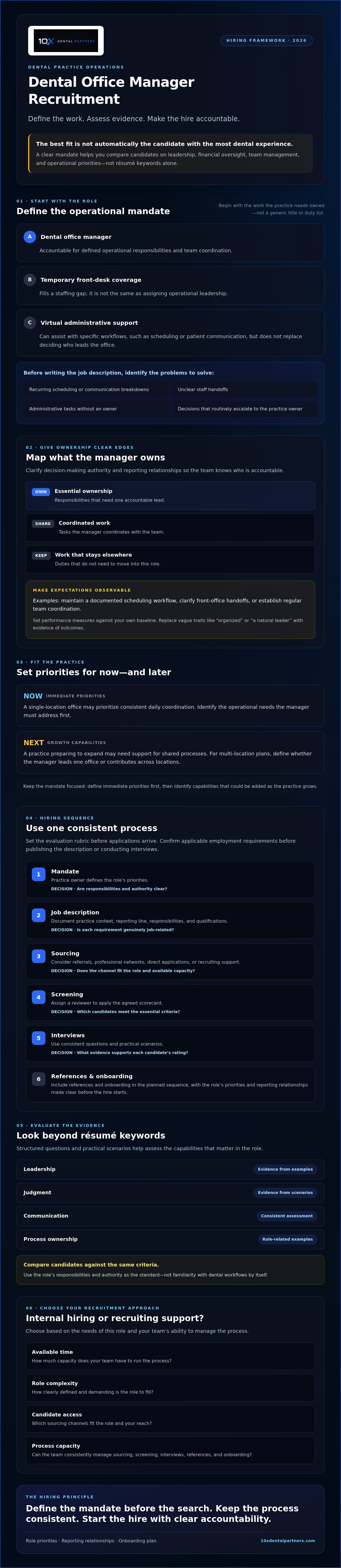
Start with the work the practice needs owned, not with a job title or a generic list of duties. Hiring a dental office manager is different from arranging temporary front-desk coverage. The manager is accountable for defined operational responsibilities and team coordination; temporary coverage fills a staffing gap. Virtual administrative support can help with specific workflows, such as scheduling or patient communication, but it doesn’t replace the need to decide who leads the office. These distinctions keep dental office manager recruitment focused on the actual need.
Before drafting the job description, document the problems you want the hire to address. Note recurring scheduling or communication breakdowns, unclear staff handoffs, administrative tasks without an owner, and decisions that routinely escalate to the practice owner. The recruitment process involves more than sourcing applicants. A clear mandate gives each stage a consistent purpose.
Which responsibilities belong in the dental office manager role?
Build the role around how your practice operates. Scheduling oversight, patient experience, team coordination, and administrative workflows may belong in the position, but the right combination varies by practice. Identify what the manager owns, what they coordinate, and what remains with the owner or other team members. Specify decision-making authority and reporting relationships so everyone understands who is accountable.
- Essential ownership: Responsibilities that need one accountable lead.
- Shared work: Tasks the manager coordinates with the team.
- Work that stays elsewhere: Duties that don’t need to move into this role.
Connect responsibilities to observable outcomes. A concise scorecard might state that the manager maintains a documented scheduling workflow, clarifies front-office handoffs, or establishes regular team coordination. Set performance measures against your own baseline, and avoid relying on vague traits such as “organized” or “a natural leader.”
How should practice size and growth plans shape the mandate?
Separate what the practice needs now from capabilities it may need later. A single-location office may prioritize consistent daily coordination, while a practice preparing to expand may also need someone who can support shared processes. For multi-location plans, define whether the manager leads one office or contributes to operations across locations. If the growth plan is still taking shape, dental practice growth consulting can provide relevant context for role design.
Keep the mandate focused. Combining every future aspiration with today’s responsibilities can make the role difficult to explain and assess. Define immediate priorities first, then identify capabilities that could be added as the practice grows.
Build a dental office manager recruitment checklist before sourcing candidates
A defined hiring sequence keeps the process anchored to the practice’s needs instead of shifting with each résumé. Set the evaluation rubric before applications arrive, and confirm applicable employment requirements before publishing the job description or conducting interviews. The U.S. Bureau of Labor Statistics’ overview of Medical and Health Services Managers offers broader context on management skills. Your criteria, however, should reflect this role’s responsibilities and authority.
Use this checklist to assign ownership and establish a decision point at every stage:
- Mandate: The practice owner defines the role’s priorities. Decision: Are the responsibilities and authority clear?
- Job description: The owner or hiring lead documents the practice context, reporting line, responsibilities, and qualifications. Decision: Is each requirement genuinely job-related?
- Sourcing: The hiring lead selects referrals, professional networks, direct applications, or recruiting support. Decision: Does the channel fit the role and available capacity?
- Screening: An assigned reviewer applies the agreed scorecard. Decision: Which candidates meet the essential criteria?
- Interviews: The interview panel uses consistent questions and scenarios. Decision: What evidence supports each candidate’s rating?
- References: The designated decision-maker checks relevant work examples. Decision: Do references support the evidence gathered?
- Onboarding: The manager and owner prepare access, introductions, and initial priorities. Decision: Is the practice ready for the person to begin?
What belongs in the job description and candidate scorecard?
State the practice context, reporting line, core responsibilities, and decision authority plainly. Separate required qualifications from preferences, and remove criteria that aren’t necessary for the work. Turn competencies into evidence you can assess. For example, ask candidates to describe how they resolved a workflow breakdown or coordinated a team through a change. Score every candidate against the same job-related criteria before comparing applications.
Where can a practice source qualified candidates?
Referrals may offer useful context, professional networks can surface relevant experience, and direct applications may bring a wider mix of backgrounds. Specialist recruiting support is another option when role complexity or limited internal capacity makes the search difficult. Each channel has trade-offs, so choose based on fit rather than assumptions about reach or results. For a comparison of evaluation principles in a different hiring category, see this guide to dental associate recruitment services. Associate and office manager roles are not interchangeable.
If internal capacity or role complexity is making the process difficult, you can explore recruiting and talent acquisition support as one possible approach.
Evaluate dental office manager candidates on evidence, not résumé keywords
Dental experience provides useful context, but it doesn’t prove that a candidate can lead people, make sound operational decisions, or take ownership of processes. In dental office manager recruitment, compare the same types of evidence for every finalist: résumé examples, structured interview responses, a practical scenario, and relevant references. Use one scorecard so strong presentation skills or familiar job titles don’t outweigh the capabilities the role requires.
- Résumé evidence: Look for specific responsibilities and examples of workflow or team coordination, not just a list of software or duties.
- Interview responses: Assess how clearly the candidate explains decisions, communicates with others, and follows through.
- Practical scenario: Observe how they identify priorities, gather information, and propose next steps.
- References: Confirm the candidate’s role, collaboration style, and examples of ownership.
Which interview questions reveal operational judgment?
Ask each candidate the same core questions, then rate answers against the role’s scorecard. Useful prompts include: “Tell us about a work process you assessed and improved. What did you observe, and how did you know whether the change helped?” and “How would you respond if a scheduling disruption affected the patient experience while team members disagreed about the next step?” Listen for a reasoned approach: clarifying the issue, communicating with the people involved, setting priorities, and following up. Strong answers demonstrate judgment, not just confidence.
Ask candidates how they handled a team concern or competing demands, while reminding them to protect confidential information. Focus on their actions and the outcome, not details that could identify a former employer, patient, or colleague.
How can a practical exercise and references strengthen selection?
Use a short scenario based on a real operational challenge in your practice. For example, present a fictional day with a schedule disruption, an unclear handoff, and a staff concern. Ask the candidate what they’d address first, what information they’d need, and how they’d communicate. Score their reasoning and trade-offs, not whether they guess your preferred answer. Keep the exercise job-related, and don’t ask for confidential materials or work product from previous employers.
For references, ask about responsibilities the candidate actually held, how they collaborated with a team, and a specific example of following through on an operational issue. The aim is to validate relevant evidence, not collect general praise.
A leadership hire is also different from delegated administrative task support. Virtual staffing may support workflows such as scheduling, patient communication, or insurance verification, while an office manager carries the leadership responsibilities defined by your practice. Learn more about virtual staffing for dental offices to clarify that distinction.
Choose internal hiring or recruiting support using a practical decision test
There’s no universally best route for dental office manager recruitment. The right approach depends on whether your practice can run a consistent search while keeping daily operations on track. Compare the options across four factors: available time, role complexity, access to candidates, and ownership of each hiring stage. Neither internal hiring nor outside support guarantees a faster or better hire. Both require a clear mandate and a disciplined evaluation process.
- Available time: Can someone reliably manage sourcing, screening, interviews, and follow-up alongside regular responsibilities?
- Role complexity: Is the position clearly defined, or does it span leadership, workflows, and growth needs that require careful alignment?
- Candidate access: Can your existing networks and channels reach people whose experience matches the role?
- Process ownership: Is one person accountable for coordinating stages, applying the scorecard, and communicating decisions?
Inconsistent screening, long gaps in candidate follow-up, changing interview criteria, or uncertainty about who makes the final decision can signal that internal capacity is stretched. These are process signals, not proof that outside recruiting is automatically the answer. Identify the constraint first, then choose support that addresses it.
When is an internal recruitment process a reasonable fit?
Internal hiring can work well when responsibilities and requirements are clear and a designated team member has the time and authority to manage each stage. Confirm that the practice can source applicants, apply consistent screening criteria, coordinate interviews, and follow up reliably. Set a date to review progress before launching. If the search stalls or the process becomes inconsistent, reassess the sourcing channel, workload, or need for additional support.
When should a practice consider specialist recruiting support?
Consider outside support if the role is complex to define, internal sourcing isn’t reaching suitable candidates, or the team can’t manage evaluation and communication consistently. Before engaging a provider, clarify what the support covers, who owns each decision, how often you’ll receive updates, and how candidate fit is assessed. Keep the practice involved in defining success criteria and making the hiring decision.
If you’d like to discuss recruiting support in light of your practice’s needs and internal capacity, discuss dental recruiting and talent needs with 10X Dental Partners.
Turn the office manager hire into an accountable onboarding plan
A signed offer doesn’t complete the hiring process. The role now needs to work in practice, with responsibilities translated into priorities, access, relationships, and regular communication. Carry the commitments made during dental office manager recruitment into onboarding so the new manager and practice owner share the same understanding of the role.
What should the first weeks of onboarding establish?
Prepare the basics before the start date: system access, reporting relationships, introductions to key team members, and current process documentation. Clarify which decisions the manager can make independently, which require owner approval, and how urgent issues should be raised. Give the manager time to understand existing workflows before expecting them to refine those processes.
Set initial priorities based on the practice’s needs, not a generic onboarding template. If team coordination is a priority, for example, arrange time to understand current handoffs and communication routines. Schedule structured conversations with the owner or executive sponsor to answer questions, surface role ambiguity, and adjust priorities as the manager gains context.
How should leaders review whether the hire is working?
Use the agreed role scorecard as the basis for regular check-ins. Discuss evidence related to the responsibilities defined during hiring: what’s been learned, where ownership is clear, which workflows need attention, and what support would help. Avoid applying a universal performance threshold. The right measures and timing depend on the mandate, starting conditions, and the manager’s scope.
Make the review two-way. Ask the manager what is obstructing progress, and invite relevant team feedback about communication, decision-making, and process changes. If expectations are unclear or a workflow lacks documentation, address that gap rather than treating it automatically as an individual performance issue. Agree on next steps and revisit them at the next check-in.
Strong onboarding connects the hiring decision to the way the practice operates. It gives the manager a clear platform to lead and gives owners a practical way to provide direction and assess progress without relying on vague impressions.
For practices considering how recruitment and broader operational needs fit together, explore 10X Dental Partners recruiting and operational support.
Make your next hiring decision with a clear plan
A strong office manager hire starts with a defined operational mandate and carries that clarity through candidate evaluation and onboarding. This checklist helps you focus on evidence of leadership and process ownership instead of résumé keywords alone. It also offers a practical way to decide whether your team can manage the search internally or would benefit from recruiting support.
That structure makes dental office manager recruitment part of a broader effort to strengthen practice operations, not simply fill an open position. 10X Dental Partners offers Recruiting and Talent Acquisition, along with support for dental practice growth, operations, and multi-location infrastructure.
If you’re weighing your next hiring step, discuss your dental practice recruiting needs with 10X Dental Partners. Define the role around what your practice needs now, and build a sound foundation for future growth.
Frequently Asked Questions
What does a dental office manager do?
A dental office manager leads the operational responsibilities assigned by the practice, which may include coordinating staff, overseeing scheduling workflows, supporting patient experience, and maintaining administrative processes. The scope varies by practice. In one office, the manager may focus on daily team coordination; in another, the role may include broader operational planning. Define decision authority and reporting relationships so the manager knows what they own and what requires escalation.
How do I recruit a dental office manager?
Start dental office manager recruitment by identifying the operational needs the hire should address, then translate those needs into clear responsibilities and job-related criteria. Choose sourcing channels that fit the role and your team’s capacity to manage applications. Use consistent screening criteria, structured interviews, a relevant practical scenario, and reference checks. Before making an offer, clarify the reporting relationship and prepare an onboarding plan that connects the agreed responsibilities to initial priorities.
What qualifications should a dental office manager have?
Qualifications should reflect the responsibilities and authority of the specific position, rather than a universal template. Relevant experience coordinating teams, managing administrative workflows, or improving processes may be valuable evidence. Dental office experience can provide useful context, but it doesn’t automatically demonstrate leadership or operational judgment. Separate essential qualifications from preferences in the job description, and be prepared to explain how each requirement relates to the work the manager will perform.
How can I tell whether a dental office manager candidate is a good fit?
Look for consistent evidence that the candidate can handle the role’s actual responsibilities. Ask for examples of how they communicated a decision, addressed a workflow problem, or coordinated people with competing priorities. Compare their answers using the same scorecard, and consider whether their understanding of the role matches its decision boundaries. A good fit isn’t simply a familiar résumé; it’s a candidate whose experience and reasoning align with the practice’s needs.
Should a dental practice use a recruiter to hire an office manager?
A recruiter may be worth considering if the role is difficult to define, internal sourcing isn’t reaching relevant candidates, or the team lacks capacity to manage the process consistently. Internal hiring may suit a clearly scoped role when someone can own each stage and follow up reliably. Neither route guarantees a better result. 10X Dental Partners offers Recruiting & Talent Acquisition alongside broader support for practice operations and growth.
What should a dental office manager interview include?
Include consistent, job-related questions about communication, judgment, team coordination, and process ownership. Ask candidates to describe how they assessed a workflow and what they did to improve it. Add a short scenario based on a challenge relevant to your practice, and assess how the candidate reasons through priorities and next steps. Use the same core questions and rating criteria for each candidate, and avoid requesting confidential information from former employers.
How do I write a dental office manager job description?
Describe the practice context, reporting line, core responsibilities, and decisions the manager can make independently. Distinguish work the manager owns from tasks they coordinate or that remain with other team members. Separate required qualifications from preferences, keeping each requirement tied to the job. Replace broad traits such as “organized” with observable expectations, such as maintaining a defined workflow or coordinating team handoffs. This gives candidates a clearer picture of the role and supports consistent evaluation.


