Google Ads for Dentists: 2026 High-Production PPC Guide

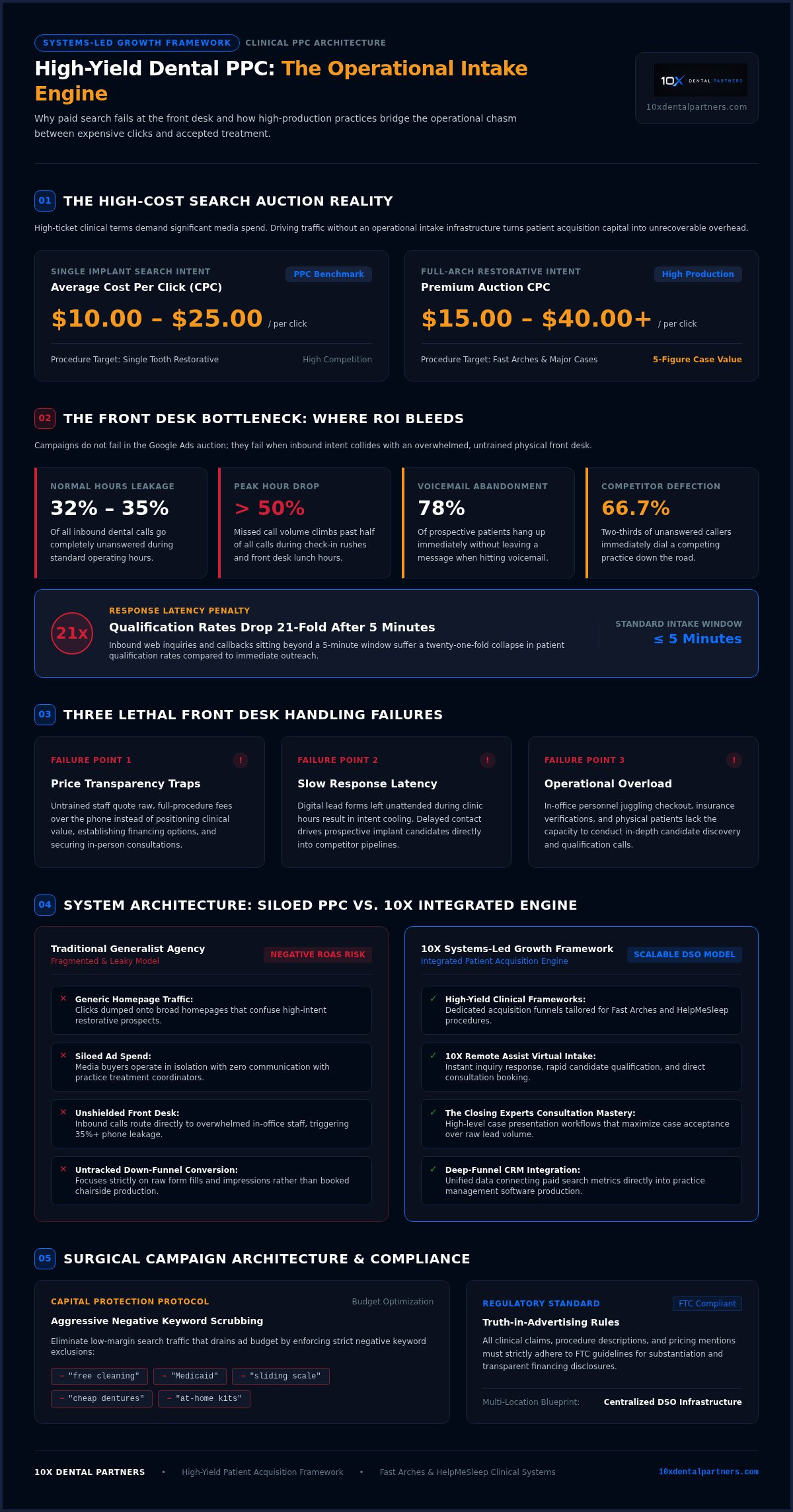
Your search marketing doesn't fail in the ad auction; it fails the second the phone starts ringing. Running Google Ads for dentists in 2026 feels increasingly brutal when full-arch clicks command $15 to $40 or more, while industry research shows roughly 32% to 35% of inbound dental calls go completely unanswered during normal business hours. That disconnect turns high-ticket clinical intent into costly overhead instead of clinical production.
You already know that buying clicks without operational follow-through is unsustainable. Pouring ad spend into an overwhelmed front desk that cannot field inquiries, qualify candidates, or confirm consultations just accelerates practitioner burnout. A profitable campaign demands far more than granular keyword targeting; it requires a tightly integrated patient acquisition engine that connects the click directly to the operatory chair.
In this guide, you will master the strategic framework of dental PPC to capture high-value cases like implants and sleep apnea while building the infrastructure required for sustainable practice growth. Below, we break down high-production campaign architecture, conversion compliance, and the systems-led operations needed to convert inbound search demand into accepted treatment.
Key Takeaways
- Discover why traditional Google Ads for dentists fail when operational intake bottlenecks break down before prospective patients reach the operatory.
- Learn how to pivot campaigns away from low-margin general terms toward specialized, high-yield procedures through clinical frameworks like Fast Arches and HelpMeSleep.
- Uncover why scaling high-production case acceptance requires elite sales infrastructure and consultation mastery from The Closing Experts rather than chasing raw lead volume.
- Implement deep-funnel conversion tracking and deploy 10X Remote Assist to secure immediate patient intake, eliminate phone leakage, and protect clinical margins.
- Master the multi-location blueprint to centralize acquisition systems, scale DSO-level infrastructure, and establish predictable, high-value practice growth.
Why Most Dental Google Ads Campaigns Fail (The Infrastructure Gap)
Most failed paid search campaigns are misdiagnosed. Clinicians blame the algorithm, the search terms, or the bidding strategy when their return on ad spend turns negative. In reality, the failure point is almost never technical execution inside the auction. The real culprit is the operational chasm separating paid traffic from chairside production.
Traditional search marketing functions like pouring expensive water into a leaking bucket. Generalist agencies drive clicks through the Google Ads platform, check a box for impressions, and send prospects directly to generic homepages. These low-conversion landing pages fail to match search intent, confusing prospective patients who are seeking immediate solutions for missing teeth or severe restorative needs. When running Google Ads for dentists, traffic volume means nothing without an operational pipeline built to capture it.
Generalist agencies cannot compete in 2026. They treat high-production clinical terms the same way they treat residential plumbing leads, ignoring clinical treatment cycles, case presentation workflows, and patient psychology. Without an integrated operational mechanism like 10X Remote Assist to field inquiries instantly, high-cost traffic simply bleeds away before ever reaching the practice management software.
The Front Desk Bottleneck
Front desk teams face constant operational crossfire. Industry data shows dental offices fail to answer roughly 32% to 35% of inbound calls, with missed calls climbing past 50% during peak front-desk check-in rushes and lunch hours. When prospective patients hit voicemail, 78% hang up without leaving a message; two-thirds immediately call a competitor down the road.
High-value cases cannot survive untrained telephone handling:
- Price transparency traps: Untrained staff quote raw procedure fees over the phone rather than positioning consultations and value.
- Slow response latency: Inquiries sitting beyond five minutes see their qualification rates drop twenty-one-fold compared to rapid outreach.
- Operational overload: In-office team members juggling patient checkout cannot conduct detailed discovery calls.
Deploying 10X Remote Assist bypasses this physical bottleneck entirely. Dedicated virtual staffing answers inquiries instantly, qualifies restorative candidates, and secures committed consultation appointments before search intent cools off.
Fragmented Marketing vs. Integrated Systems
Siloed marketing is a lethal liability. In a competitive market where full-arch clicks carry premium costs, you cannot afford disconnected vendors managing PPC, web forms, and in-house staff independently. When your media buyer does not communicate with your treatment coordinator, ad spend burns with zero accountability.
Sustainable production requires that your advertising infrastructure talks directly to your CRM, intake pipelines, and talent strategy. Moving beyond fragmented tactics means adopting a systems-led growth framework. When clinical marketing, dedicated virtual intake, and consultation workflows integrate into a single engine, Google Ads transforms from an unpredictable expense into a scalable revenue driver.
Targeting High-Value Cases: Implants, Full Arch, and Sleep Apnea
Bidding on broad terms like "dentist near me" keeps your chairs filled with hygiene checks, but it drains capital when your clinical goal is restorative production. Single implant queries average $10.00 to $25.00 per click, while full-arch search terms regularly climb from $15.00 to $40.00 or more. At those auction rates, running Google Ads for dentists requires surgical keyword architecture rather than generic broadcast advertising.
Success starts with aggressive negative keyword scrubbing. Filter out low-margin traffic by negating terms like "free cleaning," "Medicaid," "sliding scale," "cheap dentures," and "at-home kits." Clear away this noise so your budget focuses entirely on clinical procedures with five-figure potential.
Compliance also dictates your ad copy. All clinical claims, pricing mentions, and procedure descriptions must strictly align with FTC truth-in-advertising guidelines regarding substantiation and financing disclosures. Practices scaling these high-yield service lines often partner with 10X Dental Partners to align compliant messaging with high-converting campaign structures.
Full Arch PPC Strategy
Scaling full-arch cases demands a shift from clinical jargon to problem-oriented search intent. Patients rarely search for "All-on-4 torque values." Instead, they search for answers to broken bridges, failing teeth, and the embarrassment of ill-fitting dentures.
- Targeting solution intent: Bid heavily on phrases like "fix failing teeth fast" or "permanent alternative to dentures" alongside procedure-specific terms.
- Deploying educational landing pages: High-ticket restorative cases running $20,000 to $50,000 require video proof, doctor credentials, and clear financing pathways.
- Building dedicated funnels: Implement the structured Fast Arches approach to direct traffic into specialized conversion environments, as outlined in our blueprint for full arch dental marketing.
Sleep Medicine and Speciality Growth
Dental sleep medicine provides an exceptional growth vehicle that circumvents traditional physician referral bottlenecks. Millions of patients diagnosed with obstructive sleep apnea abandon their continuous positive airway pressure devices due to discomfort, noise, or travel hassles.
Capturing this market through direct-to-consumer search means positioning oral appliance therapy directly against CPAP machines. Focus ad creative on terms like "CPAP alternative," "snoring mouth guard by dentist," and "intolerant to CPAP mask." Our dedicated HelpMeSleep program integrates this ad targeting with clear messaging on medical cross-coding and oral appliance therapy benefits. You can explore the mechanics behind capturing this patient demand in our operational guide to sleep apnea dental practice growth.
Dental PPC Agency vs. Strategic Growth Partner
Traditional marketing vendors sell a dangerous illusion: that your practice only needs more leads. They celebrate arbitrary metrics like impressions, clicks, and form submissions while remaining completely detached from your profit and loss statement. Paying for raw leads solves barely one-third of the operational equation. If those inquiries never convert into accepted clinical treatment, your cost per acquisition spikes while net margins erode.
A strategic growth partner operates from an enterprise perspective. Rather than obsessing over click costs, a true partner aligns campaign performance directly with gross production and EBITDA contribution. This requires integrating search acquisition with case presentation training, call center protocols, and clinical recruiting. When deploying Google Ads for dentists, ethical positioning is paramount. Campaign messaging must comply with truthfulness standards outlined in the ADA Principles of Ethics and Code of Professional Conduct, preserving practice integrity while driving predictable patient volume.
Marketing cannot outrun operational capacity. Scaling your ad spend without recruiting qualified clinicians and support staff simply burns out your existing team.
What to Look for in a 2026 Partner
Selecting an acquisition partner requires vetting their operational depth beyond digital media buying. Ask critical structural questions before signing an agreement:
- DSO scalability: Do they possess the systems architecture required for multi-location expansion and DSO infrastructure development?
- Case presentation execution: Can they deploy dedicated case acceptance training through The Closing Experts to turn $30,000 consults into closed production?
- Enterprise valuation focus: Are they chasing short-term lead volume, or are they structuring clinical capacity to systematically elevate enterprise value?
The ROI of an Integrated Growth Platform
Comparing a conventional PPC agency to an integrated growth platform reveals stark financial differences. Standard agencies collect management fees while leaving internal bottlenecks untouched. In contrast, an integrated platform unifies targeted PPC, specialized talent acquisition, and virtual staffing.
Centralized intake protocols multiply the yield of every marketing dollar spent. When inbound inquiries route to professional call center specialists rather than distracted desk staff, appointment show rates rise significantly. Combining Google Ads for dentists with targeted sales facilitation closes the loop between ad spend and realized revenue, unlocking predictable scale across single practices and emerging dental groups alike.
Maximizing ROI: The Leads-to-Patients Conversion Pipeline
Tracking ad performance by counting form submissions creates a false sense of security. A click that fills out a questionnaire is merely potential energy. Turning that intent into realized clinical revenue requires a rigorous, multi-stage conversion pipeline engineered specifically for high-production dentistry.
Transforming ad spend into collections follows four distinct operational stages:
- Deep-funnel conversion tracking: Look past the standard confirmation page. Track the journey through consult attendance, clinical acceptance, and scheduled treatment.
- Immediate lead intake: Deploy 10X Remote Assist to capture every inquiry within seconds, preventing patient drop-off before internal friction develops.
- Elite case presentation: Utilize The Closing Experts to guide prospective patients past financial anxiety and procedural fear into accepted care.
- Continuous feedback loops: Feed actual case production numbers back into Google's Smart Bidding engine, systematically training algorithms to prioritize high-value searches over low-margin queries.
If your practice struggles to turn paid clicks into paid treatments, build your high-yield conversion pipeline with 10X Dental Partners to bridge the gap between marketing spend and clinical production.
Optimizing the Intake Process
Speed to lead remains the single greatest variable dictating conversion rates. Patient intent drops off rapidly after a form submission. When intake teams respond within the first 60 seconds, qualification rates jump dramatically compared to waiting an hour.
Phone conversations must also pivot away from transaction details. Staff should guide callers from immediate price fixation toward emotional and clinical possibility. Because roughly 45% of high-intent search inquiries occur outside traditional 9-to-5 working hours, leveraging virtual staffing for dental offices guarantees complete coverage. Inquiries received at night or over weekends receive immediate professional handling rather than rotting in a neglected voicemail inbox.
Advanced Tracking and Attribution
Clean data infrastructure reveals the true efficiency of Google Ads for dentists. Connecting offline conversion tracking directly to practice management systems allows you to trace a specific search click straight through to an accepted, fully paid Fast Arches case. This closed-loop visibility replaces guesswork with mathematical certainty.
This level of attribution enables accurate calculation of Patient Acquisition Cost (PAC) by individual procedure type. You can easily isolate high-yield implant cases from routine dental checkups. It also uncovers ghost leads: prospective patients who submit inquiries but prove unqualified or unreachable. Filtering out this dead weight sharpens ad targeting, protects practice capital, and sets your acquisition engine up for aggressive multi-location expansion.
Scaling with 10X Dental Marketing: The Blueprint for 2027
Scaling beyond a single location exposes structural weaknesses that a solo practice can often hide. When expanding your footprint, managing separate campaigns in regional isolation burns capital through duplicated overhead and inconsistent brand messaging. Sustainable multi-location expansion requires centralized control coupled with localized conversion architecture.
Future-proofing your acquisition model also demands preparation for emerging search behaviors. As generative search and conversational engines reshape commercial discovery heading into 2027, algorithmic scrutiny around clinic authority will intensify. Success requires leveraging comprehensive dental practice growth consulting to align marketing spend with clinical operations, real estate strategy, and provider recruitment. Mastering Google Ads for dentists at an enterprise scale is about engineering an end-to-end operating system.
From Solo Practice to DSO
Transitioning from a founder-dependent clinic into a dental service organization requires operational synchronization across three core pillars:
- Proportional budget deployment: Scale campaign spend in direct coordination with newly added associate operatories, avoiding empty schedules or overbooked clinicians.
- Centralized call routing: Implement centralized call center infrastructure to field inquiries nationwide, ensuring prospective patients experience immediate intake regardless of which location they contact.
- Predictive clinical recruitment: Use systematic talent acquisition pipelines to recruit skilled associates and treatment coordinators well before increased lead volume overwhelms your practice.
A centralized intake hub answers regional inquiries instantly while scheduling patients into specific local practices, preserving community familiarity without sacrificing institutional intake efficiency.
Sustainable Growth Systems
Marketing spend functions merely as fuel; your internal operations remain the actual engine. Driving massive search volume into an unstable clinical environment creates practitioner fatigue and wasted spend. True scale happens only when patient acquisition, case presentation frameworks, and staffing infrastructure function in complete harmony.
At 10X Dental Partners, we focus on genuine partnership rather than detached media procurement. We collaborate directly with practice owners to architect the systems, talent, and workflows required to dominate high-yield procedures and drive long-term enterprise valuation. If you are prepared to modernize your patient acquisition and eliminate operational bottlenecks, request a strategic growth audit to evaluate your practice infrastructure and build a predictable path toward 2027 scale.
Transform Search Demand into Predictable Practice Equity
Achieving sustainable profitability through Google Ads for dentists requires stepping off the broken vendor carousel. Buying search traffic without operational infrastructure is just an expensive distraction. Lasting clinical scale happens when targeted patient acquisition aligns seamlessly with disciplined clinical operations, specialized high-production programs, and expert consultation mastery.
At 10X Dental Partners, we eliminate the operational divide. By combining proprietary growth frameworks like Fast Arches and HelpMeSleep with integrated virtual staffing solutions and DSO-level infrastructure expertise, we help practice owners turn unpredictable search clicks into reliable, high-yield production. Stop letting valuable restorative cases slip through the cracks of a fragmented front desk.
Your clinical skill deserves an operational framework that protects your time, elevates your margins, and builds long-term enterprise value. Take command of your clinical pipeline today: Scale your practice with the 10X Strategic Growth Audit.
Frequently Asked Questions
Is Google Ads still effective for dentists in 2026?
Yes, Google Ads remains one of the most effective commercial channels for capturing active patient intent in 2026. Search algorithms reward practices that combine verified doctor credentials with optimized landing pages and fast response workflows. While generic clicks have grown more competitive, running strategic Google Ads for dentists continues to generate reliable returns when paired with dedicated intake infrastructure and offline conversion tracking.
How much should a dental practice spend on Google Ads per month?
Target spend depends on clinical objectives. A baseline general dentistry campaign requires $1,000 to $3,000 per month to exit Google's algorithmic learning phase. High-ticket procedures like implants and full-arch cases require an ad spend floor of $4,000 to $10,000 or more per month. Investing below those thresholds deprives bidding systems of the conversion volume required to optimize bids for high-value treatment seekers.
What is a good cost-per-lead for dental implants?
A competitive cost per lead for single dental implants typically ranges between $120 and $300 across search campaigns. Full-arch and All-on-4 leads generally average between $150 and $450 due to steeper auction competition. Raw inquiry costs matter less than conversion yield, however. What truly protects margins is having the intake speed and presentation infrastructure required to turn those leads into completed surgical consultations.
Should I run Google Ads myself or hire a dental marketing agency?
Managing campaigns internally rarely produces positive returns for high-ticket procedures. The dental search vertical carries steep click costs and complex healthcare policy restrictions that quickly waste unmanaged ad spend. However, hiring a traditional agency that only monitors clicks leaves clinical conversions unaddressed. You need a strategic growth partner that connects Google Ads for dentists directly to call center intake, talent acquisition, and treatment presentation.
How do I target high-value patients specifically with PPC?
Targeting high-value cases requires bidding on symptom- and solution-oriented search queries rather than basic preventive terms. Isolate full-arch procedures using dedicated funnels like Fast Arches, and implement aggressive negative keyword lists to exclude budget shoppers, Medicaid inquiries, and routine checkups. Feed verified consultation values back into Google Ads via offline conversion tracking so automated bidding prioritizes patients seeking extensive restorative care.
What happens if my front desk can't keep up with PPC leads?
Your marketing ROI collapses. Front desks miss roughly 32% to 35% of inbound calls during busy practice hours, and most prospective patients who reach voicemail immediately contact a competing clinic. When in-house teams are overwhelmed, deploying dedicated virtual staffing through 10X Remote Assist ensures immediate lead contact, thorough candidate qualification, and reliable consultation booking without increasing physical office overhead.
Does Google Ads work for specialty services like sleep apnea?
Yes, targeted search advertising captures patients actively looking for alternatives to CPAP therapy. Successful sleep campaigns target CPAP intolerance, snoring oral appliances, and medical insurance cross-coding rather than generic dental care. Through structured programs like HelpMeSleep, practices can connect high-intent search queries directly to dedicated clinical consults, establishing a predictable revenue channel independent of traditional medical referrals.
How long does it take to see results from a dental Google Ads campaign?
Initial lead inquiries typically appear within days of launching an active campaign. However, establishing statistical efficiency takes roughly 30 to 60 days as bidding algorithms navigate their learning period and collect conversion signals. Complex restorative cases carry extended deliberation cycles, meaning realized production accelerates once intake protocols, consultation confirmations, and follow-up nurture sequences are fully operational.


