
Scaling Sleep Apnea Dental Practice Growth: The 2026 Operational Blueprint

Over 80 million American adults currently suffer from obstructive sleep apnea, but a staggering 80 percent of those cases remain undiagnosed. You've likely recognized this massive clinical opportunity and invested in the necessary education; however, clinical proficiency rarely translates into a scalable business model without the right architecture. Many clinicians find their sleep apnea dental practice growth stalled by the administrative weight of medical billing and the chaos of fragmented patient lead flow. It's a common frustration to see a high-demand service become an operational bottleneck that overwhelms your front desk and drains your overhead.
Scaling dental sleep medicine in 2026 requires moving past the "side service" mentality and embracing a systemic, operator-led approach. This blueprint details how to transform your DSM vertical into a high-production revenue engine by deploying virtual infrastructure and specialized outsourcing. We'll examine the deployment of 10X Remote Assist for medical insurance verification, the integration of the HelpMeSleep marketing system, and the structural requirements for scaling sleep operations across a multi-location DSO. You'll learn how to eliminate administrative friction and build a predictable, autonomous system for sustainable, high-level growth.
Key Takeaways
- Shift your focus from clinical training to operational infrastructure to unlock sustainable sleep apnea dental practice growth.
- Discover how virtual staffing via 10X Remote Assist removes the administrative friction of medical billing and insurance pre-authorizations.
- Leverage the HelpMeSleep marketing framework to specifically target CPAP-intolerant patients who are searching for oral appliance alternatives.
- Implement a centralized "Hub and Spoke" operational model to successfully integrate and scale dental sleep medicine across a multi-location DSO.
- Transition your DSM vertical from a low-volume side service into a predictable, high-production revenue engine through systems-based lead management.
Beyond Clinical Competence: Why Most DSM Programs Fail to Scale
Clinical knowledge is just the baseline. Many doctors return from weekend CE courses ready to fit mandibular advancement splints, only to find their production hasn't moved. This is the "Clinical Trap." Clinical skill doesn't solve administrative exhaustion. Real sleep apnea dental practice growth depends on building a business engine that operates independently of your clinical intuition. Proficiency in the chair is useless if your operational infrastructure can't support a high-volume patient flow.
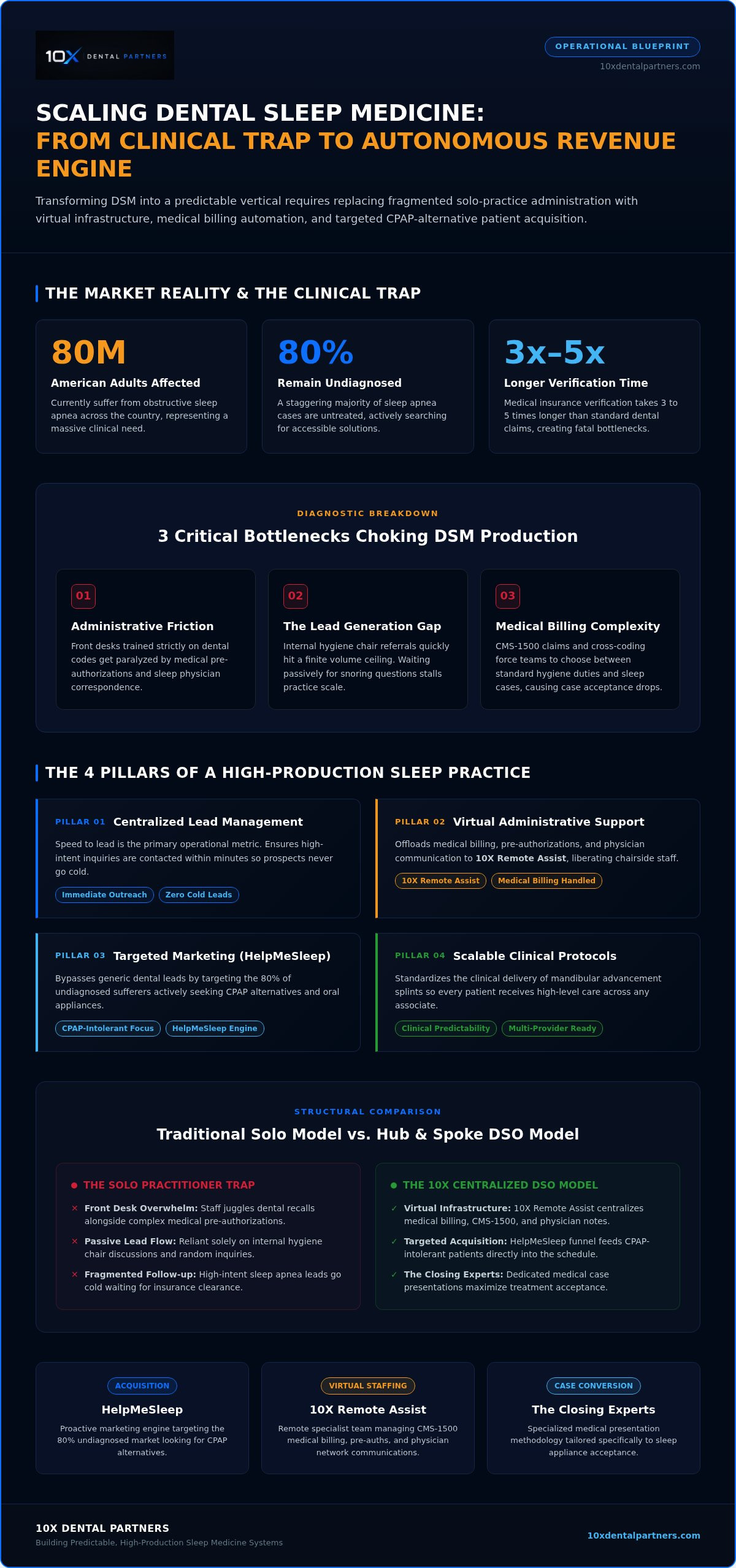
You can't scale a service that relies on manual, fragmented processes. Three primary bottlenecks consistently choke DSM production: administrative friction, inconsistent lead flow, and medical billing complexity. When these aren't addressed, you aren't building a vertical; you're just adding more stress to an already busy general practice. This lack of structure leads to wasted marketing spend and missed opportunities.
The Administrative Friction Point
Your front desk is often the biggest obstacle to growth. They're trained for dental codes, not medical pre-authorizations or sleep physician correspondence. Verifying medical benefits takes three to five times longer than standard dental claims. This complexity creates a friction point where cases stall. While your team struggles with CMS-1500 forms, case acceptance drops. This is why our framework utilizes The Closing Experts approach, which focuses on specialized presentation strategies that differ fundamentally from traditional dental sales. We remove the burden from your staff so they can focus on patient care.
The Lead Generation Gap
Internal referrals from your hygiene chair are a finite resource. They provide a start, but they eventually hit a ceiling. Relying on passive marketing or waiting for patients to ask about snoring is not a strategy for sleep apnea dental practice growth. You need a proactive acquisition engine. Programs like HelpMeSleep move beyond clinical awareness to target the 80 percent of undiagnosed sufferers actively seeking alternatives to CPAP. This transition from passive observation to active acquisition is what separates a hobby from a high-production revenue engine.
The traditional solo-practitioner model assumes your current staff can just handle the extra load. It's a recipe for burnout. Adding a complex medical vertical without dedicated infrastructure like 10X Remote Assist forces your team to choose between their core duties and the sleep program. Usually, the sleep program loses. Scaling requires a shift from being a solo clinician to becoming a master operator of a unified system. It's about building a predictable framework that supports long-term stability and expansion.
Building the Infrastructure: Four Pillars of a High-Production Sleep Practice
Infrastructure is the skeleton upon which sleep apnea dental practice growth is built. Without it, the program is just a collection of expensive tools and unused knowledge. Scaling requires a shift from manual tasks to a systemized architecture that can handle volume without increasing your personal workload. This transition relies on four operational pillars that work in tandem to create a predictable revenue stream.
- Centralized Lead Management: Speed to lead is the only metric that matters for high-intent inquiries. A centralized system ensures every prospect is contacted within minutes, preventing leads from going cold.
- Virtual Administrative Support: Offloading medical billing, pre-authorizations, and physician correspondence to a dedicated team like 10X Remote Assist removes the primary bottleneck from your in-office staff.
- Targeted Marketing: Utilizing the HelpMeSleep framework allows you to bypass general dental leads and focus on patients specifically searching for CPAP alternatives.
- Scalable Clinical Protocols: Standardization ensures that every patient receives the same high level of care, regardless of which associate is in the chair.
Standardizing the Patient Journey
A standardized workflow is the only way to ensure clinical predictability at scale. This journey begins with a 30-second chairside screening and moves through a tech-enabled sequence of diagnosis, digital impressions, and appliance delivery. By utilizing intraoral scanners and CAD/CAM fabrication, you reduce chair time from 45 minutes to 15 minutes. Automation tools should handle the heavy lifting of compliance tracking and follow-up scheduling. An optimized patient journey is a friction-less operational sequence that converts clinical necessity into a predictable, high-production outcome through automated compliance tracking and standardized titration protocols.
Operational Integration
Successful integration means DSM screenings happen during every hygiene appointment without disrupting the schedule. This isn't a task for an overwhelmed Office Manager. You need a dedicated Sleep Coordinator who understands the nuances of medical insurance and physician networks. This role is the "Master Operator" of your sleep vertical, ensuring that clinical screenings actually turn into treated cases. According to the National Institutes of Health sleep apnea treatment guidelines, custom oral appliances are a primary treatment pathway for patients who fail CPAP therapy, making this a medically necessary service for your existing patient base.
For those managing multiple locations, the challenge is maintaining this consistency across the group. You can learn more about this in our guide on DSO Infrastructure Development. Building this foundation allows you to scale with confidence and precision. If you're ready to see how these systems fit into your specific model, a consultation with 10X Dental Partners can help define your roadmap.
Solving 'Front Desk Friction' with 10X Remote Assist
The front desk is the engine room of your practice, but most dental engines aren't built for medical billing. General dental teams are proficient in dental codes, yet they often struggle with the granular requirements of medical pre-authorizations and sleep physician correspondence. This misalignment creates "front desk friction" that stalls sleep apnea dental practice growth before it can gain momentum. Relying on an already overwhelmed chairside assistant to navigate the complexities of HCPCS Code E0486 and medical insurance verification is a strategic error that limits your production ceiling.
10X Remote Assist functions as a specialized extension of your team, operating as Division III of our infrastructure. By deploying remote experts, you move the administrative weight offsite. These operators manage the intake process, acquire sleep physician records, and handle the back-and-forth of medical benefits verification. This ensures that your in-office staff remains focused on high-value, chairside customer service while our virtual team secures the authorizations necessary for high-production cases. It's a model that provides a 24/7 presence for sleep leads, capturing high-intent patients who search for solutions outside traditional office hours.
Offloading the Administrative Burden
Effective scaling requires a clear division between clinical execution and administrative support. Your virtual team should own the tasks that typically cause bottlenecks. This includes medical insurance verification, pre-authorization submissions, and the meticulous recovery of unscheduled treatment plans. Maintaining seamless communication between your clinical team and virtual staff is vital for operational flow. For a deeper look at how this integration works, see our Virtual Staffing for Dental Offices 2026 Strategic Guide. By adhering to AADSM clinical practice guidelines for physician collaboration, our remote assistants ensure your practice remains compliant while maximizing throughput.
Scaling Through Outsourced Expertise
Virtual staffing allows you to expand your DSM production without the capital expenditure of adding physical desk space or increasing local headcount. This approach directly impacts your bottom line by reducing overhead while increasing case acceptance rates through professional call center services. When patients speak with a knowledgeable professional who can immediately address insurance concerns, their confidence in the treatment plan grows. Removing these "billing headaches" from your in-office team also significantly reduces staff turnover. You're no longer asking your dental team to perform medical tasks they aren't equipped for; instead, you're providing them with the support of a master operator system designed for sleep apnea dental practice growth.
The 2026 Sleep Apnea Marketing Funnel: From Awareness to Oral Appliance
General dental marketing is built for volume, not specialty conversion. You can't use the same funnel for a routine cleaning that you use for a life-altering medical intervention. To achieve sustainable sleep apnea dental practice growth, your marketing must pivot from "dentistry" to "sleep health." The HelpMeSleep framework is designed to capture high-intent patients who are actively searching for alternatives to traditional treatments. By focusing on the specific pain points of sleep deprivation and CPAP intolerance, you position your practice as a medical solution provider rather than a general practitioner.
A multi-channel acquisition strategy is essential for 2026 operations. Google Ads capture patients in the decision phase, while social media platforms build awareness among the 80 percent of sufferers who remain undiagnosed. Integrating social proof through video testimonials is vital; patients need to see the real-world impact of oral appliance therapy on energy levels and relationship health. This authoritative approach builds the trust necessary to move a prospect from a digital ad to a clinical consultation.
Attracting High-Value Sleep Patients
The primary driver of your growth vertical is the "CPAP dropout" demographic. Research indicates that Continuous Positive Airway Pressure therapy has a long-term abandonment rate between 50 percent and 83 percent. These individuals are not looking for a dentist; they are looking for a way to breathe at night without a restrictive mask. Your messaging must focus on health outcomes like reduced cardiovascular risk and improved cognitive function. For practices looking to scale multiple high-production services, integrating these strategies mirrors the precision found in Full Arch Dental Marketing, where the focus remains on life-changing clinical results.
The Physician Referral Engine
Building a predictable referral system with local sleep labs and MDs requires a commitment to medical-grade documentation. Physicians will only refer to dentists who provide consistent, high-quality reports and adhere to co-management standards. 10X Remote Assist manages this documentation loop, ensuring that sleep physicians receive the necessary follow-up data without adding work to your chairside team. The 2026 physician-dentist referral loop is a standardized, bi-directional communication framework that utilizes virtual administrative support to automate documentation exchange and co-manage patient compliance between sleep medicine specialists and dental providers.
To deploy a high-conversion acquisition engine for your practice and secure your market position, schedule a strategy session with 10X Dental Partners.
Scaling to the DSO Level: Integrating Sleep Medicine into Multi-Location Growth
Scaling to the DSO level represents the final phase of operational maturity. It requires moving from a localized effort to a "Hub and Spoke" architecture where high-production services are managed through a centralized command center. For a DSO with 10 or more locations, maintaining consistency is the primary challenge. Without a unified system, clinical quality and case acceptance vary wildly between sites. Achieving sustainable sleep apnea dental practice growth across a group relies on standardizing the intake, billing, and follow-up processes at the corporate level.
Centralized call centers are the backbone of this model. They ensure that every inquiry is handled with the same high-level expertise, regardless of which office the patient eventually visits. By utilizing 10X Remote Assist to handle medical billing and physician reporting for the entire group, you eliminate the need for specialized administrative staff at every location. This reduces local overhead and creates a scalable framework for recruiting and training associates who can focus exclusively on clinical delivery. You aren't just hiring dentists; you're recruiting clinicians to execute a proven, systemic vertical.
Centralized Systems for Group Success
Standardization is the only path to group-level success. Medical insurance verification and pre-authorizations must be handled by a centralized team to ensure accuracy and compliance across the organization. This allows the DSO to monitor production through a single dashboard of KPIs, tracking lead-to-start ratios and case acceptance across the entire portfolio. This systemic approach is a core component of modern Dental Patient Acquisition Strategies. By viewing each location as a node in a larger network, you can deploy resources with surgical precision and maintain brand integrity.
Long-Term Value and Valuation
A robust sleep medicine vertical does more than increase monthly production; it fundamentally shifts your DSO's EBITDA. Sleep appliance therapy is a high-margin service with minimal supply costs, making it incredibly attractive to private equity during an exit. Building a brand recognized as a regional leader in sleep health creates a competitive moat that general practices cannot cross. This is the "Master Operator" mindset. You're no longer just running dental offices; you're managing a vertically integrated healthcare group. By refining these systems today, you're building a legacy of structured, undeniable growth and long-term stability.
Deploying the 2026 Sleep Apnea Blueprint
Transitioning from clinical proficiency to a high-production vertical requires a fundamental shift in your operational architecture. Sustainable sleep apnea dental practice growth is achieved when you offload the administrative weight of medical billing and lead management to specialized systems. By deploying the 10X Remote Assist virtual staffing model, you solve the front desk friction that causes most programs to stall. This infrastructure, combined with the high-intent patient acquisition of the HelpMeSleep program, ensures your practice captures the massive undiagnosed market while maintaining lean overhead.
Whether you're a solo practitioner or leading a multi-location organization, the path to scaling lies in centralization and DSO-level infrastructure expertise. You don't have to navigate the complexities of dental sleep medicine alone. Our systems are built to transform your practice into a predictable revenue engine that operates with precision and stability. It's time to move beyond the clinical trap and become the master operator of your growth vertical.
Scale your practice with the HelpMeSleep program and 10X Dental Partners.
Your blueprint for a more profitable and systemized future is ready for deployment.
Frequently Asked Questions
How much can a sleep apnea program realistically grow my dental practice revenue?
A systemized sleep program can generate over $50,000 in monthly production when implemented as a primary vertical. Medicare allowable reimbursement for HCPCS Code E0486 ranges from $1,800 to over $2,363 depending on your jurisdiction. By treating just 15 patients per month, you create a high-margin revenue stream with minimal chair time. This growth is sustainable as the US market is projected to reach $2.20 billion by 2035.
Do I need to hire a full-time medical biller to scale my sleep practice?
You don't need to hire a full-time in-office medical biller to achieve significant scale. Most practices find that adding specialized headcount increases overhead and requires extensive training. Utilizing virtual solutions like 10X Remote Assist allows you to outsource insurance verification and pre-authorizations to experts. This ensures your medical billing is handled by professionals who understand CMS-1500 forms without the complexity of managing a new physical employee.
What is the best way to market sleep apnea services to my existing patient base?
The most effective internal strategy is integrating a 30-second screening into every hygiene appointment. Since 32.2 percent of the US adult population suffers from obstructive sleep apnea, a significant portion of your current patients are already at risk. Use standardized questionnaires like STOP-BANG to identify high-risk individuals. Focus on health outcomes such as improved energy and reduced cardiovascular risks to drive sleep apnea dental practice growth from within.
How does the HelpMeSleep program differ from traditional dental marketing?
The HelpMeSleep program differs from traditional dental marketing by targeting high-intent medical prospects rather than general dental leads. Traditional ads focus on aesthetics or hygiene, while HelpMeSleep focuses on CPAP intolerance and specific health-related search queries. It utilizes a specialized funnel that captures patients looking for alternatives to restrictive masks. This framework combines targeted lead generation with professional closing techniques to maximize your case acceptance rates.
Can virtual staffing really handle complex dental sleep medicine scheduling?
Virtual staffing is highly effective for managing the specialized demands of patient intake and physician correspondence. Our 10X Remote Assist team handles medical records acquisition and coordinates home sleep tests. They integrate directly into your practice management software, ensuring your in-office clinical team only focuses on chairside delivery. This remote infrastructure provides a 24/7 presence to capture leads outside standard business hours, maintaining momentum for your sleep program.
What are the essential KPIs for measuring sleep apnea dental practice growth?
You should track lead-to-consultation ratios, case acceptance rates, and medical insurance reimbursement timelines. Monitoring these metrics allows you to identify where friction exists in your operational funnel. High-production practices aim for an oral appliance therapy adherence rate between 77 percent and 90 percent at 12-month follow-ups. Tracking these specific KPIs ensures your sleep apnea dental practice growth is measurable, predictable, and aligned with your long-term revenue goals.
Is it better to build a sleep practice as a solo owner or within a DSO structure?
While solo owners can build successful programs, a DSO structure provides the centralized infrastructure necessary for rapid scaling across multiple sites. DSOs benefit from centralized call centers and standardized medical billing that can be deployed across 10 or more locations. This "Hub and Spoke" model reduces localized overhead and ensures consistent clinical quality. However, solo owners can achieve similar efficiency by adopting virtual staffing and systemized marketing frameworks.
How do I overcome CPAP intolerance objections during a sleep consultation?
Address CPAP intolerance by highlighting that 50 percent to 83 percent of patients eventually abandon mask therapy. During the consultation, focus on the comfort and portability of custom mandibular advancement devices. Emphasize that oral appliances achieve superior real-world compliance compared to CPAP, leading to better mean disease alleviation. Use data from The Closing Experts to present OAT as a medically necessary, mask-free alternative that fits the patient's lifestyle.


