Virtual Staffing for Dental Offices: 2026 Strategic Guide

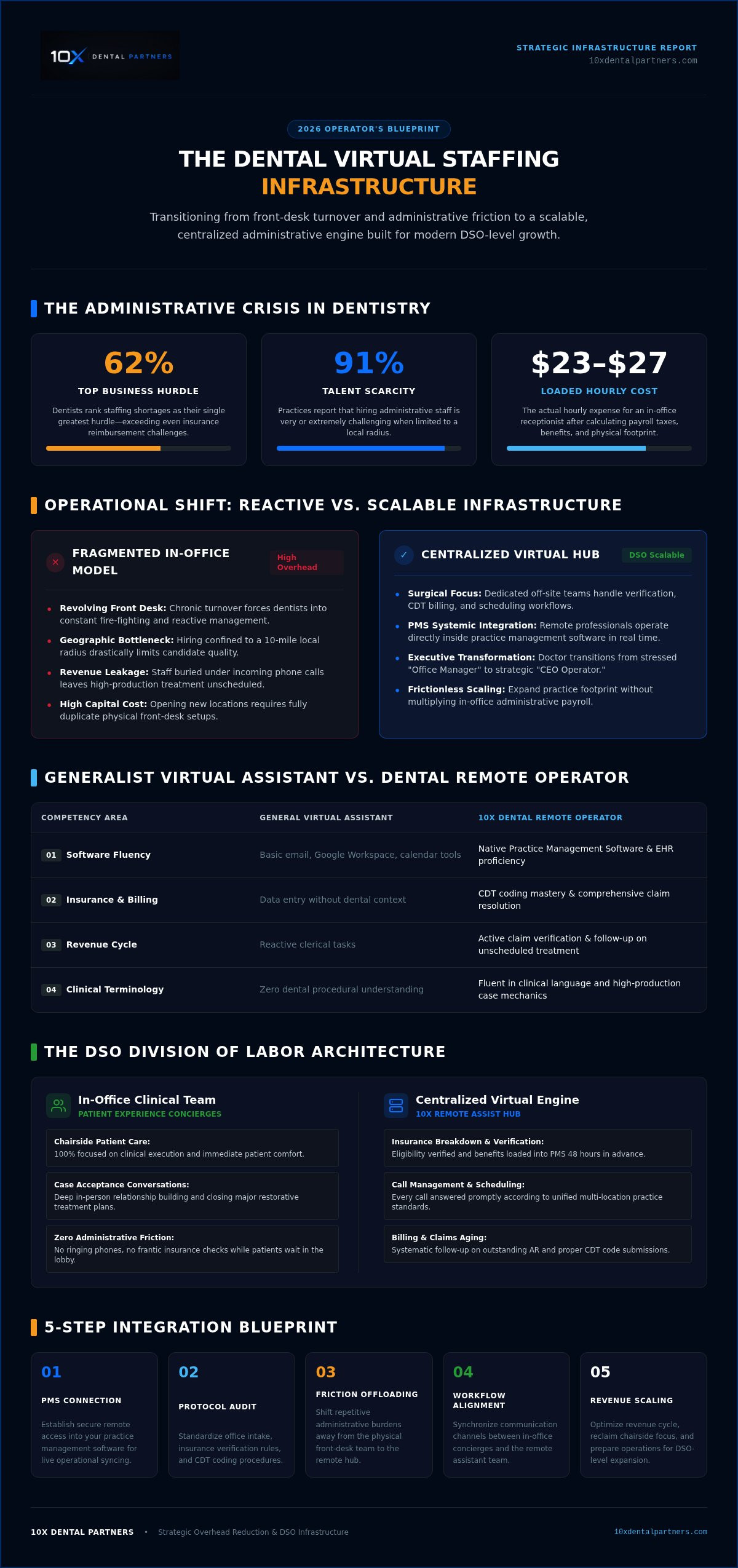
Did you know that 62% of dentists now rank staffing shortages as their single greatest business hurdle, even above insurance reimbursement issues? If you're struggling with the revolving door at your front desk, you've likely realized that traditional hiring often fails to keep pace with modern demand. Strategic virtual staffing for dental offices is no longer a simple cost-saving "hack"; it's the essential infrastructure required to scale. You've probably felt the frustration of watching high-production cases slip through the cracks because your team is buried under insurance verifications and ringing phones. It's time to stop treating these operational gaps as inevitable costs of doing business.
This strategic guide shows you how to integrate high-performance remote operations to slash your overhead and reclaim your focus as a clinician. You'll discover how to transition from a fragmented office model to a seamless, centralized hub using 10X Remote Assist. We'll break down the blueprint for predictable payroll costs, professionalized scheduling, and the scalable infrastructure necessary to prep your practice for DSO-level growth. By de-coupling clinical duties from back-office friction, you aren't just saving money; you're building a master-operator system that runs with precision while you're at the chair.
Key Takeaways
- Understand why virtual staffing for dental offices is the foundational infrastructure needed to transition from a reactive practice to a scalable, systems-led DSO.
- Identify the critical dental-specific skill sets, including EHR proficiency and CDT coding expertise, that distinguish elite remote professionals from generalist assistants.
- Learn how to eliminate the hidden costs of staff turnover and recruitment by shifting high-friction administrative tasks to a predictable, professionalized remote hub.
- Master a five-step blueprint for integrating remote support into your existing practice management software and communication workflows without disrupting patient care.
- Discover how 10X Remote Assist provides an integrated growth platform that aligns your administrative engine with long-term revenue optimization goals.
Beyond the Front Desk: Why Virtual Staffing is the New Dental Infrastructure
The modern dental practice can't survive on a reactive hiring model. Traditional administrative structures, where every task happens within the physical office, have become a liability. We're seeing a fundamental shift toward viewing virtual staffing for dental offices as a centralized administrative engine rather than a temporary fix. It's the difference between managing a series of disconnected tasks and building a unified, scalable system. By moving high-friction roles off-site, you create a dedicated hub for scheduling, billing, and insurance that operates with surgical precision.
Economic factors in 2026 make the old way of doing things unsustainable. The loaded cost for an in-office receptionist now totals between $23 and $27 per hour once you factor in taxes, benefits, and physical overhead. This financial burden eats into profit margins at a time when practice efficiency is non-negotiable. Implementing a remote strategy is a core pillar of dental practice overhead reduction. It allows you to deploy expert talent without the heavy tax of a physical footprint.
The Staffing Crisis vs. The Scaling Opportunity
Local talent pools for specialized dental roles are shrinking. Research shows that 91% of practices find hiring administrative staff very or extremely challenging. When you're limited to a 10 mile radius, you're competing for a vanishing resource. Leveraging virtual assistants breaks these geographic barriers. It allows you to move from a "manager" mindset, where you're constantly putting out fires, to a "CEO" mindset, where you focus on high-production cases. This transition is one of the most effective dental practice burnout solutions because it removes the chaos of the front desk from your clinical environment.
Centralized Operations: The DSO Advantage
Scaling to multiple locations requires a unified nervous system. Fragmented management creates massive revenue leakage and inconsistent patient experiences. Centralized operations are now the foundational layer of DSO infrastructure development. A centralized virtual hub ensures that every call is answered and every claim is filed according to a single, high-performance standard.
- Systemic Integration: Your remote team works directly in your practice management software, ensuring real-time data accuracy across all locations.
- Predictable Growth: You can add new locations without the immediate need for a full in-office administrative team, drastically lowering your initial capital requirements.
- Operational Clarity: Moving billing and scheduling off-site allows your in-office team to function as "Patient Experience Concierges," focusing entirely on the patients in the chair.
Core Competencies: What Defines a High-Performance Dental Virtual Assistant
Effective virtual staffing for dental offices hinges on a single distinction: the difference between a generalist and a trained dental operator. A general virtual assistant might manage a calendar, but a high-performance dental remote professional manages your revenue cycle. This requires more than basic administrative skills; it demands a deep fluency in the language of clinical dentistry and practice management systems. According to the Bureau of Labor Statistics occupational outlook for dental assistants, the administrative burden on clinical staff is rising, making specialized remote support a necessity for maintaining operational flow. You don't need a freelancer; you need an integrated team member who understands the stakes of a missed follow-up or an incorrectly coded claim.
Clinical Knowledge and Administrative Mastery
Your remote team must possess an instinctive understanding of CDT procedure codes and chair-time optimization. It isn't enough to simply "check benefits." A master operator identifies insurance verification leakage and optimizes claims to ensure maximum reimbursement before the patient even walks through the door. When managing complex scheduling for high-production cases, such as dental implants or full-arch restorations, the assistant must understand the specific clinical sequence to prevent scheduling bottlenecks. This technical expertise ensures that your high-value operatory time is never wasted on low-production gaps. Beyond the technical, the ability to handle remote patient communication for dentists requires sophisticated soft skills to maintain the high-touch feel of a local practice while operating from a distance.
Security and Compliance Protocols
In 2026, HIPAA compliance has evolved past simple training videos. It now requires rigorous secure workspace protocols to protect patient data from end to end. Elite virtual staffing involves vetting through comprehensive background checks and the implementation of audited technical infrastructure. This includes dedicated VPNs, multi-factor authentication, and encrypted EHR access within paperless environments that leave no digital footprint on local devices. The 2026 standard for HIPAA-compliant remote access mandates that every virtual operator must utilize a dedicated, audited virtual desktop environment that prevents any local storage of Protected Health Information while maintaining an encrypted, bi-directional link to the practice management software. If you're ready to upgrade your infrastructure, exploring 10X Dental Partners can bridge the gap between clinical excellence and administrative security.
By prioritizing these core competencies, you move away from the risk of fragmented management and toward the calm of structured growth. High-performance virtual assistants don't just fill a seat; they refine your entire operational blueprint, allowing you to scale without compromising the integrity of your patient data or the quality of your clinical schedule.
The ROI of Virtual Staffing: Overhead Reduction vs. Revenue Growth
The financial impact of virtual staffing for dental offices extends far beyond a simple reduction in hourly wages. It's a fundamental recalibration of your EBITDA. While a traditional front-desk hire carries a loaded employer cost of $23 to $27 per hour, the true drain on profit margins lies in the peripheral expenses of the in-office model. Taxes, health insurance, and paid time off add a 25% to 30% overhead burden that many owners fail to fully quantify. By shifting to a managed remote model, you replace these variable liabilities with a predictable operational expense. This move eliminates the hidden costs of physical workspace and hardware, allowing you to reallocate capital toward high-production clinical technology.
Calculating the True Cost of Staff Turnover
Staffing remains the primary challenge for 62% of dentists, yet few account for the $10,000 direct cost associated with losing a single team member. This "Recruitment Trap" creates a cycle of constant training that prevents your practice from reaching its full production potential. Beyond the direct costs, the opportunity cost of an unoptimized schedule is staggering. High-volume practices often miss 20% to 30% of incoming calls during peak hours. With each missed new patient call representing roughly $850 in immediate year-one production value, an understaffed front desk is a massive revenue leak. Virtual staffing provides instant scalability, ensuring no lead is left unanswered without increasing your fixed rent or physical footprint.
Revenue Capture: Turning the Front Desk into a Sales Engine
A high-performance remote hub doesn't just save money; it generates it. 10X Remote Assist transforms the administrative function from a cost center into a sales engine. By integrating "The Closing Experts" framework into remote patient communication, your virtual team becomes a frontline force for case acceptance. This is particularly critical for high-value clinical programs like Fast Arches, where proactive follow-up determines the success of the entire production cycle. To maintain this growth safely, all remote operations must strictly adhere to HHS Business Associate Agreement guidelines, ensuring that revenue capture never comes at the expense of compliance. When you measure the ROI through scheduling density and collection consistency, the transition to a unified system becomes the most logical step for any growth-oriented operator.
Operational Integration: A 5-Step Blueprint for Remote Staff Onboarding
Successful virtual staffing for dental offices requires more than just hiring a remote worker; it demands a methodical integration into your practice's central nervous system. Most operators fail because they treat remote staff as a detached service rather than a core component of their infrastructure. To build a DSO-ready engine, you must follow a structured deployment strategy that bridges the gap between your physical office and your remote hub. This process ensures that your remote partners operate with the same clinical context and urgency as your in-office team.
Step 1: Audit your internal workflows to isolate high-friction tasks. These are typically administrative bottlenecks, such as insurance eligibility verification and unscheduled treatment follow-ups, that pull your in-office team away from patient care. Step 2: Deploy your technology stack, ensuring your remote hub has secure, real-time access to your EHR and VOIP systems. Step 3: Establish clear accountability frameworks. You must track specific KPIs, such as call conversion rates and schedule density, to measure the impact of your remote team. Step 4: Prioritize cultural integration. Remote staff should participate in morning huddles and share in the practice’s production goals to foster a sense of unified purpose. Step 5: Implement continuous optimization loops. Use weekly feedback sessions to refine scripts and workflows based on actual patient interactions and revenue outcomes.
Technology Stack for Remote Success
A seamless "Virtual Front Desk" depends on absolute data synchronization. Your remote team needs the same visibility into the schedule as your in-office staff to prevent scheduling conflicts and patient friction. Utilizing unified communication tools like Slack allows for instant office-to-remote coordination, while VOIP extensions enable remote assistants to make and receive calls using your local practice ID. This setup maintains a consistent brand presence and ensures that the patient experience remains high-touch, regardless of where the administrative task is performed.
Training for High-Performance Production
The 10X approach repositioned remote staff as "Growth Partners" rather than simple assistants. By integrating frameworks from "The Closing Experts," your virtual team learns to convert high-value implant leads into scheduled consultations with precision. This specialized training focuses on converting clinical needs into patient commitments, which is essential for scaling programs like Fast Arches. The ideal training duration for a pre-vetted dental virtual assistant involves a structured seven to ten day window focused on practice-specific workflow alignment and software nuances. If you are ready to deploy this elite infrastructure, you can build your remote hub with 10X Dental Partners to start scaling immediately.
10X Remote Assist: Scaling Your Practice with Integrated Virtual Support
10X Remote Assist represents the final piece of the master-operator blueprint. While many agencies offer generalist support, this is the only solution engineered specifically for the complexities of DSO-level growth. It functions as a specialized division within 10X Dental Partners, providing the tactical execution needed to support a high-level strategic vision. By deploying virtual staffing for dental offices through this integrated framework, you aren't just filling an administrative gap; you're installing a revenue-driving engine that understands the nuances of clinical production and patient acquisition.
The focus here is on high-production outcomes. Whether you're scaling a full-arch program like Fast Arches or integrating dental sleep medicine through HelpMeSleep, your remote team is trained to handle the specific intake and follow-up requirements these cases demand. This isn't about simple task delegation. It's about revenue optimization. Your 10X Remote Assist team operates as the frontline of your growth strategy, ensuring that every lead is nurtured and every claim is maximized within a unified system. This transition allows you to move from being a solo practitioner buried in paperwork to a high-performance operator who directs a scalable enterprise.
The 10X Advantage: More Than Just Staffing
The true power of this model lies in the broader 10X ecosystem. You gain access to elite growth consulting and recruiting services that work in tandem with your virtual support. We approach your practice as a "Growth Architect," building the infrastructure first so that your scaling efforts don't lead to operational collapse. This vertical integration means your remote staff is already aligned with your marketing efforts and clinical goals, creating a level of synergy that standalone VA shops cannot replicate. You aren't just hiring a worker; you're deploying a system designed to support elite clinical programs and maximize your EBITDA.
Next Steps for Strategic Operators
The transition to a high-performance model begins with an honest audit of your current administrative workflows. You must identify the efficiency gaps that are stalling your production and preventing you from focusing on high-value cases. Moving to a centralized, virtual-first model is the most effective way to stabilize your overhead while preparing for multi-location expansion. If you're ready to stop managing chaos and start architecting growth, you should book a strategy call to build your 10X Remote Assist infrastructure. Growth is no longer an accident; it's the result of a proven, undeniable system.
Architecting Your Practice for 2026 and Beyond
The transition from a clinical practitioner to a master operator requires a fundamental shift in how you view your administrative engine. We've established that virtual staffing for dental offices is no longer an optional "extra" but a foundational requirement for long-term stability and profit. By de-coupling clinical care from back-office friction, you eliminate the constant cycle of staff turnover and build a predictable, DSO-ready infrastructure. High-performance remote support ensures that your high-production cases, from dental implants to complex restorations, receive the dedicated follow-up they require to convert consistently.
Success in this new landscape depends on choosing a partner who understands the mechanics of revenue optimization. 10X Remote Assist isn't a standalone service; it's a core component of the 10X Strategic Growth Platform. This infrastructure is specifically engineered to handle high-production dental cases and provide the centralized operations needed for multi-location scaling. You have the clinical expertise; it's time to deploy the systems that allow that expertise to flourish without the weight of administrative chaos. Scale your practice with 10X Remote Assist today and start building the scalable, high-performance future your practice deserves.
Frequently Asked Questions
Is virtual staffing for dental offices HIPAA compliant?
HIPAA compliance is a foundational requirement for virtual staffing for dental offices. We ensure all remote operators execute a formal Business Associate Agreement (BAA) before accessing your practice management software. Beyond legal paperwork, we implement technical safeguards such as multi-factor authentication and encrypted data tunnels. This architecture guarantees that Protected Health Information (PHI) is never stored locally on remote devices, maintaining the same security standards as your in-office workstations.
Can a virtual assistant really handle my dental insurance verification?
Specialized assistants are highly proficient in handling complex dental insurance verification. Unlike generalist VAs, 10X Remote Assist professionals are trained in CDT procedure codes and claim optimization. They don't just check eligibility; they identify potential denials and pre-authorization requirements before the patient arrives. This proactive approach reduces claim write-offs and ensures your revenue cycle remains consistent while your clinical team focuses on high-production cases.
How do remote staff access my Practice Management Software (PMS)?
Remote staff access your Practice Management Software through secure, role-based gateways. Whether you use a cloud-native platform like Dentrix Ascend or a server-based system like Eaglesoft, we utilize encrypted VPNs or audited virtual desktops. This ensures real-time data synchronization between your remote hub and clinical team. You maintain full control over permissions, granting the assistant exactly the level of access needed to manage scheduling and billing without compromising system integrity.
Will patients know they are talking to a remote assistant?
Patients generally experience a seamless interaction that feels local and personal. By utilizing VOIP technology and unified communication tools, remote staff make and receive calls using your practice's local caller ID. Our 10X Remote Assist team is trained in sophisticated patient communication frameworks to maintain a high-touch experience. This ensures that scheduling and follow-up calls reflect your practice's professional standards, making the remote nature of the support invisible to the patient.
What tasks should I outsource to a dental virtual assistant first?
You should first delegate high-friction, administrative tasks that don't require physical presence. Insurance verification, unscheduled treatment recall, and patient intake are the most effective starting points. Moving these responsibilities off-site immediately reduces front-desk burnout and allows your in-office team to function as patient experience concierges. This strategic delegation clears the path for your clinical staff to focus entirely on high-production programs like Fast Arches and complex restorations.
How does virtual staffing help in scaling to multiple dental locations?
Virtual staffing is the foundational layer of DSO infrastructure development. It allows you to centralize scheduling, billing, and insurance verification into a single, high-performance hub that serves multiple locations. Instead of duplicating administrative overhead at every office, you build a unified system that ensures operational consistency. This centralized model makes scaling to new locations faster and more capital-efficient by reducing the physical footprint and local hiring requirements for each site.
What is the typical ROI of switching to a virtual front desk model?
The ROI is driven by a combination of overhead reduction and revenue optimization. By replacing the high loaded cost of in-office administrative hires with a managed remote model, you eliminate expenses related to payroll taxes, benefits, and physical workspace. Simultaneously, you capture more revenue through increased call answer rates and proactive follow-up on high-value leads. This dual impact moves the needle on your EBITDA by making your administrative engine a profit center.
How do I ensure a virtual assistant fits my practice's unique culture?
Cultural fit is achieved through intentional integration into your daily workflows. We position our remote staff as "Growth Partners" rather than detached assistants. They participate in your morning huddles, align with your specific practice goals, and utilize your preferred patient communication scripts. This collaborative approach ensures that your virtual staffing for dental offices feels like a natural extension of your team, sharing the same commitment to clinical excellence and patient satisfaction.


