
How to Increase Dental Practice Value: A Practical Owner’s Roadmap

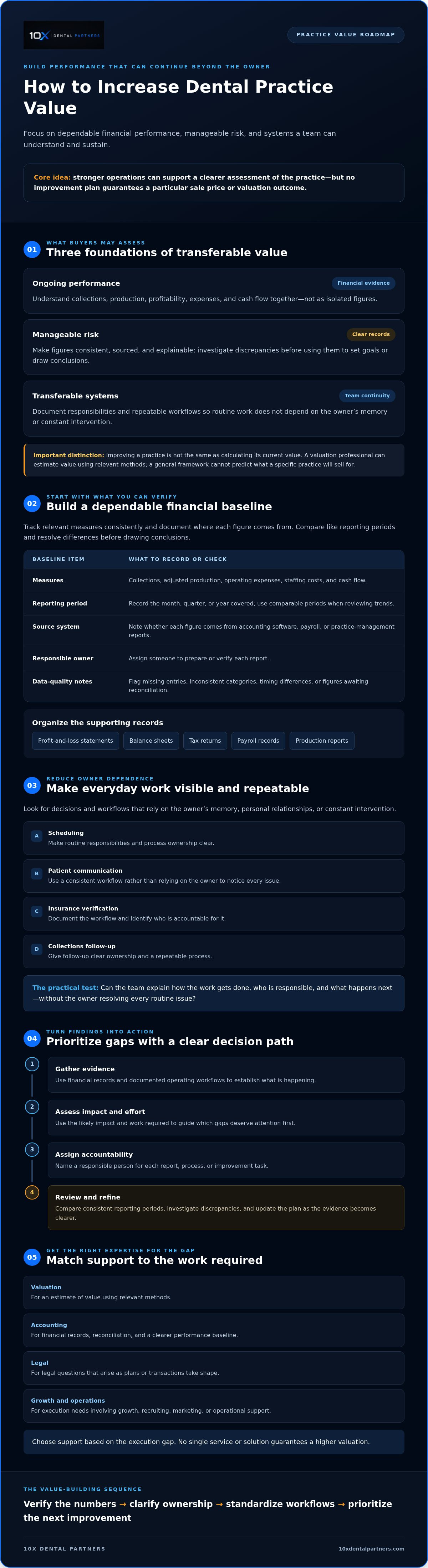
What if the strongest way to increase dental practice value isn’t simply to produce more, but to build earnings and systems that can continue without you at the center of every decision? If you’re asking how to increase dental practice value, it’s natural to focus on collections, production, or the valuation multiple. Those numbers matter, but they don’t tell the whole story. Buyers may also consider how reliably the practice performs, how dependent it is on the owner, and whether its systems can support a smooth transition.
This roadmap turns broad advice into a prioritized plan grounded in financial and operating data. You’ll review the drivers that support durable, transferable performance, including profitability, team capacity, patient flow, and consistent processes. You’ll also learn when valuation, accounting, legal, or growth-operations expertise may help close execution gaps. The goal is a stronger practice, not a promise of a particular sale price or outcome.
Key Takeaways
- Learn how to increase dental practice value by focusing on dependable performance, manageable risk, and operations that can continue beyond the owner.
- Build a reliable financial baseline by tracking key measures consistently and documenting where each figure comes from.
- Identify owner-dependent workflows in scheduling, patient communication, insurance verification, and collections follow-up.
- Turn operational gaps into a prioritized action plan, using evidence, impact, effort, and accountability to guide next steps.
- Match execution needs with appropriate growth, recruiting, marketing, or operational support without assuming any one solution guarantees a higher valuation.
How to Increase Dental Practice Value: Start With What Buyers Can Rely On
Practice value is specific to a transaction. The buyer, deal structure, financial evidence, owner’s role, and perceived risks all shape how a potential buyer may assess an opportunity. Improving the business is not the same as calculating its current value, and neither step can reliably predict a future multiple. A valuation professional can estimate value using relevant methods, while owners can strengthen the operating and financial fundamentals behind that estimate.
Transferable practice value reflects the strength of ongoing performance and systems that can be understood and sustained beyond the current owner. Buyers may consider financial performance alongside risk, transferability, and growth capacity. The underlying approaches to business valuation provide useful context, but a general framework cannot determine what a specific dental practice will sell for.
Why stronger collections alone may not tell the whole story
Collections show how much revenue the practice actually receives. Production reflects the value of dental services provided, while profitability shows what remains after operating expenses. Each answers a different question. Strong collections can coexist with high staffing costs, inconsistent cash flow, or records that make recurring earnings difficult to understand.
Review these measures together and compare them with the practice’s own history. Check whether changes in production are translating into collections, whether expenses are moving in step with revenue, and whether financial records distinguish recurring costs from unusual items. The aim is a consistent, well-supported picture, not a benchmark chosen without regard to your practice.
What makes a practice less dependent on its owner?
Start by identifying decisions and workflows that rely on the owner’s memory, personal relationships, or constant intervention. Document responsibilities, name an accountable person for each process, and make routine work repeatable. For example, patient communication and collections follow-up should have clear ownership and a consistent workflow, rather than depending on the owner to notice and resolve every issue.
That continuity helps a potential buyer understand how daily operations work and where a transition may require additional support. It also gives the team a clearer operating structure now. Owners looking to build those capabilities as they grow can explore this dental practice growth consulting guide.
So, how to increase dental practice value in a practical way? Begin with what you can verify and improve: reliable reporting, visible operating responsibilities, and workflows that don’t depend on one person. Those fundamentals won’t guarantee a particular price, but they can give you and a future buyer a clearer basis for assessing the business.
Build a Financial Baseline Before You Try to Increase Practice Value
A useful improvement plan starts with numbers you can trust. Before setting targets, build a consistent record of performance across your accounting and practice-management systems. A baseline helps you see what is changing, identify gaps that need investigation, and give professional advisers a clearer picture of the practice.
Consistent financial records make practice performance easier to assess, compare, and explain. Use a worksheet to track relevant measures and the reliability of each figure:
- Measure: Collections, adjusted production, operating expenses, staffing costs, and cash flow.
- Reporting period: Record the month, quarter, or year covered, and use comparable periods when reviewing trends.
- Source system: Note whether the figure comes from accounting software, payroll, or practice-management reports.
- Responsible owner: Assign a person to prepare or verify each report.
- Data-quality notes: Flag missing entries, inconsistent categories, timing differences, or figures still awaiting reconciliation.
This structure makes it easier to spot when two reports describe the same period differently. Resolve discrepancies before using the figures to set goals or draw conclusions.
Which financial records should an owner organize first?
Gather profit-and-loss statements, balance sheets, tax returns, payroll records, and production reports. Check that reporting periods align, then reconcile relevant totals across accounting and practice-management systems. Separate recurring operating activity from unusual, owner-specific, or nonrecurring items, but don’t assume every adjustment should be treated the same way. Ask a CPA or qualified adviser to review the accounting treatment and supporting records for proposed adjustments.
How can owners spot performance issues without chasing vanity metrics?
Review monthly and annual trends rather than reacting to one strong or weak period. Look for changes in collections, expenses, staffing costs, and payer mix, then investigate unexplained variances before setting an improvement target. For example, a rise in production deserves closer review if collections or cash flow don’t move in a similar direction. The dental practice revenue optimization framework offers additional context for connecting financial signals to operating systems.
As you determine how to increase dental practice value, use the baseline to prioritize questions, not to promise a particular outcome. If the numbers reveal execution gaps your team needs help addressing, dental revenue optimization support may be one option to assess alongside your CPA or other advisers.
Strengthen the Team and Systems That Make Performance Transferable
Documented workflows turn daily operations from individual know-how into shared infrastructure. Start by asking what happens when the owner or a key team member is unavailable. If scheduling, patient communication, insurance verification, or collections follow-up pauses because one person holds the process in their head, that’s a continuity gap to address.
Use this comparison to identify where responsibilities and steps need to become clearer:
| Owner-dependent process | Documented, delegated workflow |
|---|---|
| The owner steps in to resolve scheduling conflicts. | A designated team member follows written scheduling guidelines and knows when to escalate exceptions. |
| Patient communication varies by who handles the conversation. | Shared guidance defines responsibilities, consistent steps, and when a question needs escalation. |
| Insurance verification depends on one experienced employee. | Documented steps and cross-training support coverage when that employee is away. |
| Collections follow-up happens when someone remembers. | An assigned role follows a consistent process and records outstanding items for review. |
The goal isn’t to remove judgment from the work. It’s to make ownership, routine steps, and escalation paths visible, so the team can respond consistently and a future buyer can better understand how the practice operates.
Which operating systems should a dental owner document?
Map recurring front-office and administrative workflows from the first task through completion. For each one, record who owns it, what information or system is needed, what gets documented, and when an issue moves to a manager or clinician. Include scheduling, patient communication, insurance verification, and collections follow-up. Review privacy and security practices against current requirements, and confirm compliance questions with a qualified adviser rather than relying on an informal checklist.
How can staffing capacity support business continuity?
Assess whether trained team members can maintain essential operations during owner absences or vacancies. Review role coverage, onboarding steps, cross-training, performance-review responsibilities, and who leads recruitment. Track turnover patterns and open positions, then identify duties with no backup. A coverage plan won’t prevent every disruption, but it can make dependencies and next steps easier to manage.
For practices developing systems across multiple locations or preparing for more structured growth, the DSO infrastructure blueprint provides a related framework. As you decide how to increase dental practice value, treat workflow and staffing improvements as readiness work, not a promise of buyer demand or transaction value. The practical test is whether responsibilities are clear and essential operations can continue without constant owner intervention.
Turn Your Dental Practice Value Assessment Into a Prioritized Action Plan
An assessment is useful only if it leads to owned, reviewable actions. Convert each evidence-backed gap into a worksheet entry, then rank it by risk reduction, operational importance, and feasibility. Don’t assign a task a dollar value or assume it will change a future sale price. The purpose is to strengthen the business and track whether the underlying issue is improving.
Use these fields for every action:
- Gap: What needs attention, stated clearly.
- Evidence: The report, workflow, or staffing information that confirms it.
- Business impact: What the gap disrupts or puts at risk.
- Effort: The people, time, or coordination needed to address it.
- Owner: The person accountable for moving the action forward.
- Review date: When progress and evidence will be checked again.
Separate quick recordkeeping corrections, such as reconciling inconsistent reports, from longer-term work like cross-training, redesigning a workflow, or addressing a recruiting need. Review progress on a regular cadence, such as monthly or quarterly, and update the evidence and next steps. Bring in financial, legal, or transaction advisers when a decision depends on specialized analysis, deal terms, tax treatment, or legal obligations.
A five-step practice value readiness assessment
Use this sequence to move from broad intent to accountable work:
- Define the goal and timing. Clarify whether you’re planning for succession, a sale, a partnership, or growth.
- Assemble the information. Gather recent financial, operational, staffing, and patient-flow records relevant to that goal.
- Identify and assign. Document evidence-backed gaps, then name a responsible person for each action.
- Check progress and data quality. Confirm that the underlying information is reliable and the work is advancing.
- Escalate where needed. Consult qualified advisers when the next decision requires valuation, accounting, legal, or transaction expertise.
When should you get a professional valuation?
A planning estimate can help frame questions, but it isn’t the same as a formal valuation or deal-specific transaction advice. Seek qualified valuation and tax professionals when you’re making a decision that depends on detailed financial analysis, transaction structure, or tax consequences. For a deeper discussion of the factors behind estimated sale prices, see our separate article on how much a dental practice is worth.
A practical roadmap can reveal where execution support may help. If your priorities involve growth strategy, team capacity, or operating systems, explore dental practice growth support as one option to consider alongside your professional advisers.
Put the Right Growth Infrastructure Behind Your Value-Building Plan
Once the priorities are clear, match support to the constraint. A staffing gap, an unclear growth plan, and inconsistent patient communication call for different responses. The right support can help a practice execute its plan, but it can’t guarantee growth, sale readiness, a particular valuation, or buyer interest. Keep the focus on the operational issue you’ve identified and the evidence you’ll use to review progress.
Match support to the specific constraint, not a generic growth promise
Use growth consulting when priorities, accountability, or growth infrastructure need coordination. Consider recruiting and talent acquisition when an identified vacancy or hiring need is limiting team capacity. Marketing may be relevant if the practice has a defined need to strengthen its marketing activity; call center services may fit a patient-communication or case-acceptance gap. For scheduling, patient communication, or insurance verification needs, virtual staffing may be an option to assess.
Before implementing support, agree on a baseline measure, who owns the work, and how progress will be reviewed. For example, if the issue is incomplete insurance verification, define the workflow measure you’ll monitor, assign responsibility, and set a review date. That creates accountability without assuming a particular result.
What to prepare before speaking with a growth partner
Bring a clear picture of the goal, timeframe, team structure, and operating concerns. Share relevant financial and workflow information through appropriate secure channels, and be ready to explain what you’ve already tried. Ask how responsibilities will be divided, what reporting you’ll receive, and how often progress will be reviewed. Clear answers help you determine whether the proposed support addresses the actual constraint.
Support can involve more than one operating area. A practice might need to coordinate team capacity with patient communication systems, or align growth priorities with operational execution. 10X Dental Partners offers growth consulting, recruiting and talent acquisition, virtual staffing and outsourcing, call center services, revenue optimization, and dental marketing. Evaluate these options against your needs rather than treating them as a promise of transaction outcomes.
If you’re considering how to increase dental practice value, bring your priorities into a focused conversation. Discuss your practice goals, timeline, and operational constraints with a growth partner, then assess whether the proposed approach fits your plan.
Build a Practice That’s Ready for What Comes Next
Knowing how to increase dental practice value starts with building a business that performs consistently and can operate beyond the owner’s daily involvement. Reliable financial records help you see where improvement is needed. Clear roles and repeatable workflows make it easier to maintain continuity. A focused action plan turns those findings into accountable next steps, without treating any change as a promise of a specific valuation or sale outcome.
Execution may require coordinated support. 10X Dental Partners offers growth consulting and DSO infrastructure development, alongside recruiting, marketing, revenue optimization, and call center services. 10X Remote Assist supports scheduling, patient communication, and insurance verification. The right fit depends on your goals, timeline, and operational constraints.
Discuss your practice growth priorities with 10X Dental Partners and identify next steps that align with your plan. Start with the evidence you have, focus on the gaps that matter, and build forward with purpose.
Frequently Asked Questions
How can I increase the value of my dental practice before selling?
Focus on improving reliable earnings and reducing dependence on the owner before a sale. Start by reconciling financial records, reviewing collections alongside expenses and cash flow, and identifying recurring operational gaps. Then document key workflows, assign clear team responsibilities, and track progress against a practical action plan. These steps can strengthen the business and make its performance easier to assess, but they can’t guarantee a sale price or transaction outcome.
What makes a dental practice more attractive to a buyer?
A buyer may find a practice easier to evaluate when its financial records are consistent, its team has clear responsibilities, and essential operations don’t rely on the owner’s constant involvement. Documented processes for scheduling, patient communication, insurance verification, and follow-up can help explain how work gets done. Buyer priorities vary, so treat these as sound operating fundamentals, not a checklist that guarantees buyer interest or a particular offer.
Does increasing dental practice revenue always increase its value?
No. Higher revenue doesn’t automatically mean stronger profitability or a higher transaction value. Review collections alongside operating and staffing expenses, cash flow, and the reliability of financial records. For example, production may rise without a corresponding improvement in collections, or added revenue may come with increased costs. Compare trends over consistent reporting periods, investigate variances, and seek qualified advice before assuming a revenue change will affect value.
How important is EBITDA when valuing a dental practice?
EBITDA can be important, particularly when a larger practice or group is assessed based on ongoing cash-generating capacity. But it isn’t the only relevant measure, and the approach depends on the practice and transaction. Smaller owner-operated practices may be considered using other methods, while adjusted EBITDA requires careful review of owner compensation, personal expenses, and nonrecurring costs. Ask a qualified valuation professional to assess which measures apply to your situation.
Can better systems make a dental practice easier to sell?
Better systems can make daily operations and responsibilities easier to understand, which may help a potential buyer assess continuity and transition needs. Document who owns essential workflows, how routine tasks are completed, and where unusual issues are escalated. Cross-training can also clarify whether the team can maintain operations during an owner’s absence. These improvements support readiness, but they don’t ensure a sale, buyer demand, or a higher valuation.
When should I get a professional dental practice valuation?
Engage a qualified valuation professional when an important decision depends on a defensible, practice-specific estimate, such as planning a sale, partnership, or succession. A planning estimate is not the same as a formal valuation or transaction advice. Deal structure, financial records, the owner’s role, and the likely buyer can all affect the analysis. Consult a tax professional as well when decisions depend on tax treatment or transaction structure.
How long does it take to improve dental practice value?
There’s no fixed timeline. Correcting inconsistent records may be a near-term priority, while strengthening team coverage, documenting workflows, or addressing staffing gaps can require sustained implementation and review. The timeframe also depends on the practice’s starting point and goals. Set review dates, track evidence of progress, and adjust the plan as needed. Begin early if you’re preparing for a transition, rather than assuming improvements can be made at the last minute.


