
DSO Advisory Services: How to Choose the Right Growth Partner in 2026

More locations don’t automatically create a stronger dental group. As practices join a growing organization, differences in staffing, patient communication, revenue processes, and leadership can turn expansion into operational strain. The real test is whether DSO advisory services connect growth decisions to the people, systems, and shared infrastructure needed to support them.
Leaders may know they need more structure but lack a clear sequence for building it. They may also be unsure whether a provider offers strategic guidance, transaction support, or legal services. This article explains how to define the advisory scope that fits your group’s stage, assess provider fit, and turn growth plans into practical work without confusing distinct roles.
We’ll examine what effective DSO advisory should cover and how to evaluate a potential growth partner. From operating priorities and talent needs to marketing, revenue operations, and virtual support, the focus is alignment: build a foundation before complexity compounds. You’ll also find questions that reveal whether a partner can help put the plan into action, and when legal or transaction specialists belong at the table.
Key Takeaways
- Match DSO advisory services to your group’s growth stage and the operational challenges you need to solve first.
- Translate strategic priorities into repeatable systems, clear ownership, and adoption across locations.
- Compare advisors by scope, deliverables, implementation support, expertise, and accountability. Keep operational guidance distinct from legal, accounting, valuation, and deal services.
- Prepare for an engagement by defining objectives, gathering location-level information, assigning internal owners, and setting a review cadence.
- Assess whether connected capabilities such as recruiting, marketing, revenue optimization, and virtual staffing fit the needs in your growth plan.
What DSO advisory services should solve as a dental group grows
DSO advisory services provide strategic and operational guidance to help a dental group plan growth and build the leadership, shared services, talent, and systems needed to support multiple locations. A group can add practices without creating a consistent operating model. Advisory work connects the growth plan to the infrastructure required to carry it out. For background on the organization model, see this overview of Dental service organizations (DSOs).
Growth changes the work of leading a practice group. Decisions that once sat with an owner may need clear decision rights across group leadership and location teams. Recruiting needs can expand, shared services may need to support more sites, and leaders need a reliable way to assign and review accountability. Without those connections, each new location can bring its own workflows and exceptions instead of strengthening the organization as a whole.
When a dental group needs advisory support
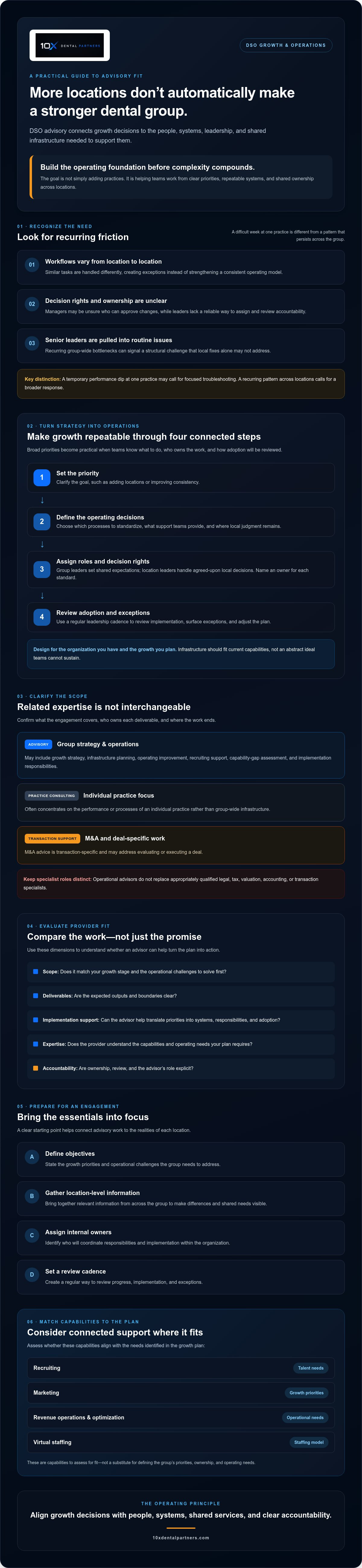
Look for recurring friction, not just a difficult week. Locations may handle similar tasks differently, managers may be unsure who can approve changes, or senior leaders may spend time on routine issues instead of group-level priorities. These patterns can point to a structural challenge when they occur across locations or persist despite local fixes. A temporary performance dip at one practice may call for focused troubleshooting; a recurring group-wide pattern calls for a broader response. Adding locations before defining operating systems and ownership can multiply variation and decision bottlenecks.
What DSO advisory services do and do not include
The scope should match the group’s needs. It may include growth strategy, infrastructure planning, operating improvement, and recruiting support. General practice consulting often concentrates on the performance or processes of an individual practice. DSO infrastructure development focuses on how leadership, shared functions, and operating systems work across a group. M&A advice is transaction-specific and may address evaluating or executing a deal. These scopes can intersect, but they aren’t interchangeable.
Advisors can help define priorities, identify capability gaps, and organize implementation responsibilities. They don’t replace appropriately qualified legal, tax, valuation, or transaction specialists. Before work begins, confirm who owns each deliverable and where the engagement ends. For a deeper look at the operating foundation, review this DSO infrastructure development blueprint.
How DSO advisory turns growth strategy into operating infrastructure
Growth strategy becomes repeatable when people know what to do, systems make the work clear, and leaders can see whether each location is adopting the plan. DSO advisory services help translate broad priorities, such as adding locations or improving consistency, into operating decisions: which processes to standardize, who owns them, what support teams provide, and how progress is reviewed.
Start by turning each priority into an operational sequence. If the goal is to support more locations, leaders might define which functions belong centrally, identify the roles needed to support them, and assign responsibility for rollout. Governance clarifies decision rights: group leaders set shared expectations, while location leaders handle agreed-upon local decisions. A regular leadership cadence gives owners a place to review implementation, surface exceptions, and adjust the plan. The Academy of General Dentistry’s To DSO or Not to DSO? offers a balanced discussion of DSO models and considerations for dentists, useful context when assessing how a group’s structure should support its goals.
Build the core systems before adding complexity
Decide which workflows need a consistent group-wide foundation and where local judgment should remain. For example, a group might set shared expectations for reporting or administrative handoffs while allowing locations to organize daily schedules in ways that fit their needs. Name an accountable owner for each standard, document how changes are approved, and set a review rhythm. Infrastructure should fit current capabilities and planned growth, not an abstract ideal that teams can’t sustain.
Keep the feedback loop practical. Location leaders need a clear route to flag a process that isn’t working as intended. Group leadership needs enough visibility to distinguish a local exception from a pattern that may require a broader change.
Coordinate people, technology, and shared services
Map responsibilities against actual capacity. Recruiting plans should reflect the roles the group needs, while shared services should have defined responsibilities and escalation paths. Technology can support those workflows, but tools alone won’t resolve unclear ownership. Scheduling, patient communication, and insurance verification, for example, may be handled through local teams, centralized functions, or remote support, depending on the group’s design and needs.
Assess workload, handoffs, and communication requirements before choosing a model. For groups considering remote administrative support, this virtual staffing guide for dental offices can help frame the evaluation. 10X Dental Partners lists virtual staffing, recruiting, and DSO infrastructure development among its capabilities. Explore its growth consulting support as one option when evaluating execution needs.
How to compare DSO advisors, consultants, and M&A specialists
Provider titles can blur together. Compare what each professional is responsible for, what they will deliver, and who will carry the work forward. DSO advisory services may guide growth strategy and operating infrastructure, while practice consultants may focus on defined performance or process needs. M&A specialists support transaction-related work. One provider may cover more than one area, but don’t assume that from a label alone.
| Growth or DSO advisor | Practice consultant | M&A specialist | |
|---|---|---|---|
| Scope | Group strategy, infrastructure, and operating priorities | Defined practice or functional challenges | Transaction readiness, evaluation, or execution, depending on the engagement |
| Typical deliverables | Priorities, operating plans, role clarity, and implementation roadmap | Assessment and recommendations for the agreed focus area | Deal-specific analysis, advice, or transaction work within the specialist’s remit |
| Implementation support | May help coordinate adoption and follow-through; confirm explicitly | Varies by engagement | Usually tied to transaction responsibilities, not ongoing group operations |
| Expertise to verify | Multi-location growth and infrastructure development | Relevant practice or functional experience | Relevant legal, financial, tax, valuation, or transaction expertise |
| Accountability | Clarify owners, milestones, and review cadence | Confirm who acts on recommendations | Define transaction-specific responsibilities and decision points |
Acquisition integration can involve both tracks. A transaction may require qualified legal, financial, tax, and valuation professionals, while operational advisors help the group plan how leadership, staffing, shared services, and workflows will function after a practice joins. Keep those responsibilities distinct and confirm which professionals are accountable for each deliverable. For broader context on growth consulting, see this dental practice growth consulting guide.
Questions to ask before selecting a DSO advisor
Get specific before signing. Ask which operating problems the engagement will address, what work is out of scope, who will work directly with your leadership team, and how progress and unresolved issues will be reviewed. If a provider shares examples, ask what work they performed. Request references only with the organization’s permission. Look for clear evidence, not unsupported promises.
Recommendations also need owners. Ask who is responsible for turning each recommendation into a decision or action, how the advisor supports follow-through, and what happens if implementation stalls. A well-defined engagement makes responsibilities visible from the outset. Your team should understand what it must provide, what the advisor will deliver, and when both sides will assess progress.
How to prepare for a DSO advisory engagement
Preparation gives an advisor a clearer view of the decisions ahead and helps leadership scope the work realistically. Before engaging DSO advisory services, define the questions you need answered, assemble what’s already known, name internal owners, and agree on how progress will be reviewed. This sequence helps distinguish documented facts from assumptions and turns an open-ended discussion into a working plan.
Set the engagement goals and baseline
Start with the business questions, not a preferred solution. Are you preparing to add locations, clarifying central versus local responsibilities, addressing inconsistent workflows, or assessing staffing capacity? Then gather available information that can help answer those questions. A useful preparation sequence is:
- Define objectives: Write down the decisions leadership needs to make and the outcomes the engagement should inform.
- Gather a baseline: Collect available location-level information on staffing, workflows, patient communication, and existing systems. Review how processes differ across locations without assuming every variation is a problem.
- Record gaps and constraints: Note missing information, working assumptions, dependencies, and operational limits that could affect the plan.
- Assign owners: Identify the leaders who can provide information, make decisions, and coordinate each workstream.
- Set a review cadence: Agree on how often the team will assess progress, resolve open questions, and update priorities.
Keep the baseline useful, not perfect. If a report is incomplete or teams define a process differently, record that limitation instead of filling the gap with an estimate presented as fact. This gives the advisor a more accurate starting point and helps leadership decide whether the first task is analysis, alignment, or implementation.
Agree on ownership, milestones, and implementation
Before work begins, confirm who has authority to approve decisions and who will carry them through at group and location levels. Break the engagement into practical milestones, such as completing a current-state review, agreeing on priorities, assigning owners, and reviewing early adoption. The right milestones depend on the scope and the group’s capacity. Clarify how leaders will assess progress and raise issues that require a decision or outside specialist input.
For related planning considerations, see this five-location scaling roadmap. If you’re defining priorities for multi-location growth, explore 10X Dental Partners’ growth consulting support as one option to evaluate.
How 10X Dental Partners can support a DSO growth plan
A growth plan is only useful if the organization has the capacity and support to act on it. 10X Dental Partners offers strategic consulting and DSO infrastructure development, alongside recruiting, marketing, revenue optimization, virtual staffing, and call center support. These capabilities can support different parts of a group’s operating plan. The right scope depends on your priorities, current systems, and the people available to lead the work.
Match the support model to the organization’s priorities
Start with the constraint you’re trying to address. If leadership needs a clearer structure for multi-location growth, strategic consulting and infrastructure development may be relevant. If staffing capacity or hiring is a pressure point, recruiting and virtual staffing are separate capabilities to evaluate. Marketing and revenue optimization may support other priorities. Each capability should connect to a defined need, rather than be added simply because it’s available.
Administrative responsibilities also deserve a deliberate design. 10X Remote Assist supports scheduling, patient communication, and insurance verification. Consider whether those tasks fit your existing workflows, where handoffs would sit, and how the arrangement would work with your current systems and team responsibilities. No single support model fits every group.
Use the same selection criteria discussed earlier: clarify the work in scope, identify who will be involved, and confirm how responsibilities and progress will be reviewed. Ask how the proposed support relates to your growth objectives and execution capacity. The aim is to determine fit, not assume that a collection of services automatically forms the right operating model.
Choose a clear next step
Before an initial conversation, bring a concise view of your growth objectives, current constraints, and the questions leadership needs answered. Note which locations or functions are most affected, what systems are already in place, and where ownership is unclear. That context can help both sides assess whether the proposed DSO advisory services and related support align with the work your group needs.
Keep specialist responsibilities clear. Legal, tax, valuation, and transaction matters may require separate qualified professionals; 10X Dental Partners does not replace those specialists. To assess whether the service scope fits, discuss your DSO growth priorities with 10X Dental Partners.
Build the Foundation for Your Next Stage of Growth
Sustainable multi-location growth depends on more than adding practices. It requires clear decision rights, shared systems, accountable owners, and the capacity to put plans into practice. The right DSO advisory services should match your group’s stage and connect strategic priorities to an achievable operating plan.
As you evaluate partners, define the problems you need solved, clarify what’s in scope, and ask who will support implementation. Keep strategic and operational guidance distinct from legal, tax, valuation, and transaction responsibilities, which may require separate specialists.
10X Dental Partners offers strategic consulting and DSO infrastructure development, along with recruiting, marketing, revenue optimization, and virtual staffing support. The right combination depends on your goals, current systems, and execution capacity. Review 10X Dental Partners’ growth consulting support to assess whether its service scope fits your organization. With clear priorities and the right support in place, your next stage of growth can begin on a stronger foundation.
Frequently Asked Questions
What do DSO advisory services include?
DSO advisory services typically cover strategic and operational guidance to build a dental group’s capacity to grow. Depending on the provider and engagement, this may include growth planning, infrastructure design, leadership roles, shared services, recruiting needs, and operational improvement. Some advisors also support implementation planning or follow-through. Offerings vary, so confirm the specific deliverables, who will do the work, what your team must own, and which services are outside the engagement.
When should a dental practice consider DSO advisory services?
Consider advisory support when growth or recurring operational friction exposes gaps in how the organization works. Signals can include inconsistent workflows across locations, unclear decision rights, leadership stretched by routine issues, or recruiting and shared-service needs that current systems don’t address. There’s no universal location-count threshold. A temporary issue at one practice may need focused troubleshooting, while a persistent pattern across the group may call for structural planning.
How do I choose a DSO advisory firm?
Choose a firm by matching its scope and relevant experience to the operating problems you need to address. Ask for specific deliverables, who will work with your leadership team, how communication and progress reviews will happen, and who owns implementation tasks. Request examples that relate to your needs, and verify them through references or other evidence when available and permitted. A clear explanation of limitations and out-of-scope work is also a useful selection signal.
Are DSO advisory services the same as dental M&A consulting?
No. DSO advisory typically focuses on growth strategy, organizational infrastructure, and operational priorities. Dental M&A consulting is transaction-specific and may involve deal readiness, evaluation, or execution, depending on the provider’s qualifications and scope. Legal counsel, financial and tax advice, and valuation work require appropriately qualified specialists. A group may need both operational guidance and transaction expertise, but confirm responsibilities in writing so one provider’s role isn’t mistaken for another’s.
Can a DSO advisor help integrate an acquired dental practice?
A DSO advisor may help plan operational integration by clarifying leadership responsibilities, reviewing workflows, identifying staffing needs, and coordinating how shared services fit into the group. The specific support depends on the advisor’s expertise and engagement scope. Transaction execution, legal review, financial and tax advice, and valuation are separate specialist responsibilities. Define handoffs between the advisor and qualified transaction professionals so operational planning supports integration without being confused with deal advice.
What information should I prepare before hiring a DSO advisor?
Prepare your growth objectives, the decisions leadership needs to make, and the constraints that could affect execution. Gather available location-level information on staffing, workflows, patient communication, and current systems, noting gaps rather than filling them with guesses. Identify decision-makers and potential owners for major workstreams. A concise list of open questions, dependencies, and assumptions helps a prospective advisor understand your starting point and determine whether the proposed scope fits.
How can a dental group tell whether an advisory engagement is working?
Assess progress against the milestones, deliverables, and ownership agreed on at the start. Review whether decisions are being made, assigned work is advancing, and planned changes are being adopted where intended. Use a consistent review cadence to surface delays, dependencies, and issues that need leadership input. Compare progress with the group’s documented starting point, not an assumed universal benchmark. This creates accountability without treating any specific business result as guaranteed.
To discuss your growth objectives and assess whether 10X Dental Partners’ consulting and operational support fit your needs, contact 10X Dental Partners.


