
Dental Insurance Verification Outsourcing: The 2026 Strategic Resource Guide

Insurance verification is the first step in a patient’s financial conversation, not just another front-desk task. When your team spends time on hold, staff turnover disrupts follow-through, and incomplete estimates create collection friction, dental insurance verification outsourcing can make the process more consistent and easier to manage.
The right service should fit your practice’s workflow and provide useful benefit details, clearer patient estimates, and a reliable handoff from verification to case presentation. To assess that fit, look beyond how quickly checks are completed. Consider what information is collected, how exceptions are handled, and where the results are recorded.
This guide explains how to compare outsourcing models, assess workflow fit, and choose a partner that can support your practice as it grows. It also covers how 10X Remote Assist connects trained professionals with scheduling and verification work as part of a broader approach to practice growth.
Key Takeaways
- Benefit breakdowns can give your team a stronger basis for patient estimates than eligibility checks alone.
- Compare AI-only and human-led workflows to see where automation helps and where review by a trained person adds value.
- Dental insurance verification outsourcing can support clearer cost conversations and smoother case presentation.
- Assess workflow fit, practice management system handoffs, and how verified information is recorded.
- 10X Remote Assist connects verification with scheduling and patient communication as part of a virtual staffing approach.
What is Dental Insurance Verification Outsourcing?
Dental insurance verification outsourcing delegates eligibility checks and benefit breakdowns to an outside team. It does more than move phone calls off the front desk. Verification is an early control point in Revenue cycle management (RCM): the information gathered before treatment can inform patient estimates, treatment discussions, claim preparation, and payment follow-up.
A basic eligibility check indicates whether coverage appears active. A more useful verification process gathers the details staff need to explain expected coverage and patient responsibility. That means checking relevant plan terms, recording limitations, and flagging information that needs clarification. Actionable benefit information is especially important when a practice is preparing for scaling a dental practice across more providers or locations.
The Core Components of Modern Verification
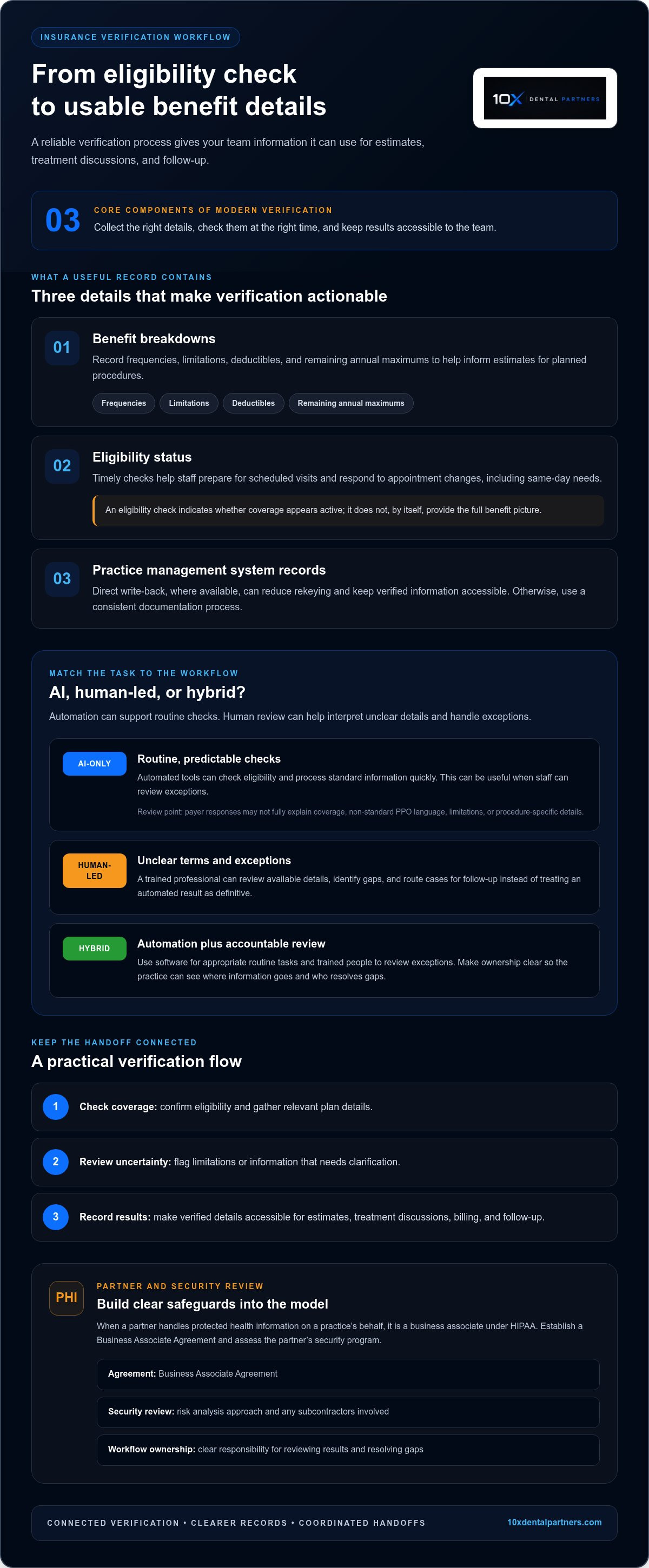
A complete workflow organizes relevant coverage details so the team can use them without piecing together scattered notes. It can include:
- Benefit breakdowns: Frequencies, limitations, deductibles, and remaining annual maximums help inform estimates for planned procedures.
- Eligibility status: Timely checks help staff prepare for scheduled visits and respond to appointment changes, including same-day needs.
- Practice management system records: Direct write-back, where available, can reduce rekeying and keep verified information accessible. If results are entered another way, use a consistent documentation process.
These details connect verification to the next steps. Staff can prepare a clearer estimate, and the practice has an organized record to support billing and follow-up.
Why In-House Verification Often Fails
The issue is rarely a lack of commitment from an in-house team. Verification competes with calls, check-ins, scheduling, and patient questions. An employee who is on hold is not available to coordinate care or support patients in the office. When staffing is stretched, checks can become inconsistent or rushed.
Manual entry creates another opportunity for errors. A mistyped date, overlooked limitation, or misplaced benefit note can contribute to an estimate that differs from the payer’s processing, leading to rework and difficult collection conversations. Frequent interruptions can also make administrative work harder to sustain.
Dental insurance verification outsourcing is best treated as operational infrastructure, not an isolated task. 10X Remote Assist provides trained professionals for scheduling and verification, helping practices add skilled support to their operating workflows. The aim is to protect front-desk capacity and give the revenue cycle a more reliable starting point.
AI vs. Human-Led Verification: Choosing the Right Model
AI can speed up routine eligibility checks, but speed alone does not make a verification process reliable. Match each task to the right level of automation and review. A high-volume practice may use software for repeatable checks, while complex benefit questions may need a trained person to interpret details and handle exceptions. A hybrid workflow can combine efficiency with accountability rather than forcing a choice between technology and people.
The AI Automation Framework
Automated tools can check eligibility and process standard information quickly, which makes them useful for a high volume of predictable cases. But a response from a payer system may not fully explain coverage. Non-standard PPO language, limitations, or procedure-specific details can require interpretation, not just data extraction.
Software may be a good starting point when the main need is automating routine checks and staff can review exceptions. Before adopting a platform, map which steps it automates, which results need human review, and how information reaches the practice management system. A fast check only helps when the result is accurate, accessible, and acted on.
The Virtual Staffing Advantage
Human review is particularly useful when plan terms are unclear or do not fit a standard pattern. A trained professional can review the available details, identify gaps, and route cases for follow-up instead of treating an automated result as definitive.
10X Remote Assist provides trained professionals for scheduling and verification, bringing human support into administrative workflows. Clear processes and communication guidelines help remote team members follow the practice’s preferred patient-facing approach. The goal is a coordinated front desk, not a disconnected handoff among software, remote staff, and in-office employees.
Build Security Into the Model
Include patient information handling in your technology and partner review. When an outsourcing partner handles protected health information on a practice’s behalf, it is a business associate under HIPAA. Practices should establish a Business Associate Agreement and assess the partner’s security program, including its approach to risk analysis and any subcontractors involved in the work.
Choose a workflow with clear ownership: software handles appropriate routine tasks, trained people review exceptions, and the practice can see where information goes and who is responsible for resolving gaps. For practices considering how virtual support fits into a wider operating model, 10X Dental Partners’ growth resources explore the strategic role of integrated support.
The ROI of Precision: Driving Case Acceptance Through Verification
Insurance information shapes the financial conversation before treatment begins. When an estimate is based on verified benefits, the treatment coordinator can explain expected coverage and patient responsibility more clearly. That can help patients understand the costs involved and make a more informed decision about how to proceed.
Verification is not a promise that a payer will cover a procedure or pay a particular amount. It is a disciplined way to gather and document available benefit information, explain its limits, and prepare patients for possible differences between an estimate and the final explanation of benefits. Transparency helps build trust among the patient, coordinator, and doctor.
From Verification to The Closing Experts
High-production treatment plans, including implants and full-arch cases, call for careful financial preparation. Coverage details, limitations, and patient responsibility can affect the discussion. Verify relevant benefits and distinguish confirmed information from estimates. Precision supports the conversation, but it does not guarantee coverage or a particular case outcome.
With a clearer financial picture, a treatment coordinator can address questions without first having to reconstruct benefit details. The Closing Experts supports high-production case acceptance, where clear information helps teams guide patients through decisions without pressure. When a patient says, “I need to think about it,” financial clarity can help identify whether the concern is coverage, affordability, timing, or something else.
Eliminating Revenue Leaks
Poor verification can create avoidable revenue-cycle friction in three common places:
- Incomplete benefit details: Missing frequencies or limitations can lead to estimates that do not reflect plan terms.
- Data-entry mistakes: Incorrect or incomplete information can contribute to claim errors, follow-up work, and delayed payment.
- Unclear patient estimates: A difference between the amount discussed and the payer’s final response can lead to retroactive billing and difficult conversations.
Better information will not eliminate every denial or payment variation. It can help the practice identify questions earlier, document the basis for an estimate, and explain uncertainty before treatment rather than after a claim is processed. This supports transparency for patients and can reduce avoidable rework for staff.
Dental insurance verification outsourcing can give this work a defined place in the revenue workflow instead of leaving it to compete with every front-desk interruption. When reliable information informs staffing and process decisions, it can also support dental practice overhead reduction by helping the practice focus resources on patient communication and sustainable operations.
Evaluating Outsourcing Partners: A Resource Checklist
A verification partner should fit the way your practice operates now and support the structure you are building. Evaluate more than task completion. Review workflow ownership, information quality, security practices, reporting, and the ability to support consistent processes as your organization grows.
Start with the technical handoffs. Open Dental, Dentrix, and Eaglesoft are common examples of practice management systems, but compatibility alone is not enough. Map how results enter the system: through direct write-back, another structured workflow, or manual entry. Identify which fields are populated, how exceptions are flagged, and who resolves missing information. This helps prevent a new service from creating an extra layer of work.
Assess the Workflow, Not Just the Software
For new-patient benefit breakdowns, define what information is needed, when it must be available, and how urgent or incomplete cases are handled. Establish a process for disputed coverage details and missing payer information, including when an issue returns to your in-house team. Useful performance measures can include completion timeliness, information completeness, exception resolution, and rework. These measures make service quality visible without reducing it to speed alone.
Make security part of the evaluation from the outset. If a partner handles protected health information, clarify responsibilities through a Business Associate Agreement and review how the partner manages data access, security risk analysis, and subcontractors. The workflow should make ownership and escalation paths clear.
Evaluate Strategic Fit and Scalability
For a growing practice, repeatable processes matter. A partner should be able to work within defined procedures across locations and support the reporting and operational visibility leadership needs. Assess dental insurance verification outsourcing as part of your infrastructure, not just as a stand-alone administrative fix. Consider how the model could develop alongside DSO infrastructure.
10X Remote Assist provides trained professionals for scheduling and verification as part of a broader virtual staffing approach. 10X Dental Partners combines operational support with strategic consulting to help practices grow. As you design any workflow, define how team members use dental terminology, communicate with patients, and coordinate with in-office staff so the patient experience stays consistent.
Finally, compare contract terms with your growth plans. Review renewal terms, scope changes, transition responsibilities, and performance reviews. To explore a growth-oriented approach to virtual support, review 10X Dental Partners’ practice support approach.
Scaling with 10X Remote Assist: The Integrated Solution
Verification works best as part of an operating system, not as a task isolated from the rest of the front desk. 10X Remote Assist provides trained professionals for scheduling and verification, helping practices connect administrative workflows with patient communication and broader growth priorities. As a practice adds providers or locations, consistent processes can support expansion without placing every new task on the in-office team.
For example, verification information can prepare the team for the next patient conversation, while scheduling and communication workflows help keep appointments moving. Aligning these functions creates a more coordinated front-desk experience. See how remote patient communication can contribute to that approach.
The 10X Difference in Virtual Staffing
10X Remote Assist provides virtual staffing support, not simply a verification handoff. Remote professionals work within practice operating workflows, supporting scheduling and verification as an extension of the in-office team. The focus is on strengthening capacity and supporting revenue optimization, not just counting completed tasks.
This operating perspective can also support practices with high-production programs like Fast Arches, where coordination across administrative touchpoints helps teams manage patient interactions consistently. Dental insurance verification outsourcing can contribute to the infrastructure, while the connection between people, processes, and technology supports a scalable model.
Your Roadmap to Scaling
Growth does not require a solo practice to solve every operational challenge at once. Start by mapping the work: where verification begins, how information is recorded, who follows up on gaps, and how verified benefits inform scheduling and patient conversations. Then identify recurring bottlenecks, such as interruptions, inconsistent documentation, or tasks that depend on one staff member.
- Document the current workflow: Track handoffs from eligibility check through estimate preparation and follow-up.
- Define ownership: Clarify which tasks belong to remote professionals, in-office staff, and practice leadership.
- Set useful measures: Monitor completion, exceptions, rework, and how smoothly information moves across the team.
- Plan for the next stage: Build repeatable processes that can serve additional providers or locations.
This operational review gives leadership a practical starting point for reducing administrative strain and assessing where virtual staffing fits. 10X Dental Partners brings together people, technology, and strategic consulting to help practices build DSO-level infrastructure. To explore how that approach could support your growth plans, explore growth consulting with 10X Dental Partners.
Build a More Predictable Path to Practice Growth
Verification is more than a front-desk task. It is an early control point in your revenue cycle that can shape patient estimates, case discussions, and the work that follows. A strong process combines detailed benefit information, appropriate human review, and workflows that can keep pace as your practice grows.
Dental insurance verification outsourcing can reduce administrative strain when it connects to a broader operating model. 10X Remote Assist provides virtual staffing for scheduling and verification, while The Closing Experts supports high-production case acceptance. Alongside strategic growth and DSO infrastructure expertise, these services help practices build a more coordinated foundation for scale.
Ready to make verification part of a stronger growth plan? Scale your practice with 10X Remote Assist and take the next step toward a more focused operation. Build systems that support your team as your practice grows.
Frequently Asked Questions
What is the typical cost structure for dental insurance verification outsourcing?
Pricing models commonly vary by verification volume, service scope, and staffing arrangement. Options may include per-verification fees, a monthly plan, or dedicated staffing. Compare what each model includes, such as detailed benefit breakdowns, exception handling, onboarding, and reporting. Evaluate the full scope against your expected workload rather than focusing on a single unit price.
How does outsourced verification integrate with my existing dental software?
Integration depends on the workflow and your practice management system. Information may be entered through direct write-back, another structured process, or manual entry. Before implementation, map which benefit fields are recorded, how exceptions are flagged, and who corrects missing data. The goal is to make useful information available in your established workflow while minimizing duplicate entry and unclear handoffs.
Will outsourcing insurance verification affect my relationship with patients?
It does not have to. A coordinated remote team can support scheduling and verification behind the scenes while your in-office team remains central to patient conversations. Set communication guidelines, clarify who owns patient questions, and define handoff procedures so patients receive consistent information. Staff should distinguish verified benefits from estimates and explain that payer decisions may affect final responsibility.
Can an outsourced service handle complex PPO optimization and negotiations?
Verification and PPO contract negotiations are different functions. A verification team can gather plan details, document limitations, identify unclear coverage, and route discrepancies for review. Contract analysis or negotiation is a separate strategic process, so define the scope clearly. 10X Dental Partners also provides Revenue Optimization and strategic growth support as part of its practice operations focus.
How quickly can a dental practice see ROI from outsourcing verification?
There is no universal timeline. Results depend on staffing demands, verification volume, workflow design, and how consistently the team uses the information. Establish a baseline for staff time, incomplete records, rework, estimate adjustments, and patient payment follow-up. Review those measures alongside outsourcing expenses over time to assess whether the model is freeing capacity and improving financial clarity.
What is the difference between a billing service and a verification service?
A verification service gathers eligibility and benefit information before treatment, helping the team prepare estimates and identify coverage questions. A billing service generally supports work after care, such as claim submission, payment posting, or accounts follow-up, depending on its scope. The functions are connected but not interchangeable. Clarify which revenue-cycle tasks are included and how information passes among verification, treatment planning, and billing.
How do I ensure HIPAA compliance when using a virtual staffing solution?
When a virtual staffing partner handles protected health information, include security and responsibility in implementation planning. Establish a Business Associate Agreement, review the partner’s security risk analysis and safeguards, and understand how it manages access, incidents, and subcontractors. Define your internal access controls and workflows as well. Compliance depends on coordinated practices, not simply choosing a vendor or signing an agreement.
Is outsourcing suitable for a single-location practice or only for DSOs?
Outsourcing can suit a single-location practice as well as a multi-location group. An independent office may use virtual support to strengthen scheduling and verification capacity, while a DSO may value repeatable workflows across locations. 10X Remote Assist supports dental practices with trained professionals, and 10X Dental Partners provides DSO-level infrastructure support to help independent practices build toward sustainable growth.


