
Dental Practice Profitability Analysis: A Practical Checklist for 2026

What if your practice is collecting more but keeping less? A dental practice profitability analysis looks beyond revenue and cash flow to show where profit is being lost, and whether the cause is rising costs, production gaps, or collection issues.
It’s easy to see a weak month in the numbers. It’s harder to tell whether it signals a lasting performance problem or a one-time fluctuation. Without that distinction, decisions about staffing, scheduling, expenses, and growth can miss the real constraint.
This practical checklist will help you build a reliable financial baseline, connect changes in profitability to the operating systems behind them, and prioritize measurable next steps. You’ll review key revenue and expense categories, examine production and collection workflows, and separate persistent patterns from temporary shifts. The goal is a clearer view of what’s driving results, plus a disciplined way to track whether changes are working across your people, processes, and patient communication.
Key Takeaways
- A useful dental practice profitability analysis connects financial results to the operating activity behind them.
- Set a consistent reporting period and use reliable source records before comparing performance.
- Separate revenue-side and expense-side drivers, then assess your practice’s trends before relying on outside benchmarks.
- Turn verified findings into specific improvement questions, ranked by impact, effort, ownership, and measurement.
- Build a recurring review process that links financial reporting to operational support and follow-through.
What Dental Practice Profitability Analysis Reveals Beyond Revenue
A dental practice profitability analysis examines financial results alongside the operating activity that produced them. It looks beyond whether the practice billed more or collected more to ask what remained after expenses, how consistently the practice converted production into cash, and which workflows shaped the result.
Profitability is the financial return left after operating costs are accounted for; production measures the value of services delivered, while cash flow tracks money moving in and out of the practice. These measures are related, but they answer different questions. Production may rise without an equal increase in collections. Revenue reflects income recorded under the practice’s accounting method, while operating profit shows what remains after operating expenses. Owner compensation also matters: depending on how it’s recorded, it can change the apparent profit available to the owner. Rising revenue alone doesn’t establish stronger financial health if expenses increase faster, collections lag, or cash is tied up elsewhere.
This broader view follows the principles of financial analysis: interpret financial information in context, rather than treating a single figure as a verdict. For a dental practice, that context includes team capacity, scheduling, patient communication, and the processes that support production and collections.
Which financial measures belong in the first review?
Start with three complementary views. The income statement summarizes performance over a period; the balance sheet shows assets, liabilities, and equity at a point in time; cash flow information tracks how cash moved during the period. Together, they help distinguish reported profit from available cash and financial obligations. Separate recurring operating expenses from unusual or one-time items, and document how owner compensation is classified before comparing periods. Otherwise, a change in bookkeeping can look like a change in performance.
What makes a dental practice analysis useful?
Begin with a decision question, such as whether weaker operating profit reflects higher expenses or a slowdown in collected production. Compare like periods using consistent definitions, and record any changes in accounting treatment. Then connect each observation to something operational you can investigate: a collections pattern may prompt a review of insurance follow-up, while a staffing expense shift may lead you to examine coverage and scheduling. The analysis becomes useful when it directs a specific next question, not just another report.
Prepare a Reliable Dental Practice Profitability Checklist
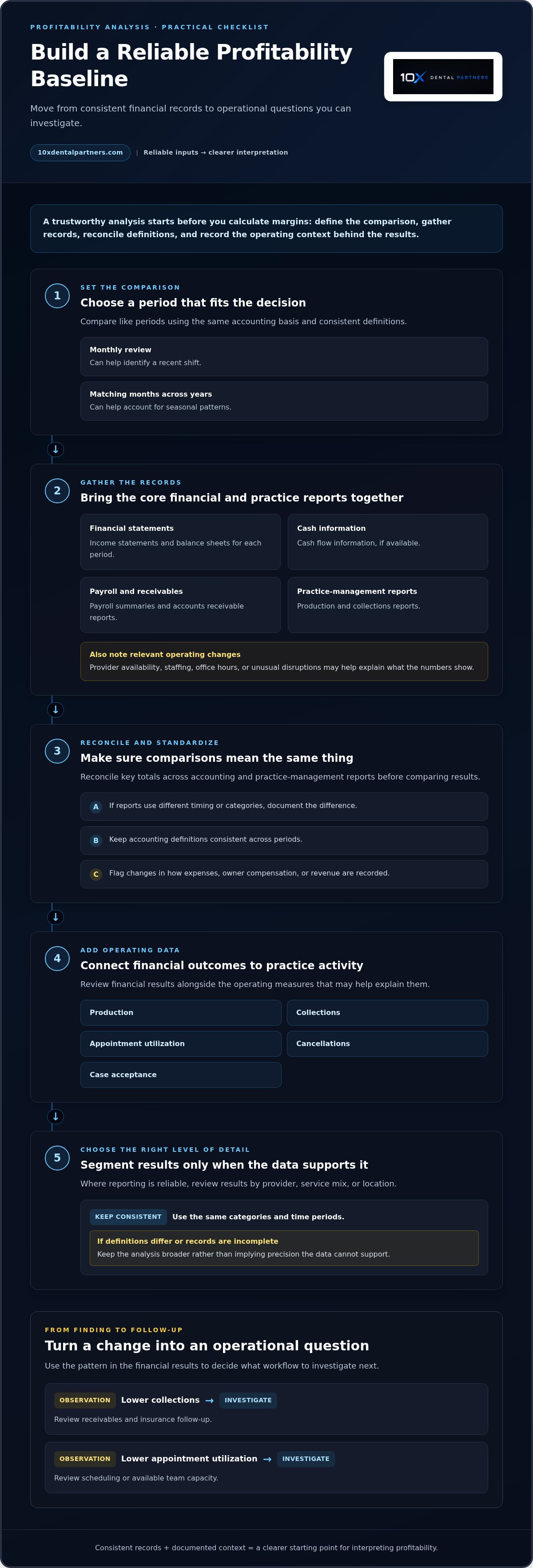
A useful analysis starts with inputs you can trust. Before calculating margins or comparing results, define the reporting period, assemble the records, and note operational changes that may explain what the numbers show. You don’t need a specific software platform; you do need consistent definitions and records that can be reconciled.
Gather financial records and define the comparison period
Choose a period that fits the decision you’re making, then compare it with a like period using the same accounting basis. A monthly review may help identify a recent shift, while comparing matching months across years can help account for seasonal patterns. Record changes such as provider availability, staffing, office hours, or unusual disruptions so they aren’t mistaken for a lasting trend.
Assemble the core financial records:
- Income statements and balance sheets for each period
- Cash flow information, if available
- Payroll summaries and accounts receivable reports
- Practice-management reports for production and collections
Reconcile key totals across accounting and practice-management reports. For example, if the production report and income statement use different timing or categories, document the difference before comparing them. Keep accounting definitions consistent, and flag any change in how expenses, owner compensation, or revenue are recorded.
Add operating data that explains the financial results
Financial records show the outcome; operating data helps explain it. Review production and collections alongside appointment utilization, cancellations, and case acceptance. If a measure changes, look for an operational connection: lower collections may prompt a review of receivables and insurance follow-up, while lower appointment utilization may lead to questions about scheduling or available team capacity.
Where reporting is reliable, segment results by provider, service mix, or location. Use the same categories and time periods across comparisons. If definitions differ or records are incomplete, keep the analysis at a broader level rather than implying precision the data can’t support. For a closer look at how operating workflows connect to revenue outcomes, explore this dental practice revenue optimization framework.
A reliable profitability checklist brings together consistent-period financial statements, payroll and receivables records, practice-management reports, and documented operating context. With that foundation in place, you can interpret changes more confidently and investigate the right drivers instead of reacting to an isolated number.
Interpret Profitability Drivers Without Misusing Benchmarks
Once the records are assembled, separate what’s happening on the revenue side from what’s happening on the expense side. That distinction keeps a lower profit figure from becoming a premature verdict about the whole practice. In a dental practice profitability analysis, the aim is to trace patterns, test plausible explanations, and identify which operating factors deserve a closer look.
Compare revenue and collection indicators with expense patterns
Review production and collections together, but account for timing differences, adjustments, and the period when revenue is recorded. If production holds steady while collections soften, inspect collection patterns and accounts receivable aging before concluding that patient demand has fallen. Aging can point to follow-up questions, but it isn’t a cause by itself.
On the expense side, examine payroll, occupancy, supplies, and administrative costs as separate categories. A payroll increase, for instance, could reflect additional capacity, changes in staffing, or a shift in scheduling. Determine what changed and whether it connects to production or service delivery before treating the expense as excess. One line item rarely tells the full story.
Use internal trends before external comparisons
Start with consistent periods within your own practice. Compare the same measures over time, then document relevant context such as provider availability, staffing changes, service mix, or unusual disruptions. This establishes whether a change is persistent and gives you a practice-specific baseline to evaluate.
External benchmarks can add perspective, but only when the comparison is genuinely comparable. Specialty, provider mix, geography, practice model, accounting definitions, and how owner compensation is recorded can all affect the figures. A benchmark built around a different mix of services or expense classifications may prompt a useful question, but it can’t diagnose your practice on its own.
Use this sequence to avoid false conclusions:
- Separate: Identify revenue-side movement and expense-side movement.
- Trace: Connect each change to a plausible operational factor, then verify it in the underlying records.
- Compare: Check consistent internal periods before looking outside the practice.
- Qualify: Treat benchmarks as context, not universal targets or proof of a problem.
When the analysis points to a workflow or capacity issue, connect the financial finding to an operational review. Growth consulting and revenue optimization support can help practices translate those findings into coordinated next steps.
Turn the Analysis Into a Prioritized Improvement Checklist
A finding only creates value when it points to an action the practice can control. Translate each verified pattern into a focused question: Are open appointment slots linked to scheduling processes, is delayed insurance follow-up affecting collections, or is team capacity limiting patient communication? Keep the question specific enough to investigate and narrow enough to assign.
Prioritize the operational levers the practice can control
Review the workflows connected to the finding, including scheduling, patient communication, insurance verification, staffing, and case presentation. If communication capacity is the diagnosed constraint, this dental front desk outsourcing guide offers relevant context. Separate a process adjustment, such as clarifying follow-up ownership, from a broader staffing or growth decision that needs planning.
Rank each opportunity using four factors: likely financial or operational impact, effort required, accountable owner, and the measure that will show progress. Then record a baseline and review date before changing a workflow or responsibility. This creates a fair comparison and helps the team distinguish the effect of the change from ordinary variation.
Measure whether changes improve financial health
Choose a small set of measures tied directly to the diagnosed issue. For a scheduling concern, that might mean tracking appointment utilization alongside production; for an insurance follow-up issue, monitor receivables patterns and collections. Keep definitions and reporting periods consistent with the baseline. Avoid changing several connected processes at once if doing so would make the result difficult to interpret.
At the review date, compare results with the baseline and document what changed, what stayed stable, and what the team learned. If the measure moves in the intended direction, decide whether to maintain or refine the action. If it doesn’t, revisit the original assumption before adding more interventions. Broader capacity, staffing, or expansion decisions may benefit from the strategic context in this dental practice growth consulting guide.
Keep the improvement checklist operational:
- Verified finding and controllable question
- Chosen action and accountable owner
- Baseline, measure, and review date
- Recorded result and next decision
This turns dental practice profitability analysis into a managed cycle of diagnosis, action, and review. For support connecting financial findings to operational priorities, explore growth consulting and revenue optimization support.
Build a Repeatable Profitability Review With the Right Support
A single review can reveal a problem. A repeatable process helps you see whether it persists, whether an action is working, and what deserves attention next. Set the cadence around your reporting cycle and the decisions you need to make. Monthly reviews can surface emerging patterns; longer-period comparisons help assess whether a change is sustained rather than a short-term fluctuation.
Create a consistent review rhythm
Use one review record to capture the reporting period, assumptions, findings, decisions, accountable owners, and follow-up dates. At each review, revisit open actions before adding new ones. If the evidence changes, update the priority rather than continuing with a plan based on an outdated assumption. This discipline makes a dental practice profitability analysis a management tool, not just a periodic look at financial statements.
Connect findings to coordinated operational support
Financial reporting support helps owners establish reliable records, consistent definitions, and a clear view of performance. Operational implementation support addresses what happens after the numbers point to a constraint. For example, a scheduling or patient communication issue may require workflow ownership and team capacity to be examined alongside collections or production.
Match the support to the finding. 10X Remote Assist supports scheduling, patient communication, and insurance verification. The Closing Experts supports patient communication and case acceptance. Growth consulting and revenue optimization can help connect these operational priorities to broader practice goals. The focus is coordinated execution across people and processes, not a promised margin or financial outcome.
Keep the review practical:
- Review monthly patterns and use longer periods to assess sustained movement.
- Record the evidence, decision, owner, and follow-up date in one place.
- Revisit earlier actions and adjust priorities when results or operating conditions change.
Start with your latest complete reporting period. Identify one finding that matters, assign an owner to investigate it, and set a date to review what the evidence shows. If you’re ready to connect financial findings with operational priorities, explore 10X Dental Partners.
Make Your Next Profitability Review Count
A strong dental practice profitability analysis connects financial results to the operating systems behind them. Use consistent records and periods, separate revenue and expense drivers, and treat benchmarks as context rather than a diagnosis. Then turn each verified finding into a measurable action with an owner and a review date.
Keep the process moving. A recurring review helps you see whether a change is taking hold and where priorities need to shift. When the findings point to operational constraints, growth consulting and revenue optimization support can help align improvement work with practice goals. For scheduling, patient communication, and insurance verification workflows, 10X Remote Assist provides additional operational support.
Take the next step and explore how 10X Dental Partners supports practice growth. With a clear baseline and a focused plan, you can make more deliberate decisions and build momentum one measurable improvement at a time.
Frequently Asked Questions
What is a dental practice profitability analysis?
A dental practice profitability analysis reviews financial results alongside the operating activity that produced them. It examines how production becomes recorded revenue and collections, what operating expenses consume, and what remains as profit under the practice’s accounting approach. Owners use it to identify trends and investigate potential causes, rather than treating a single revenue or cash-flow figure as a complete picture of financial health.
How do you calculate dental practice profitability?
Start with the practice’s revenue for a defined period and subtract the operating expenses recorded for that same period to estimate operating profit. To calculate an operating profit margin, divide operating profit by revenue and multiply by 100. Define which expenses are included and how owner compensation is treated before comparing periods. Production and collections are useful context, but they aren’t interchangeable with recorded revenue or profit.
Which financial statements should a dental practice review?
Review the income statement, balance sheet, and cash-flow information together. The income statement shows revenue and expenses over a period, the balance sheet presents assets and liabilities at a point in time, and cash-flow information tracks cash moving in and out. Add payroll summaries, accounts receivable reports, and practice-management data to investigate operating drivers. Reconcile key totals and note differences in reporting periods or accounting definitions.
What happens if production is increasing but profitability is not?
Higher production doesn’t necessarily mean higher profit. Collections may lag, adjustments may differ, or expenses such as payroll, supplies, or administrative costs may be rising faster than revenue. First check that the periods and definitions align, then compare collections and expense categories with the production trend. Investigate related workflows, including appointment utilization, insurance follow-up, staffing capacity, and case presentation, before deciding which factor is driving the gap.
Can dental practice profitability be compared with industry benchmarks?
Yes, but benchmarks are useful only when the comparison is relevant. Profitability can vary with specialty, provider mix, geography, practice model, service mix, and accounting definitions, including how owner compensation is recorded. Establish your own trend using consistent periods first. Then use external benchmarks as context, not as universal targets or a diagnosis. A difference can guide further investigation, but it doesn’t establish that a practice is underperforming.
How often should a dental practice analyze profitability?
Review monthly results to spot emerging changes, then use longer periods to judge whether those changes are sustained. The right cadence depends on the practice’s reporting cycle and the decisions under review. Keep a record of assumptions, findings, decisions, accountable owners, and follow-up dates. Revisit previous actions at each review, and adjust priorities when operating conditions or the evidence changes.
Which operational factors can affect dental practice profitability?
Profitability can be affected by scheduling and appointment utilization, cancellations, patient communication, insurance verification and follow-up, staffing capacity, and case presentation. These factors can influence production, collections, and expenses through different pathways. For example, an insurance follow-up bottleneck may appear in collection patterns, while a scheduling constraint may affect available production opportunities. Use the financial finding to identify which workflow to investigate, then track a related measure consistently.


