
Strategic Dental Practice Overhead Reduction: The 2026 Operator’s Blueprint

The traditional front-desk model is no longer a support system; it has become a silent drain on your practice's EBITDA. In 2026, many operators find themselves trapped in a cycle where 25% to 28% of gross collections are consumed by labor costs alone. You likely feel the weight of these skyrocketing payroll expenses and the constant friction of insurance verification bottlenecks that stall your cash flow. Achieving sustainable dental practice overhead reduction requires more than just cutting supply costs or renegotiating lab fees. It demands a fundamental shift in how you build your administrative infrastructure.
We understand that you cannot simply cut your way to growth without risking patient care or clinical quality. This article provides a strategic blueprint to re-architect your operations by shifting from heavy in-house bloat to a leaner, more scalable model. You'll learn how to deploy virtual integration to slash administrative burdens while driving predictable profitability. We will explore the exact pillars of a high-performance practice, from optimizing revenue cycles to utilizing elite virtual staffing solutions like 10X Remote Assist.
Key Takeaways
- Re-architect your practice infrastructure to move beyond the diminishing returns of traditional, surface-level cost-cutting strategies.
- Transform your front-office cost structure by deploying 10X Remote Assist to handle scheduling and insurance verification.
- Audit your labor-to-production ratio against a 20-25% target to pinpoint and resolve hidden operational leakage.
- Discover a systematic approach to dental practice overhead reduction that drives EBITDA growth without sacrificing patient care.
- Transition from fragmented management to a unified growth platform that prepares your practice for DSO-level scaling.
The New Reality of Dental Practice Overhead Reduction
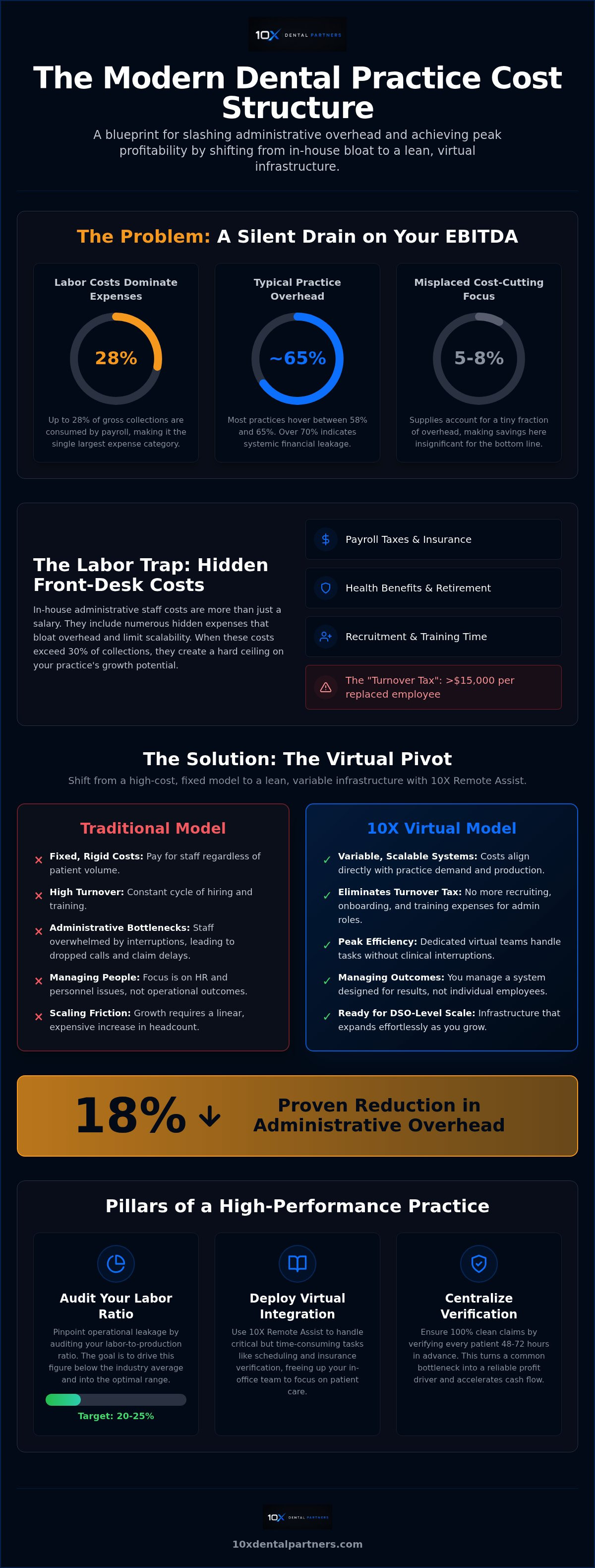
The 2026 dental landscape is defined by a brutal margin compression. While clinical supply costs have stabilized at a higher baseline, PPO reimbursement rates remain largely stagnant, creating a "squeeze" that traditional management methods can't solve. Most operators look at their P&L and see a total overhead hovering between 58% and 65% of gross collections. If your ratio crosses the 70% threshold, you aren't just facing a bad month; you're dealing with systemic financial leakage. Achieving meaningful dental practice overhead reduction isn't about finding a cheaper distributor for composite or gloves. Supplies typically account for only 5% to 8% of overhead, meaning even a 10% savings there barely impacts your bottom line.
Instead, dental practice overhead reduction is the strategic re-alignment of fixed, rigid costs toward variable, scalable systems that grow alongside your production.
The Labor Trap: Why Your Front Desk is Your Biggest Expense
Personnel costs represent the single largest expense category for any practice, typically consuming 25% to 28% of gross collections. Top-performing practices often generate $200,000 or more in production per full-time employee, yet many offices struggle to hit this benchmark due to administrative bloat. In-house administrative staff costs go far beyond a base hourly wage. You must account for:
- Payroll taxes and mandatory insurance.
- Health benefits and retirement contributions.
- Recruitment fees and training time for new hires.
- The cost of "missed opportunities" from unreturned calls.
Administrative bloat occurs when clinical teams are forced to pick up the slack for front-desk bottlenecks, such as insurance verification delays or scheduling gaps. This friction kills your EBITDA. When your front-office labor exceeds 30% of collections, it acts as a ceiling on your ability to scale, trapping you in a model where every new patient requires a linear increase in expensive headcount.
Fixed vs. Variable Costs in the Modern Practice
To build a leaner model, you must distinguish between rigid fixed costs and those that can be optimized through vertical integration. Traditionally, the front desk was a fixed cost; you paid for that seat regardless of call volume or claim volume. Modern operators are shifting this paradigm by "managing" integrated systems rather than "owning" every internal process. This transition is a core component of Dental Service Organizations, which consolidate non-clinical functions to gain massive operational leverage. By adopting this mindset, you prepare your practice for DSO infrastructure development. Moving from a fixed payroll model to variable, service-based administrative support allows your infrastructure to expand or contract based on actual demand, protecting your margins during seasonal fluctuations.
The Virtual Pivot: Deploying 10X Remote Assist to Lower Fixed Costs
Transitioning from a traditional staffing model to a virtual infrastructure is the most effective method for dental practice overhead reduction. By deploying 10X Remote Assist, you replace rigid payroll obligations with an agile, managed solution. This shift eliminates the "turnover tax," which is the recurring expense of recruiting, onboarding, and training in-house staff who often leave within 12 to 18 months. In 2026, the cost of replacing a single front-desk team member can exceed $15,000 when accounting for lost productivity and training cycles. Instead of managing people, you manage outcomes through a system designed for high-level operational efficiency.
Many operators fail to realize that their front-desk team is often overwhelmed by clinical interruptions, leading to dropped calls and unverified insurance. Virtual integration ensures that these critical business functions happen in the background, allowing your in-office team to focus exclusively on the patient in the chair. Implementing strategies for reducing overhead requires looking at where your team's time is actually spent. If your clinical leads are spending hours on the phone with payers, your production capacity is suffering.
Insurance Verification as a Profit Center
Insurance verification shouldn't be a bottleneck; it should be a profit driver. 10X Remote Assist centralizes this process to ensure 100% clean claim submissions. By verifying every patient 48 to 72 hours before their appointment, you eliminate the "write-off" culture that stems from unexpected denials. Proactive insurance management is a cornerstone of dental practice overhead reduction, as it prevents the revenue leakage associated with uncollected fees. Proactive communication regarding co-pays and coverage limits accelerates the revenue cycle and improves practice cash flow immediately.
Optimizing the Schedule Without Increasing Payroll
A full schedule is the result of relentless patient recall and reactivation. Utilizing virtual professionals for remote patient communication for dentists ensures your chairs stay filled without adding local headcount. When calls come in, they are handled by "The Closing Experts," a team trained specifically to maximize lead conversion and patient commitment. This creates a 24/7 communication loop that captures every opportunity, even after hours. By centralizing these touchpoints, you ensure a consistent brand voice and a higher standard of service that in-house teams, often distracted by the physical office environment, simply cannot maintain. To see how this infrastructure can be deployed in your office, consider a consultation with 10X Dental Partners.
Case Study: Achieving an 18% Reduction in Administrative Overhead
To understand the practical application of a lean operational model, we analyzed a three-location dental group struggling with a 65% overhead ratio. Despite strong production, the practice owner faced stagnant EBITDA and chronic staff burnout. The primary culprit was an over-reliance on local front-desk personnel to manage complex insurance verifications and high-volume scheduling. By re-architecting their infrastructure, the group achieved a measurable 18% drop in administrative overhead and a 12% increase in case acceptance within twelve months.
Phase 1: Operational Audit and Leakage Identification
The first step involved a deep dive into baseline KPIs to identify where revenue was stalling. We discovered that the labor-to-production ratio was trending at 32%, well above the healthy 20% to 25% target. Bottlenecks were everywhere. In-office teams were so buried in insurance verification and phone triage that patient follow-ups were neglected. We set a clear 12-month objective: reduce the fixed labor burden and stabilize the revenue cycle to drive EBITDA growth. Identifying these specific points of leakage allowed us to move from reactive management to a proactive, data-driven strategy for dental practice overhead reduction.
Phase 2: Deployment of 10X Remote Assist
The execution phase focused on shifting non-clinical patient touchpoints to a centralized virtual hub. We integrated 10X Remote Assist directly into the practice management software, allowing virtual professionals to handle scheduling, insurance verification, and patient reactivation in real time. Standardizing these communication protocols ensured brand consistency across all three locations. This transition freed the in-house team to focus exclusively on high-value clinical support and the "in-chair" patient experience. It wasn't just about cutting costs; it was about deploying a specialized workforce that could perform administrative tasks with higher precision than a distracted front-desk generalist.
Phase 3: The Financial Impact and Scaling
The final data review confirmed the success of the transition. The practice didn't just lower its costs; it increased its production through better schedule density and a 12% boost in case acceptance. With the administrative burden removed, the clinical team could focus on treatment presentation and patient education. The capital saved through this dental practice overhead reduction was strategically reinvested into dental practice growth consulting to refine their long-term scaling strategy. This lean model is now the blueprint for the group's expansion, providing a roadmap for adding new locations without the linear increase in overhead that typically cripples growing practices.
A Strategic Framework for Identifying Operational Leakage
To achieve sustainable dental practice overhead reduction, you must move beyond surface-level observations and conduct a rigorous audit of your operational infrastructure. Identifying leakage is not a one-time event; it's a discipline that separates high-performing operators from those struggling with stagnant margins. Use this five-step framework to pinpoint exactly where your EBITDA is eroding:
- Step 1: Calculate your true labor-to-production ratio. Your total personnel costs, including benefits and taxes, should ideally sit between 20% and 25% of net production. If you're trending above 30%, your administrative headcount is likely misaligned with your output.
- Step 2: Audit your phone conversion rates. Track every new patient inquiry against scheduled appointments. Every "missed opportunity" on the phone represents a direct loss of marketing capital.
- Step 3: Analyze your insurance aging report. Claims older than 30 days indicate administrative friction. This tied-up capital is a hidden cost that prevents reinvestment and growth.
- Step 4: Evaluate the ROI of every in-office administrative seat. Determine if the tasks performed in that physical seat require a local presence or if they could be handled more efficiently by a managed virtual professional.
- Step 5: Benchmark your supply costs against GPO standards. While supplies are a smaller portion of overhead, top-performing practices keep clinical supplies between 4% and 5%. Conduct a Synergy-style audit to ensure you aren't overpaying for consumables.
If you're ready to identify your specific points of leakage and re-architect your infrastructure, connect with the specialists at 10X Dental Partners for a comprehensive operational review.
The "Missed Call" Cost Analysis
Unanswered calls are the most expensive form of overhead in a modern practice. When your marketing generates a lead for a high-value service like Fast Arches or HelpMeSleep, and that call goes to voicemail, your cost-per-acquisition effectively doubles. Utilizing professional call center services ensures you capture 100% of these leads, even during lunch hours or after-office sessions. Improving your phone skills and response times has a compounding effect on your ROI, turning your front office from a cost center into a high-performance conversion engine.
Auditing Your Case Acceptance Rates
Low case acceptance is a silent overhead driver that many operators overlook. Every hour spent on a consultation that doesn't result in treatment is clinical time wasted, yet the fixed costs of your facility and staff remain. Implementing "The Closing Experts" framework allows your team to address patient objections and financial barriers with precision. Every treatment plan that fails to close represents a direct waste of the marketing dollars spent to bring that patient through the door. By increasing your acceptance rates, you maximize the production value of every hour your office is open, effectively lowering your overhead-to-production ratio without cutting a single expense.
Future-Proofing Profitability: The 10X Growth Platform
Sustainable dental practice overhead reduction is not a defensive maneuver; it's an offensive strategy for vertical scaling. Many operators view cost-cutting as a series of disconnected sacrifices, but true profitability comes from building a unified, high-performance infrastructure. The 10X Growth Platform moves you beyond the anxiety of fragmented management toward the calm of structured, predictable growth. By integrating elite marketing, revenue optimization, and virtual staffing into a single ecosystem, you create a model that doesn't just survive economic shifts but thrives because of its inherent efficiency.
This "Virtual-First" administrative mindset is what separates modern practices from those stuck in the high-overhead patterns of the past. When your business is built on a lean, scalable foundation, your EBITDA growth becomes predictable. This operational discipline is exactly what prepares independent practices for DSO-level valuation. Investors look for systems that can be replicated without a corresponding spike in fixed labor costs. By deploying these systems now, you're building an asset that's ready for the next level of expansion or a high-multiple exit.
Infrastructure as a Competitive Advantage
In 2026, the "lean operator" will be the one who wins the war for dental talent. By removing the administrative burden of insurance verification and scheduling from your in-office team, you create a work environment that prioritizes clinical excellence and patient relationships. This reduces staff turnover and effectively eliminates owner burnout. You stop being a firefighter and start being the architect of your own success. The transition begins with a comprehensive strategic audit that identifies exactly where your current infrastructure is failing to support your production goals.
Your Next Steps Toward a High-Margin Practice
The roadmap to a high-margin practice isn't a mystery; it's a blueprint that's been refined through years of operational experience. Consulting with 10X Dental Partners allows you to build a custom growth blueprint that addresses your specific bottlenecks and scaling objectives. Whether you need immediate relief through 10X Remote Assist or a long-term strategy for revenue optimization, our platform provides the tools to achieve significant dental practice overhead reduction while accelerating production. Your first step is to stop accepting high overhead as a cost of doing business and start treating your infrastructure as your most valuable asset.
Schedule your strategic growth audit with 10X Dental Partners today.
Re-Architecting for Sustainable EBITDA Growth
Achieving sustainable dental practice overhead reduction is no longer about finding minor savings in clinical supplies; it’s about a total re-architecture of your administrative infrastructure. We’ve explored how shifting from fixed in-house labor to scalable systems like 10X Remote Assist can reclaim your EBITDA and eliminate the friction that causes staff burnout. By deploying a DSO-level operational infrastructure and leveraging expert recruiting and talent acquisition, you position your practice as a high-performance asset ready for vertical growth. The modern operator understands that efficiency is the ultimate competitive advantage in a compressed market.
The transition from a fragmented, reactive model to a unified growth platform provides the clarity and stability required to scale beyond the solo practitioner level. You don’t have to navigate these operational complexities alone. It’s time to move from surviving margin compression to mastering the art of the lean operator. We're here to help you build a more resilient, profitable business that rewards your clinical expertise.
Partner with 10X Dental Partners to Slash Overhead and Scale Your Practice. Your blueprint for a more profitable, scalable future starts with a single strategic decision.
Frequently Asked Questions
What is the average overhead for a profitable dental practice in 2026?
The average overhead for a profitable dental practice in 2026 typically ranges between 58% and 65% of gross collections. Top-performing practices aim for a leaner 50% to 55% ratio to maximize EBITDA. If your overhead exceeds 70%, your practice is likely suffering from systemic operational leakage. Monitoring these benchmarks allows you to identify if your labor, supply, and facility costs are aligned with industry standards for high-performance practices.
How much can virtual staffing actually reduce my dental office overhead?
Virtual staffing can significantly lower your fixed labor costs by replacing expensive in-house administrative seats with a managed service model. Personnel costs typically consume 25% to 28% of gross collections in traditional models. By utilizing virtual professionals, you eliminate expenses related to physical office space, benefits, and payroll taxes. This strategic shift is a primary driver of dental practice overhead reduction, allowing you to reallocate capital toward clinical expansion.
Will using a virtual assistant for insurance verification slow down my workflow?
Using a virtual assistant for insurance verification actually accelerates your workflow by removing administrative bottlenecks from the clinical environment. 10X Remote Assist professionals handle verifications 48 to 72 hours before the appointment, ensuring your team has clean claim data before the patient arrives. This proactive approach prevents same-day scheduling delays and reduces the time your in-office staff spends on the phone with payers, allowing them to focus on patient care.
Is it better to cut supply costs or labor costs first to improve EBITDA?
You should prioritize labor costs because they represent a much larger portion of your P&L than clinical supplies. While supplies typically account for only 5% to 8% of overhead, personnel costs often exceed 25%. Reducing labor through virtual integration provides a more substantial impact on your EBITDA. Focus on optimizing your administrative headcount first to achieve meaningful dental practice overhead reduction before negotiating smaller savings on consumables or lab fees.
How does DSO infrastructure development differ from traditional practice management?
DSO infrastructure development focuses on building scalable, centralized systems that function independently of any single individual. Traditional practice management often relies on the specific skills of a few key employees, creating a "key person" risk. A DSO-level model utilizes standardized protocols, virtual integration, and centralized call centers to ensure consistent performance across multiple locations. This systemic approach allows for predictable scaling and higher practice valuations compared to fragmented, solo-operator models.
Can 10X Remote Assist work with my existing practice management software?
10X Remote Assist is designed to integrate seamlessly with your existing practice management software through secure, remote access. Our virtual professionals work directly within your system to manage scheduling, patient communication, and insurance verification in real time. This ensures that all data remains centralized and accessible to your in-office team. There is no need to switch platforms or overhaul your current digital workflow to deploy our virtual staffing solutions.
What is the "turnover tax" and how does it affect dental practice profitability?
The "turnover tax" refers to the recurring financial burden of recruiting, onboarding, and training new staff members every time an employee leaves. In the dental industry, replacing a single front-desk team member can cost upwards of $15,000 in lost production and recruitment fees. Leveraging a managed virtual staffing platform eliminates this tax by providing a stable, pre-trained workforce. This protects your profitability from the disruptions and expenses associated with high local staff turnover.
How do I know if my practice is ready to transition to a virtual front-office model?
Your practice is ready for a virtual front-office model if your labor-to-production ratio exceeds 30% or if your in-office team is consistently overwhelmed by administrative tasks. Signs of readiness include frequent missed calls, insurance verification delays, and high staff burnout. If you're looking to scale to multiple locations or improve your EBITDA without adding physical office space, transitioning to a virtual-first infrastructure is the logical next step for your operational evolution.


