Remote Patient Communication: 2026 Strategic Blueprint

Your physical front desk is no longer the command center of your practice; it's a potential bottleneck. As we move through 2026, the traditional model of tethering remote patient communication for dentists to a physical desk is failing under the weight of high turnover and escalating administrative salaries. You've likely felt the frustration of watching potential revenue slip away simply because an inquiry went unreturned or a skilled coordinator walked out the door. It's a cycle that limits your ability to scale and forces your overhead ratio into territory that stunts your growth.
This 2026 strategic blueprint provides the roadmap to decouple your growth from local labor constraints while simultaneously increasing case acceptance. We'll detail how to deploy 10X Remote Assist and other virtual systems to lower your overhead, ensure standard of care equivalence in every digital interaction, and create a scalable communication engine that operates with surgical precision. Discover how to build a high-performance infrastructure that exists outside your office walls and transforms your front desk from a cost center into a high-yield growth engine.
Key Takeaways
- Shift your operational mindset from reactive phone answering to proactive patient journey management.
- Learn how to build a centralized hub that separates administrative clutter from your clinical operations.
- Discover how remote patient communication for dentists reduces overhead by decoupling your growth from physical office space requirements.
- Implement a phased transition strategy to move insurance verification and scheduling to high-performance virtual teams.
- Scale your practice with 10X Remote Assist to ensure every patient inquiry is converted into a scheduled appointment.
Defining Remote Patient Communication in the 2026 Dental Landscape
In the current 2026 market, the concept of the "front desk" has undergone a radical transformation. Remote patient communication for dentists is no longer an optional convenience or a secondary software feature; it's the systematic centralization of every patient touchpoint occurring outside the clinical operatory. This shift represents a move from reactive phone answering to proactive patient journey management. The physical office is for clinical delivery, while the communication infrastructure exists as a separate, high-performance engine that drives practice growth without being limited by your local labor pool or office square footage.
The traditional front-desk model is failing high-production practices because it creates a single point of failure. When your only coordinator is on the phone, the patient in front of them is ignored. When they're checking out a patient, the phone goes to voicemail. This fragmentation leads to missed revenue and staff burnout. In 2026, the standard is a hybrid model. AI handles the initial routing and basic data collection, while expert remote staff manage the nuanced conversations that drive case acceptance. This vertical integration ensures that your clinical team stays focused on dentistry while your remote infrastructure handles the growth.
Synchronous vs. Asynchronous Remote Channels
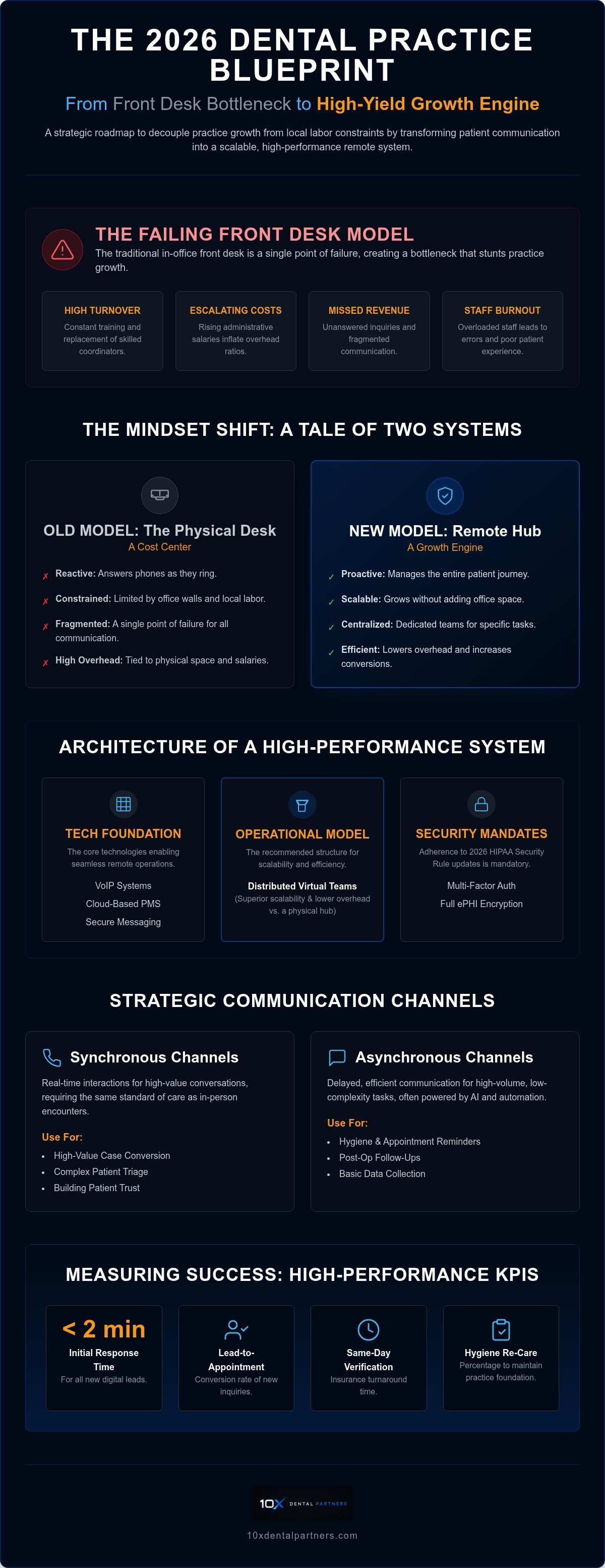
Effective remote patient communication for dentists requires a strategic blend of real-time and delayed channels. Synchronous channels, such as real-time voice calls, remain the gold standard for high-value case conversion and complex triage. As of 2026, teledentistry laws mandate that the standard of care for virtual interactions must be identical to in-person encounters. This requires remote operators to be as skilled and informed as your lead coordinator. Asynchronous channels like secure texting and email handle the high-volume, low-complexity tasks such as hygiene reminders and post-op follow-ups. This is a subset of the broader Telehealth ecosystem, where the goal is to balance AI-driven efficiency with the human touch necessary to build patient trust.
The Role of Virtual Staffing in Communication
Virtual staffing is the engine behind this architecture. Unlike legacy call centers, modern virtual assistants integrate directly into your Practice Management Software (PMS) to provide real-time insurance verification and schedule optimization. Solutions like 10X Remote Assist provide dedicated professionals who function as an extension of your team, not an outside service. They operate within a distributed model that prioritizes security and HIPAA compliance, specifically adhering to the mandatory February 16, 2026, NPP updates. This level of integration allows you to scale your practice without adding a single square foot of administrative office space. By moving these tasks to a dedicated remote team, you eliminate the noise of the front desk and create a calm, focused environment for both your staff and your patients.
The Architecture of a High-Performance Remote System
Building a high-performance architecture for remote patient communication for dentists requires more than a simple software subscription. It demands a strategic shift toward administrative centralization. By moving non-clinical tasks away from the operatory, you eliminate the friction that typically slows down high-production practices. This structural decoupling allows your clinical team to focus on delivery while your remote infrastructure drives the schedule. It is about creating a system where growth is not limited by the four walls of your office.
For DSOs and multi-location groups, the choice typically falls between a Centralized Hub or a Distributed Team model. While a hub offers physical oversight in a single secondary location, the distributed model utilizing virtual professionals provides superior scalability and lower overhead. This architecture relies on a robust technological foundation: VoIP systems, cloud-based PMS, and secure messaging. In 2026, this also means adhering to mandatory HIPAA Security Rule updates, including multi-factor authentication and full encryption for all ePHI transmissions. You aren't just answering phones; you're managing a secure data ecosystem.
Performance must be measured through aggressive KPIs rather than just attendance. A master operator tracks specific metrics to ensure the system is yielding a return. These include:
- Lead-to-appointment conversion rates for new inquiries.
- Initial response times for digital leads, with a target of under two minutes.
- Insurance verification turnaround time to ensure same-day treatment presentation.
- Hygiene re-care percentages to maintain the practice's foundation.
Integrating Technology and Human Expertise
Technology is a tool, not a replacement for high-level strategy. While AI handles basic data intake, it lacks the empathy required for high-value case conversion. We deploy 10X Remote Assist to bridge this gap. Our virtual professionals act as the "Master Operators" of your practice, using automated workflows for hygiene reminders while stepping in personally to manage complex financial conversations. This balance ensures efficiency without sacrificing the patient relationship.
Maintaining Clinical-Business Alignment
A remote team cannot operate in a vacuum. They must be deeply aligned with your specific clinical philosophy. This alignment is maintained through detailed Standard Operating Procedures (SOPs) and rigorous feedback loops between your in-office clinical staff and remote administrative teams. When everyone follows the same blueprint, the patient experience remains seamless, whether they're speaking to someone in the office or a remote coordinator. If you want to see how these systems integrate into a larger scaling strategy, our guide on dental practice growth consulting provides the necessary framework.
Overcoming the 'Front Desk Bottleneck': Strategic Benefits
The traditional dental front desk is often the most expensive square footage in the building, yet it frequently serves as the primary bottleneck for practice growth. When your administrative team is overwhelmed by the friction of dual-tasking clinical check-outs and high-volume phone inquiries, revenue leakage is inevitable. Shifting to a model of remote patient communication for dentists solves this by decoupling your revenue-generating activities from the physical limitations of your office. You aren't just moving tasks; you're optimizing the entire administrative ecosystem for maximum throughput.
Eliminating this bottleneck provides immediate relief to your in-office clinical team. By removing administrative clutter from the clinical area, you reduce staff burnout and allow your assistants and hygienists to focus exclusively on patient care. This systematic separation ensures that 100% of lead volume is captured. There are no missed calls during peak morning rushes or lunch breaks. Every inquiry is met with a professional, immediate response, which directly correlates to higher Google Review scores and a superior patient experience. Speed is the new currency of trust in 2026.
The ROI of Remote Administrative Infrastructure
The financial argument for virtual staffing is rooted in overhead optimization. In-office administrative salaries carry high burdens, including physical space costs, local payroll taxes, and benefit packages that scale with headcount. Remote professionals operate with a lower overhead ratio while providing specialized expertise. This shift also recovers significant clinical time for associates who no longer need to wait on administrative delays to present treatment plans. For a practice producing $2M or more annually, communication ROI is measured by the total recovery of unbilled clinical hours and the elimination of the revenue leakage typically caused by unreturned patient inquiries.
Scalability and DSO Growth
Scaling a dental group requires a repeatable, predictable patient experience that doesn't depend on the individual hiring luck of a single location. Centralized remote patient communication for dentists allows you to standardize intake protocols across 5, 10, or 50 locations simultaneously. This centralization is a cornerstone of high-level DSO infrastructure development. When scheduling and insurance verification are handled by a dedicated remote hub, you can acquire and integrate new locations with minimal operational disruption. You're building a plug-and-play growth engine that ensures every patient receives the same elite level of service, regardless of which facility they visit.
Best Practices for Implementing Remote Patient Workflows
Deploying a remote infrastructure requires a methodical, four-phase execution strategy to ensure operational stability. You cannot simply "switch on" a virtual team and expect immediate results without a blueprint. Successful implementation of remote patient communication for dentists depends on a structured transition that protects your current revenue while building the foundation for future scale. We treat this as a vertical integration process, moving from basic data management to high-level case conversion.
- Phase 1: Communication Audit. Identify your current failure points by analyzing missed call rates during peak hours and tracking the lag time between a digital inquiry and the first human response.
- Phase 2: Low-Complexity Transition. Move high-volume, low-friction tasks such as hygiene reminders and insurance verification to your remote team to provide immediate relief to the in-office staff.
- Phase 3: Expert Closing Deployment. Introduce specialized remote professionals to handle high-value treatment plan follow-ups and financial coordination, ensuring no large case falls through the cracks.
- Phase 4: Continuous Optimization. Use call recording and sentiment analysis to monitor performance, refining scripts based on real-world patient objections and conversion data.
If you're ready to stop losing revenue to administrative bottlenecks, partner with 10X Dental Partners to deploy a high-performance remote communication system tailored to your practice's specific clinical philosophy.
Training and Quality Control
Your remote team must project the same professional authority and warmth as your best in-office coordinator. This is achieved through rigorous scripting that focuses on outcome-oriented conversations rather than just data collection. We hold regular calibration meetings between practice owners and remote staff to ensure clinical alignment. By using call intelligence software, we can identify exactly where a conversation succeeds or fails, allowing for rapid refinement of your patient conversion strategies. It's about maintaining a standard of excellence that is independent of any single employee's presence.
Ensuring a Seamless Patient Journey
The transition between your remote team and your physical office should be invisible to the patient. We achieve this by integrating remote patient communication for dentists directly into your Practice Management Software, allowing virtual staff to access real-time data and make every interaction feel local and personal. Patients should feel they are speaking with a dedicated member of your practice, not a detached service. We implement tiered protocols for emergency inquiries, ensuring that urgent clinical needs are immediately escalated to the in-office team while administrative hurdles are handled externally. This creates a unified front that builds trust and long-term patient loyalty.
Scaling with 10X Remote Assist: The Future of Operations
Strategic growth is impossible when you're trapped in the day-to-day management of administrative turnover. 10X Remote Assist serves as the premier execution engine for dental practice growth consulting, providing the infrastructure necessary to scale beyond the limitations of a solo practitioner. We don't just provide remote patient communication for dentists; we deploy a comprehensive revenue optimization system. This system moves beyond simple phone answering to encompass expert insurance verification and precision schedule optimization that ensures your clinical hours are always filled with high-value procedures.
Our infrastructure is designed to integrate seamlessly with other high-performance pillars of your practice. When 10X Remote Assist works in tandem with 'The Closing Experts', your ability to maximize full-arch and sleep apnea cases increases exponentially. This is the 10X promise: a unified ecosystem where elite people, advanced technology, and targeted marketing are integrated into a single, unstoppable growth engine. You're no longer buying a service; you're installing a proven operational blueprint that's been refined through national DSO infrastructure expertise.
The 10X Remote Assist Advantage
We provide professionally trained dental operators who understand the specific nuances of clinical workflows and patient psychology. These aren't generalists; they're specialists who integrate directly into your existing DSO or independent practice infrastructure. Our focus remains exclusively on revenue optimization. By refining every touchpoint in the remote patient communication for dentists, we ensure that your administrative support acts as a catalyst for case acceptance rather than a hurdle for your patients to overcome.
Next Steps for the Strategic Dentist
The move from 'Managing' your practice to 'Leading' it requires a fundamental shift in how you view your administrative operations. Transitioning to a remote-first model allows you to reclaim your time and focus on high-level clinical and strategic decisions. This isn't an experimental theory; it's the standard for high-production practices in 2026. If you're ready to decouple your growth from office square footage and local labor shortages, it's time to build your centralized hub. Scale your practice with 10X Remote Assist today.
Architecting a Practice Without Boundaries
The transition to a remote-first administrative model is no longer a futuristic concept; it is the current standard for high-production dental groups. By centralizing your operations, you move from the chaos of a reactive front desk to the stability of a high-performance growth engine. We've established how remote patient communication for dentists allows you to decouple your revenue potential from the physical constraints of your office while simultaneously lowering your overhead ratio. This structural shift ensures that every patient inquiry is captured and every high-value treatment plan is followed up with professional precision.
Building this infrastructure requires a partner who understands the nuances of proven DSO scaling infrastructure and high-value case conversion. 10X Dental Partners provides the 10X Remote Assist virtual staffing and The Closing Experts methodology needed to execute this blueprint effectively. It is time to stop managing bottlenecks and start leading a scalable organization. Schedule your operational audit with 10X Dental Partners to begin refining your practice infrastructure. Your path to predictable, unstoppable growth starts with a single strategic decision.
Frequently Asked Questions
Is remote patient communication HIPAA compliant?
Remote patient communication for dentists is fully HIPAA compliant when managed through secure, encrypted platforms. All 10X Dental Partners systems adhere to the mandatory February 16, 2026, Notice of Privacy Practices updates. This includes end-to-end encryption for electronic Protected Health Information, multi-factor authentication, and strict access controls. Our virtual professionals are trained specifically in healthcare data security to ensure your practice remains protected while operating in a distributed environment.
Will patients be able to tell that the person they are talking to isn't in the office?
Patients typically cannot distinguish between a remote coordinator and an in-office staff member. We utilize local area code VoIP technology and provide our virtual assistants with direct access to your Practice Management Software. This allows them to reference specific patient history and local office details in real time. The focus is on maintaining a seamless "invisible transition" where the patient feels they're receiving dedicated, personal attention from a member of your internal team.
What tasks can a remote dental assistant handle?
A remote professional handles a wide range of administrative and revenue-generating tasks. This includes managing incoming patient inquiries, hygiene re-care scheduling, and complex insurance verification. They also execute treatment plan follow-ups and coordinate specialist referrals. By offloading these high-volume activities to 10X Remote Assist, you allow your in-office clinical team to focus exclusively on patient care without being interrupted by administrative clutter or unreturned phone calls.
How does remote communication improve my case acceptance rates?
Remote communication improves case acceptance by ensuring no treatment plan goes unfollowed. Our specialized virtual assistants, often working with The Closing Experts methodology, engage patients in high-value financial conversations shortly after their clinical visit. This immediate engagement addresses patient objections and financing concerns while the treatment is still top-of-mind. By maintaining a persistent and professional follow-up cadence, your practice can significantly increase the conversion of full-arch and other complex clinical cases.
Do I need to change my dental software to implement remote communication?
You generally don't need to replace your existing dental software to implement a remote communication model. Most modern Practice Management Systems allow for secure, cloud-based access or remote desktop integration. Our team works within your current digital environment to maintain continuity. However, we may recommend specific VoIP or secure messaging tools to optimize the remote patient communication for dentists and ensure your infrastructure is ready for national DSO-level scaling.
Can remote staff handle insurance verification and billing?
Remote staff are highly proficient in handling insurance verification and administrative billing support. This is a core function of 10X Remote Assist, where virtual professionals verify coverage before the patient arrives to ensure a smooth treatment presentation. They can also manage claims submission and follow up on outstanding accounts receivable. Centralizing these tasks reduces the error rate and ensures that your practice's cash flow remains steady and predictable.
How much can a dental practice save by moving to virtual staffing?
Moving to virtual staffing typically results in a significant reduction in administrative overhead. You eliminate the costs associated with physical office space, local payroll taxes, and the extensive benefit packages required for in-office employees. While exact savings vary by practice size, our partners often report a lower overhead ratio that allows for more aggressive reinvestment into marketing and clinical technology. It's a strategic shift from high fixed costs to a scalable, variable cost model.
What happens if a remote system goes down?
High-performance remote systems are built with multiple layers of redundancy to prevent total outages. We utilize cloud-based infrastructure with secondary failover protocols to ensure your communication lines remain open. If your local office internet goes down, your remote team can continue managing patient inquiries and scheduling from their secure locations. This distributed model provides a level of operational resilience that a single-location front desk simply cannot match, protecting your practice from local service disruptions.


